
Most conversations about AI focus on hallucinations.
But underneath that discussion sits a quieter issue.
When an AI gives an answer, we only see the final output. The reasoning, the pieces that make up the response, and the claims inside it are hidden. There is very little texture to verify what the model actually said.
That is the foundation of what @mira_network is trying to explore.
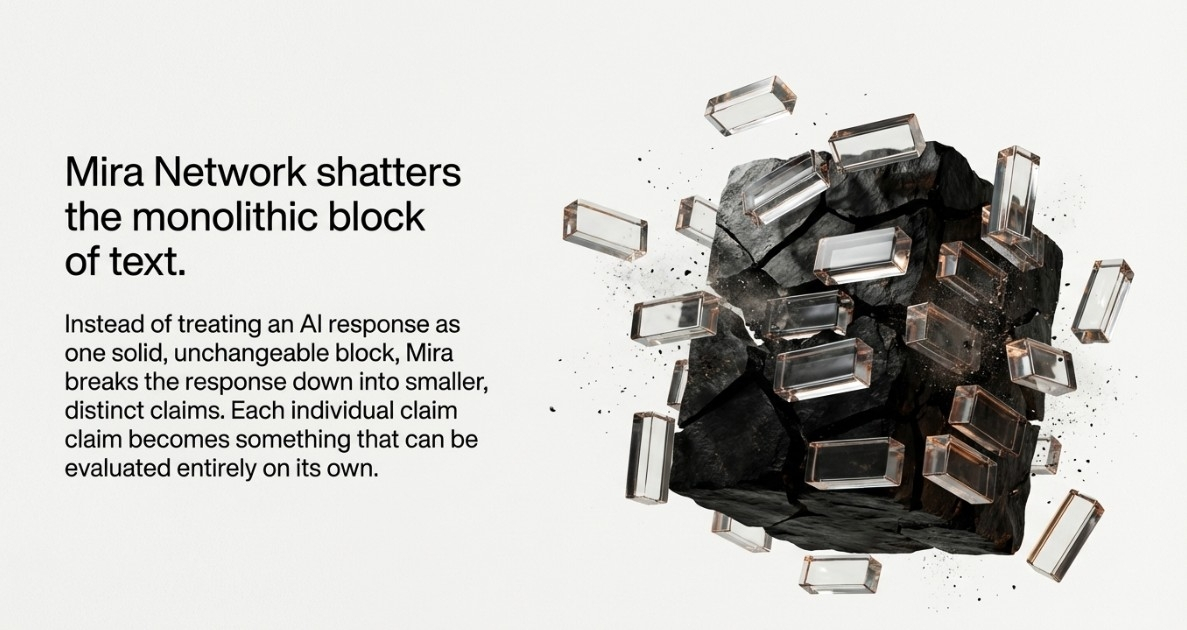
Instead of treating an AI response as one block of text, Mira breaks the response into smaller claims. Each claim becomes something that can be evaluated on its own.
Take a simple example.
If an AI writes that solar energy is the fastest growing energy source globally, that sentence does not stay buried inside a paragraph. It becomes a single claim that can be reviewed.
Those claims are then passed to participants who check whether the statement holds up. Their evaluations get recorded, and the claim receives a credibility signal tied to the network.
Over time, a response is no longer just text.
It becomes a collection of claims with verification history attached. Each piece carries its own context and record.
In theory this changes how trust forms around AI.
Right now we rely on the model provider and the training data underneath it. The user receives the answer and hopes the model got the details right.
Mira shifts part of that responsibility outward.
The network becomes part of the verification process. People review claims, disagreements surface, and the record of those decisions stays on-chain.
But this also raises a quieter tension.
If verification depends on participants, then the system only works when enough reviewers show up. One claim requires at least 1 evaluation before any signal exists, and more reviews increase confidence but also slow the process.
That introduces a tradeoff.
More verification creates a steadier record of truth, but it also adds time and coordination costs. Fast answers and careful answers do not always move at the same pace.
I am not completely sure yet where this balance lands.
Breaking AI responses into claims gives the system structure. It adds a layer where accuracy can be earned rather than assumed.
But the long term question sits in the background.
Will enough people consistently verify information so the network stays steady, or will verification become the bottleneck that slows everything down?
It is still early, but the idea of turning AI answers into verifiable claims adds a different kind of foundation to the conversation about trust.
#AIInfrastructure @Mira - Trust Layer of AI $MIRA #Web3AI #OnChainVerification #MIRA