Lately,I keep coming back to this question:what changes when intelligent machines stop being just software tools and actually start doing work in the real world?At first,it sneaks up on you AI writing text,making images,automating a few decisions.Then suddenly,robots step off the screen and into warehouses,hospitals,city streets.That’s when everything shifts.Coordination,trust,and accountability those stop being just engineering puzzles and turn into real infrastructure problems.
There’s a sticking point here.Machines are learning to reason and act, but the systems we use to manage work and value were never built to handle non human,non organization participants.Imagine autonomous agents running factories,delivering medicine,managing supply chains.Someone needs to check what happened,who gave the green light,and how value gets transferred after the fact.Without shared infrastructure identity,decision verification,coordination these systems get murky fast.Fragile,too.
Letting autonomous robots operate with no verifiable way to coordinate is like letting self driving cars roam a city with no traffic lights.Chaos,sooner or later.
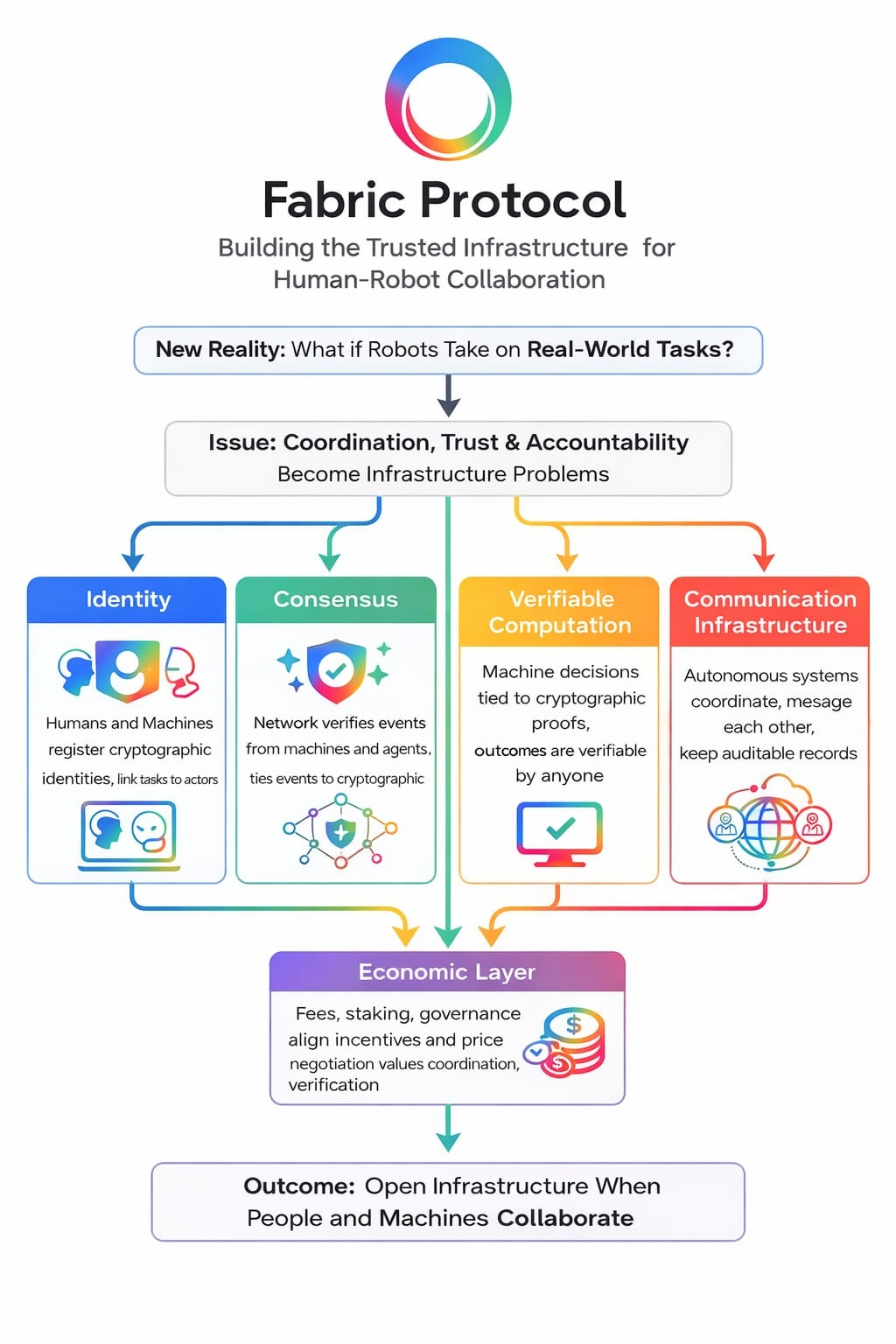
Fabric Protocol takes a run at this problem.The idea is to create an open layer where humans,AI agents,and robots interact through processes that anyone can verify.Forget about a central authority watching every move.Instead,machine actions get recorded,validated,and governed by the network itself.Every action ties back to a cryptographic identity,so both people and machines can join workflows that stay visible and auditable over time.
It all starts with identity.Both humans and machines register cryptographic identities that anchor them in the system.Now,you can link tasks,permissions,and responsibilities to specific actors.You get a persistent record who did what,under what circumstances.This structure enforces accountability,but it doesn’t force machines into the legal framework reserved for people.
Next comes consensus.It’s not just a ledger sitting there.The network verifies events from machines and agents.When an autonomous system finishes a job or makes a transaction,the rest of the network checks and agrees on what happened.No single party gets to write history alone.Trust shifts from individuals to the rules of the process itself.
Verifiable computation and data flow matter,too.Machine decisions get tied to cryptographic proofs.Anyone can check that an agent followed the right rules or models,without digging through all the internals.The point isn’t to publish every detail,but to let outsiders verify outcomes without having to blindly trust the machines.
Communication infrastructure glues all this together.Autonomous systems message each other,coordinate tasks directly,and keep auditable records of their interactions.Decentralized task allocation spreads work across agents and robots no one central scheduler handing out assignments.
Then there’s the economic layer:fees,staking, governance.If you use the network,you pay for computation,coordination,or verification.Validators and coordinators stake value,which keeps incentives aligned they have something to lose if they go rogue.Governance gives stakeholders a way to steer how the protocol evolves,especially as machines move into new industries.
Price discovery changes,too.It’s not just about speculation.The real value comes from negotiating the cost of coordination and verification.If Fabric becomes the go to system for managing machine activity,participation value tracks demand for these services not just how many transactions happen.
Of course,a lot’s still unknown.Building this kind of infrastructure means planning for systems that are just starting to take shape.Adoption depends on how fast robotics rolls out,how regulators respond,and whether developers are willing to weave open coordination into their designs.
And,honestly,no protocol can map out every twist and turn of how autonomous systems will behave in the messiness of real life.Even with cryptographic proofs and network governance,there will be surprises problems nobody predicted as intelligent machines take on bigger roles.That’s just how the future works.