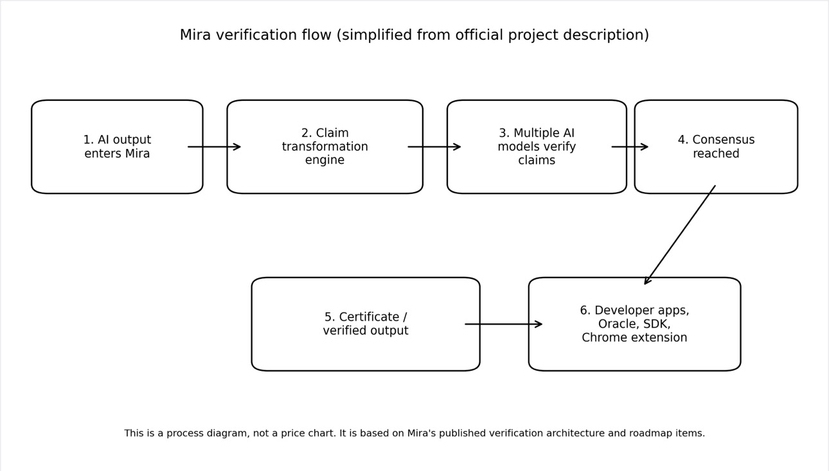
$MIRA #Mira @Mira - Trust Layer of AI

Lately I’ve been paying closer attention to projects trying to connect AI and crypto in a real way, not just through buzzwords. A lot of them talk about agents, automation, smart systems, all that. But when I look a bit deeper, one issue keeps coming back.
AI can give answers fast. But proving those answers are actually reliable is a different story.
That’s the part that made me stop on @Mira - Trust Layer of AI .
What caught my eye wasn’t just the AI angle. It was the fact that MIRA seems to be focused on verification. And honestly, I think that matters more than people realize right now. Everyone likes generation. Very few people spend enough time talking about validation.
That’s why this Klok verification rollout feels important to me.
For me, this is not just another update post or roadmap checkpoint. This feels more like the stage where MIRA starts showing whether its core idea can hold up in public. Not in theory. Not in whitepaper language. In actual use.
And I think that changes the whole conversation.
Because once live verification metrics start showing up, people stop asking, “Does this sound interesting?” and start asking, “Okay, but does it work?”
That’s a much more serious question.
What I keep noticing in AI is that the biggest problem is not output anymore. Models can already produce content, code, summaries, reasoning, almost anything. The real issue is trust. You can get a smooth answer very easily now. Sometimes too easily. And if you’ve used AI tools enough, you already know this feeling — an answer can sound smart and still be wrong.
That gap matters.
If AI is going to be used in bigger systems, especially ones handling value, coordination, automation, or decision-making, then just having output is not enough. There has to be some layer that checks things properly.
That’s where I think MIRA’s direction gets interesting.
From the way I see it, the project is not trying to win attention by saying “look, AI is the future.” We’ve heard that line too many times already. The more interesting part is the attempt to make AI outputs verifiable through a structured system.
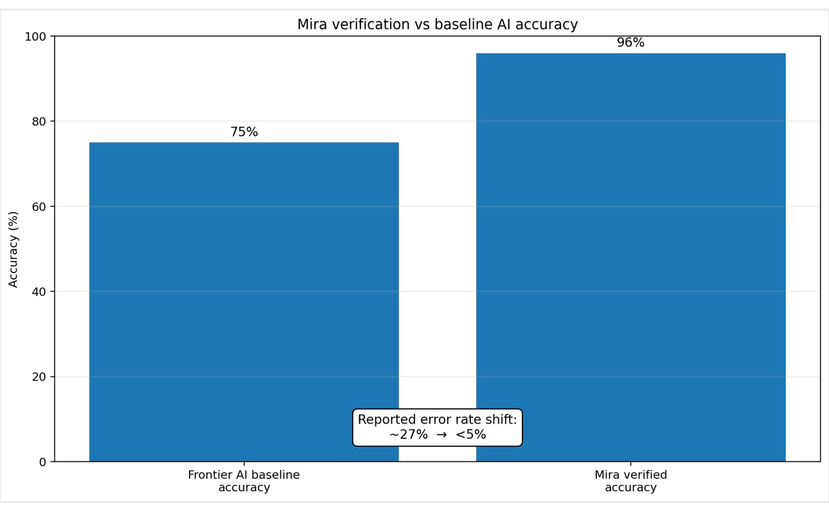
And now with Klok, the project seems to be moving toward visible proof of that idea.
That matters because developers usually don’t care much about promises. They care about signals.
Real builders look for things like:
• does the system actually run
• can I measure performance
• is the infrastructure stable
• is there a reason to build here now
That’s why I think verification metrics could be one of the most important parts of this phase.
If Klok starts showing useful live data like verification speed, proof success rate, throughput, or reliability under usage, then developers have something concrete to look at. That’s when interest becomes more real.
Whitepapers don’t pull builders in for long. Working metrics do.
Personally, I think this is the moment that could decide whether MIRA grows into real infrastructure or stays stuck as an interesting concept.
That may sound a bit blunt, but I think it’s true.
Crypto is full of projects with strong narratives and weak follow-through. So whenever a project reaches the point where it has to expose live performance, I pay more attention. That’s usually where the market starts separating story from substance.
And to me, MIRA is entering that stage now.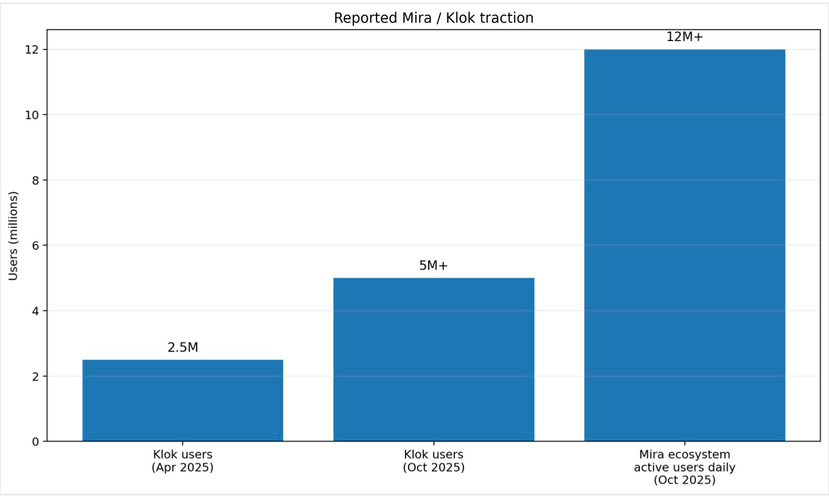
What also makes this update relevant is timing. The broader AI narrative is still strong, but the space is maturing. People are not impressed by surface-level AI mentions the way they were before. The conversation is getting tougher. Builders and users both want more than branding now. They want infrastructure that solves a real problem.
Verification is a real problem.
That’s why I think MIRA may be approaching this from a stronger angle than many people expect. Instead of competing in the crowded “AI does everything” lane, it seems to be focusing on a narrower but more important layer.
I actually think that’s smarter.
If this rollout works well, I can see why it might attract developers over time. Not all at once, of course. Ecosystems rarely grow like that. It usually happens in steps.
First, people notice the update. Then they watch the metrics. Then a few developers test things. Then small experiments start showing up. Then, if the infrastructure keeps holding up, the ecosystem begins to feel real.
That’s the kind of cycle I’d expect here too.
For me, the key question is not whether MIRA sounds ambitious. A lot of projects sound ambitious. The better question is whether the Klok verification rollout can create enough confidence for developers to care.
Because that’s what really matters in the long run.
If the metrics are strong, builders may start thinking, “Maybe I can actually use this layer.” If the metrics are weak or unclear, then adoption probably slows down.
Simple as that.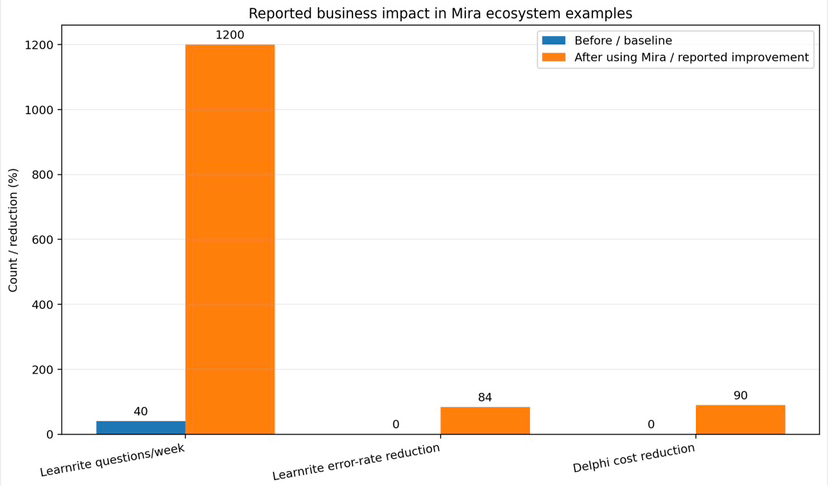
And honestly, I think developers in this area are especially data-driven. If you’re building around AI systems, trust and reliability are not small details. They’re core design issues. So if MIRA can show that verification is not just possible, but practical, that gives the project a much stronger position heading deeper into 2026.
There are still challenges, obviously.
Verification systems are not easy to scale. Speed matters. Cost matters. Reliability matters. And sometimes the technical idea is strong but the developer experience is weak. That happens a lot in crypto too. So I’m not looking at this rollout as “problem solved.” Not at all.
But I do think it’s the first phase where MIRA can start proving whether its core thesis has weight.
That’s why I find this update more interesting than a normal ecosystem announcement.
It’s not just about growth headlines. It’s about whether the base technology earns trust.
And in my view, that trust is exactly what this category needs.
One more thing I’ll say here — I don’t think the project needs everyone to understand the deep technical side immediately. What it really needs is for developers to see enough evidence to start experimenting. Once that starts happening, the story gets stronger on its own.
That’s usually how adoption begins.
So yes, I think live verification metrics really could attract developer activity, but only if those metrics are clear, credible, and consistent. If Klok can provide that kind of transparency, then MIRA’s path into broader ecosystem growth in 2026 starts making a lot more sense.
Right now, that’s the part I’m watching most.
Not the noise. Not the hype. The proof.
Because in AI, getting an answer is easy.
Getting an answer you can actually trust? That’s where the real infrastructure starts.