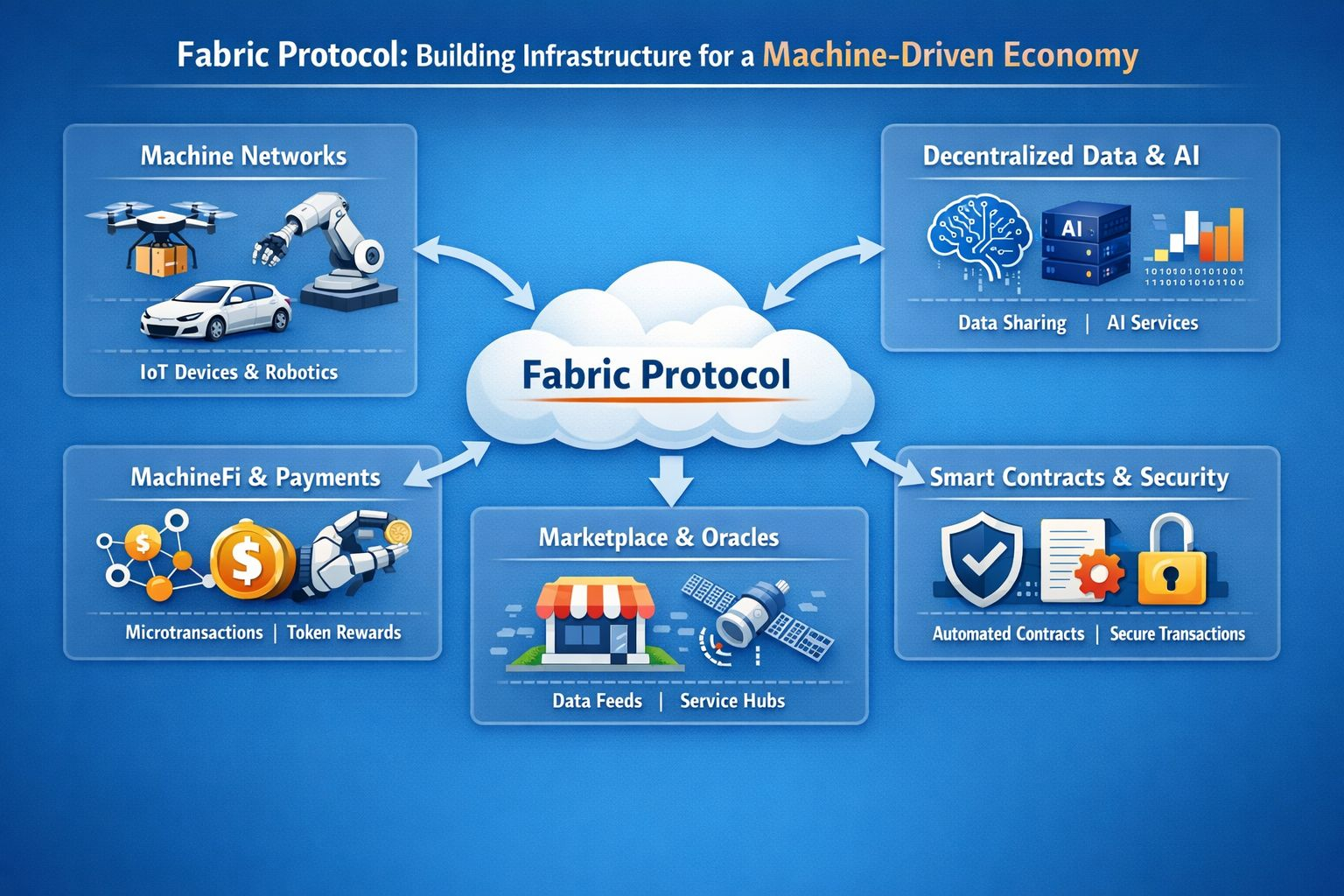
It took me a while to actually get what Fabric Protocol is doing. On paper, it looks like just another project combining artificial intelligence, robotics, and distributed systems. The kind of idea that sounds impressive but feels abstract. But when you sit with it for a while—when you read past the surface explanations—the implications become harder to ignore. The project is quietly asking a question that most technology discussions still avoid: what happens when machines start participating in the economy on their own?
Robots already work alongside humans in warehouses, factories, and research labs. Delivery drones, automated vehicles, and AI-controlled machines are becoming more capable every year. Yet the systems that coordinate these machines remain mostly closed and centralized. A company owns the robots, the software, the data, and the decision-making process. Fabric Protocol approaches the problem differently. Instead of focusing on building better robots, it focuses on the structure that allows machines to cooperate across boundaries—between companies, between systems, and potentially between entire industries.
The problem the protocol tries to solve is surprisingly simple to describe. When autonomous machines interact with each other, trust becomes complicated. If a robot performs a task, how does another system verify that the work actually happened? If two machines exchange services, how is that agreement recorded? And if something goes wrong, where does the record of responsibility live?
Traditional infrastructure solves this with centralized control. A single platform manages the activity and keeps the records. But that approach begins to break down when machines from different owners or organizations need to collaborate. Fabric Protocol proposes a different foundation. Instead of relying on one authority, it records machine activity on a shared ledger where identities, tasks, and outcomes can be verified.
At the center of the system is a digital identity for machines. Each robot or software agent receives a cryptographic identifier that allows it to operate within the network. That identity connects to a record of what the machine has done—tasks accepted, actions performed, and results verified. Over time, the machine builds a transparent history of behavior. In a world where autonomous systems are expected to operate without constant supervision, that kind of traceability becomes important.
But identity alone is not enough. The protocol also tries to address how machines coordinate work. When a task appears in the system—whether it involves moving goods, analyzing data, or interacting with physical infrastructure—the network can assign that task to machines capable of completing it. The process is recorded and verified step by step, creating a reliable trail of activity.
Think of it as a digital handshake between a delivery drone and a smart warehouse—no humans in the loop, just pure, verifiable code handling the trust.
This idea may sound theoretical at first, but it reflects a growing reality. Machines are starting to interact directly with other machines. A drone might communicate with logistics software. A warehouse robot might coordinate with an automated vehicle. As these interactions grow more complex, systems need a neutral way to record what happened and how responsibilities were fulfilled.
Fabric’s architecture is designed with that future in mind. Most digital platforms are built for human users. Interfaces, permissions, and workflows assume that a person is clicking buttons or making decisions. Fabric turns that assumption around. It treats machines and autonomous agents as first-class participants in the system. They can request tasks, accept assignments, and exchange value through automated processes.
Now, you might wonder: do we really need a blockchain for robots? Isn’t this over-engineering? It’s a fair question.
For many use cases, centralized systems already work well enough. But the argument behind Fabric becomes clearer when machines operate across different ownership structures. Imagine a network where autonomous delivery vehicles from several companies share infrastructure in a city. Or a manufacturing chain where robots from multiple suppliers coordinate production steps. In those environments, relying on one company to control the entire system can become difficult—or politically impossible. A neutral record of activity begins to look less like an experiment and more like practical infrastructure.
Behind the protocol is the Fabric Foundation, a non-profit entity responsible for guiding the project’s development and governance structure. Its role appears less about operating the network directly and more about maintaining the standards that allow the ecosystem to function. In other words, it acts more like a steward than a typical technology company.
This distinction matters because robotics raises broader questions than most software systems. Autonomous machines interact with the physical world. They perform actions that can affect safety, logistics, and economic activity. Building infrastructure that coordinates those systems requires attention not only to technology, but also to accountability and oversight.
Recent progress within the project has focused on laying the groundwork rather than rushing toward large-scale deployment. The team has concentrated on defining how machines join the network, how their identities are verified, and how their activity is recorded in a consistent way. These steps may appear modest compared with the long-term vision, but foundational infrastructure rarely appears dramatic in its early stages.
Another important piece of the system is the way machines exchange value when work is completed. If robots are going to perform tasks for different participants in the network, there needs to be a settlement mechanism designed for automated interaction. Fabric integrates a native digital asset to handle these exchanges, allowing machines to receive compensation without requiring constant human oversight.
This concept points toward a broader transformation in how technology systems operate. Artificial intelligence is gradually moving beyond analysis and decision support. It is beginning to act—controlling machines, executing instructions, and interacting with physical environments. When that shift happens, economic systems built entirely for human participants begin to look incomplete.
Fabric Protocol attempts to prepare for that transition. Instead of focusing only on smarter machines, it focuses on how those machines interact with the world around them—how their actions are recorded, how their work is coordinated, and how value moves between them.
None of this guarantees success. Integrating robotics with distributed digital systems remains a complex challenge. Hardware reliability, verification of real-world actions, and regulatory oversight all present significant obstacles. Infrastructure designed for autonomous machines must prove that it can operate safely and reliably in environments where mistakes have real consequences.
Yet the question Fabric raises remains difficult to ignore. If intelligent machines eventually become active participants in global economic activity, what systems will keep track of what they do?
That is the quiet ambition behind the project. Not simply to build another robotics platform, but to design the structural layer that allows machines, software agents, and humans to cooperate in a shared environment.
In my view, Fabric Protocol isn’t just about the technology itself—it’s about preventing a future where our machines are as isolated and fragmented as the organizations that deploy them today. Whether the project ultimately succeeds or not, it raises a deeper question worth considering: what does “labor” really mean when work is no longer performed only by humans, but also by systems made of silicon, sensors, and steel?