The idea of robots participating in the global economy has become one of the most frequently repeated narratives in both the artificial intelligence and blockchain sectors. The concept is simple and attractive: autonomous machines performing work, completing tasks, and earning value through digital payments. In theory, robots could deliver packages, inspect infrastructure, monitor industrial environments, or collect data while receiving automated compensation through decentralized systems.
However, when we move beyond the narrative and examine the mechanics of how such an economy would actually function, a critical gap appears. Most projects focus on the vision of machines doing work, but very few explain how robots would securely interact within an economic framework. For robots to participate in an open economy, several fundamental requirements must exist. Machines need verifiable identity, clear permissions, accountability for their actions, and a reliable method for economic settlement.
This is the problem that Fabric Foundation is attempting to address. Rather than presenting robotics as a distant futuristic concept, the project focuses on building the infrastructure required for machines to operate across organizational boundaries. Its core idea is that if robots are ever going to participate in real economic systems, they will need a shared coordination layer similar to the infrastructure that allows humans and businesses to interact online today.
The Structural Problem in Today’s Robotics Systems
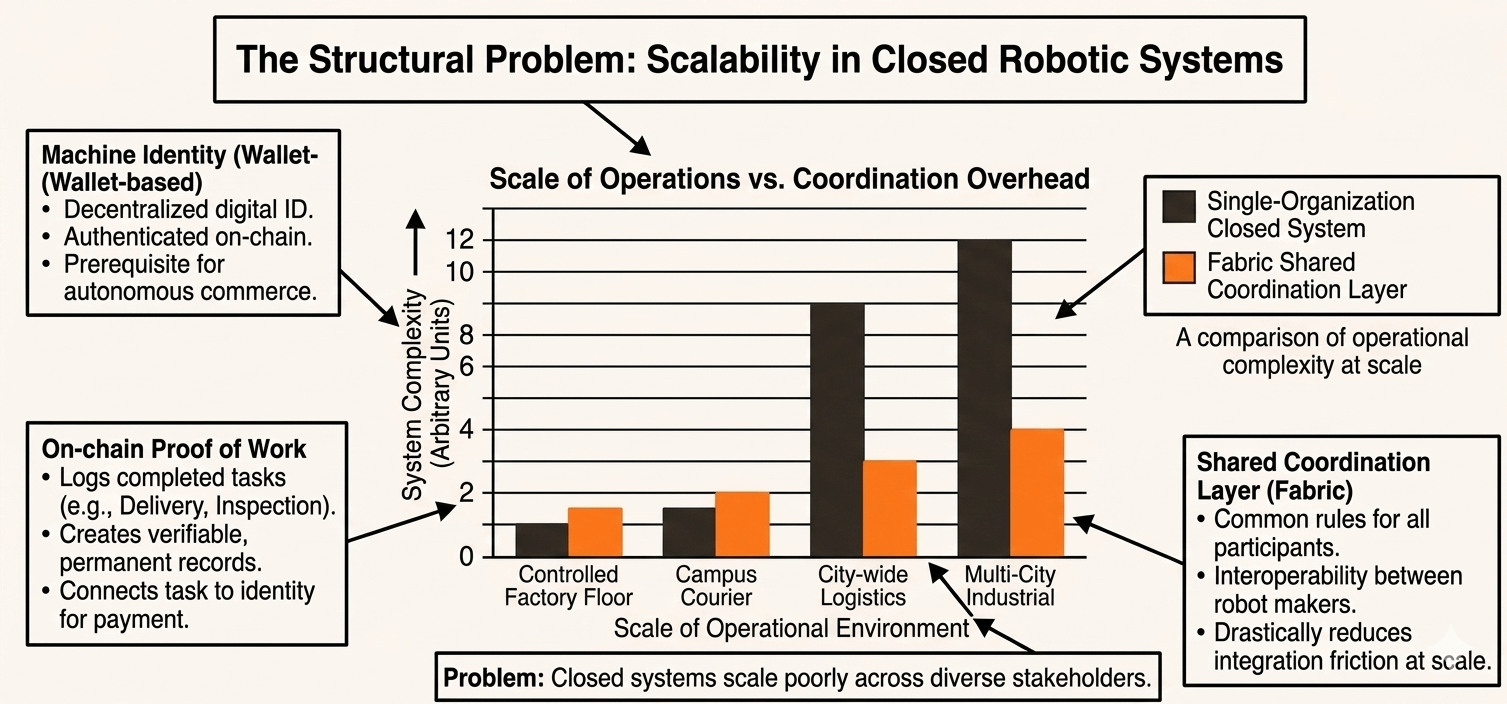
Most robotics systems today operate inside closed environments. A single organization typically builds the robot, runs the software, controls the data, and manages the operational dashboard. Within this closed structure, everything works efficiently. The company controls every variable, from task assignments to system updates.
The problem appears when robotic systems need to operate beyond the boundaries of a single organization. Imagine a delivery robot operating in a city network, or an inspection robot working across multiple industrial sites. Suddenly, multiple stakeholders become involved:
Robot manufacturers
Software developers
Operators and logistics companies
Infrastructure providers
Insurance companies
Regulators and compliance agencies
Each new participant introduces technical and administrative complexity. Systems must be integrated manually, permissions must be negotiated, and data must be shared across platforms that were never designed to communicate with each other.
As a result, scaling robotic services across organizations becomes extremely difficult. The lack of standardized coordination systems creates friction that slows down adoption.
This is where the Fabric approach becomes relevant. Instead of every company building its own isolated infrastructure, Fabric proposes a shared coordination layer where machines can operate under common rules.
Machine Identity as the Foundation of Autonomous Work
One of the most fundamental challenges in a machine economy is identity. Humans and businesses rely on identity systems to prove who they are, establish trust, and interact economically. Machines currently lack a universal mechanism for proving their identity across networks.
Fabric proposes that robots should possess a verifiable digital identity connected to a blockchain-based wallet. This identity would allow a machine to:
Prove its authenticity
Record completed tasks
Interact with decentralized applications
Receive payments for services
Through this system, machines could become participants in digital marketplaces rather than tools controlled exclusively through centralized platforms.
In practice, this means a robot performing a service such as completing a delivery or inspecting equipment could log the action on the network, creating a permanent record of the work performed.
Accountability in Physical Machine Systems
One of the most overlooked issues in robotics is accountability. When machines operate in controlled environments, responsibility is usually clear because a single organization manages the system. However, in distributed environments involving multiple stakeholders, determining responsibility becomes more complicated.
If a robot fails to complete a delivery, performs an incorrect inspection, or damages infrastructure, someone must be accountable. Without a reliable record of machine actions, disputes become difficult to resolve.
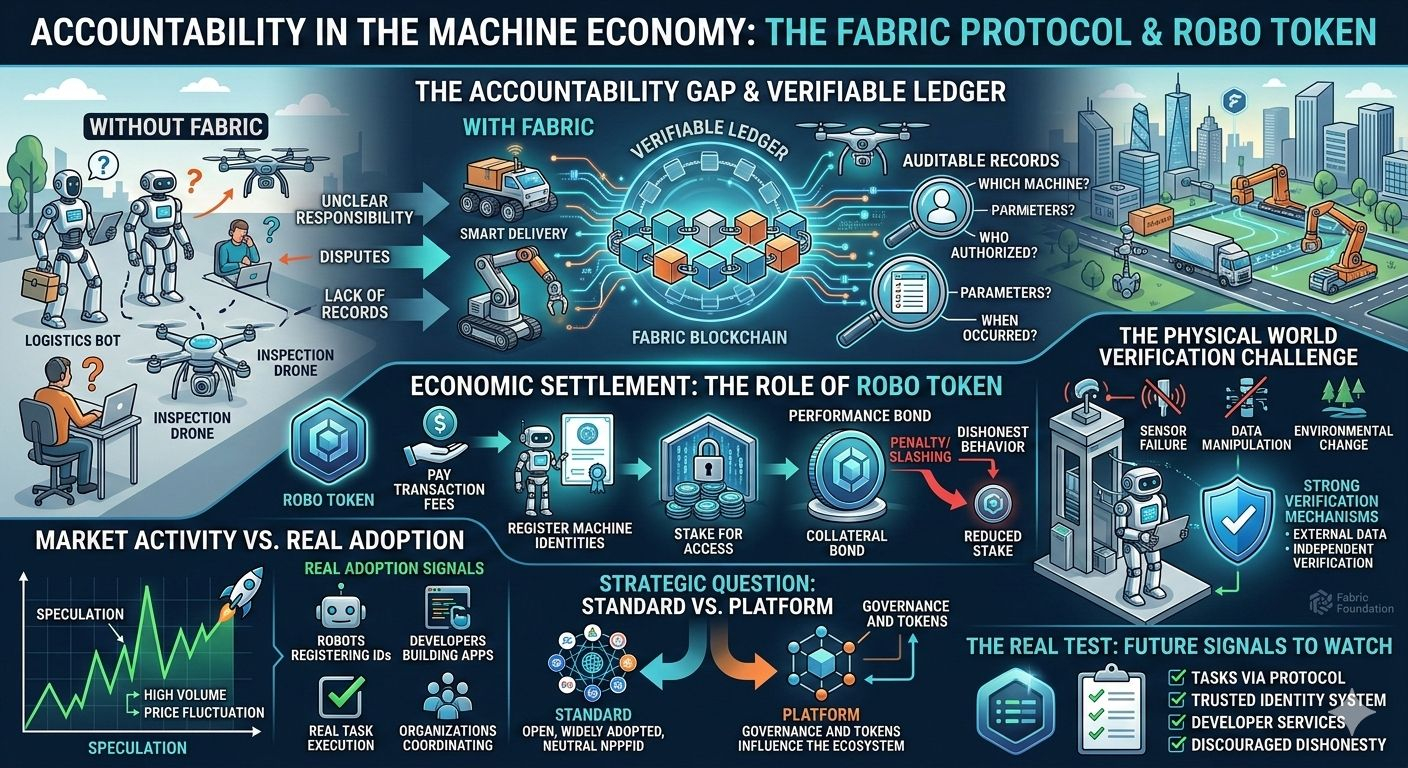
Fabric attempts to solve this problem by recording machine activity on a verifiable ledger. Every task performed by a robot could generate an auditable record that shows:
Which machine completed the task
Who authorized the action
What parameters were involved
When the event occurred
These records create a transparent history of machine behavior, which could help resolve disputes and improve trust between organizations using robotic systems.
Economic Settlement and the Role of the ROBO Token
Infrastructure alone is not sufficient for a functioning machine economy. Systems also require an economic mechanism that allows value to move efficiently between participants.
Within the Fabric ecosystem, this function is supported by the ROBO token. The token is designed to serve as the economic layer of the network, enabling payments and operational incentives.
According to the project’s design, the token can be used for several key purposes:
Paying transaction fees on the network
Registering machine identities
Staking to access network services
Acting as a performance bond for robot operators
The concept of staking is particularly important. When operators register machines, they may be required to lock tokens as collateral. If a machine behaves dishonestly or fails to perform tasks correctly, the system could penalize the operator by reducing their stake.
This mechanism attempts to align incentives and encourage responsible behavior within the network.
Market Activity Versus Real Adoption
Like many blockchain projects, Fabric has already entered a phase where market attention and trading activity are increasing. The ROBO token has launched on exchanges, and trading volume has grown as investors and traders begin speculating on the project’s future.
However, it is important to distinguish between market activity and technological adoption.
Crypto markets often interpret rising prices or high liquidity as evidence that a system is succeeding. In reality, early trading activity usually reflects speculation rather than real-world usage.
For a network like Fabric, the real signals of success would look very different. Instead of price movement, observers should look for indicators such as:
Robots actively registering identities on the network
Developers building applications that rely on the protocol
Real task execution occurring through the system
Organizations coordinating robotic services using the infrastructure
These types of activities represent genuine adoption rather than market hype.
The Physical World Verification Problem
Even if Fabric successfully builds a coordination system for machines, another major challenge remains. Robots operate in the physical world, and the physical world is unpredictable.
Sensors can fail. Data can be manipulated. Machines can malfunction. Environmental conditions can change unexpectedly.
A blockchain ledger can record events with perfect accuracy, but it cannot guarantee that those events reflect reality. For example, a robot might claim it completed a task even if the task was not actually performed correctly.
To address this issue, systems like Fabric will eventually need strong verification mechanisms. These could include sensor validation systems, external data sources, or independent verification protocols that confirm whether physical tasks were actually completed.
Without reliable verification, the integrity of machine-generated records could be questioned.
Standard Versus Platform: A Strategic Question
Another interesting question surrounding Fabric is whether it will evolve into a standard or remain a platform.
A technological standard succeeds when it becomes neutral infrastructure used by many different organizations. Standards are typically open, stable, and widely adopted across industries.
Platforms, on the other hand, attempt to control ecosystems and capture value through governance or centralized influence.
Projects that introduce tokens often struggle with this balance. Tokens can create incentives that push systems toward platform-style control rather than open infrastructure.
Over time, governance decisions within Fabric will determine which direction the network takes.
Why the Problem Fabric Addresses Matters
Despite the uncertainties, the problem Fabric is addressing is genuine. If autonomous machines become common in logistics, manufacturing, healthcare, and urban infrastructure, they will require systems that allow them to interact economically across organizational boundaries.
Robots cannot rely indefinitely on isolated dashboards and proprietary software platforms. As machine ecosystems grow, shared infrastructure will likely become necessary.
Fabric represents one attempt to build that infrastructure layer.
The Real Test of a Machine Economy
The future success of Fabric will not be determined by marketing campaigns or token listings. Instead, it will depend on whether real-world activity emerges on the network.
Key signals to watch include:
Robots performing tasks through the protocol
Operators trusting the identity system
Developers building services on the network
Economic incentives discouraging dishonest behavior
If those signals appear consistently, the ROBO token could evolve into a meaningful economic tool inside a functioning machine economy.
If they do not, the project risks becoming another example of a compelling narrative without real adoption.
For now, Fabric remains an early experiment exploring one of the most important questions in the future of automation:
How can machines participate in the economy without requiring everyone to trust a single company?