
I’ve noticed that robots have lived in isolated worlds. They operate inside factories, warehouses, and laboratories, often controlled by centralized systems built by the companies that created them. Even when robots become more intelligent through artificial intelligence, they still remain confined inside closed ecosystems. The machine might be capable, but its knowledge rarely travels beyond the walls of the organization that owns it.
When I first encountered the idea behind Fabric Protocol, what struck me wasn’t just the technology. It was the underlying philosophy. The project imagines a world where robots are not isolated tools but participants in an open global network. Instead of operating inside corporate silos, machines could collaborate, share knowledge, and evolve together.
Fabric Protocol presents itself as a global open network supported by the Fabric Foundation. Its purpose is to enable the construction, governance, and collaborative evolution of general-purpose robots through verifiable computing and agent-native infrastructure. But when I try to interpret that in simpler terms, I see it as an attempt to build something like an internet for robotic intelligence.
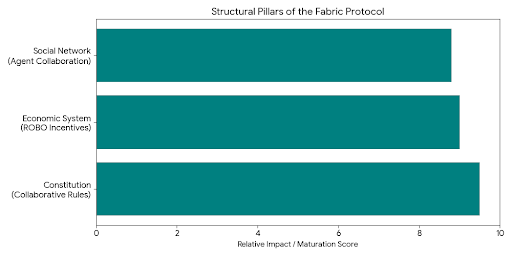
What fascinates me is that the protocol doesn’t just connect machines—it tries to coordinate data, computation, and governance through a public ledger. That means the information robots use, the computations they perform, and even the rules guiding their behavior can be verified transparently across a decentralized network.
This approach immediately raises a deeper question in my mind: why would robotics need something like this in the first place?
The answer becomes clearer when I think about the biggest limitation facing robotics today—trust.
Robots are entering increasingly sensitive environments. They assist surgeons in hospitals, transport goods through crowded cities, and help manage massive logistics networks. Yet the decision-making systems behind these machines are often opaque. Their training data is hidden. Their algorithms are proprietary. When something goes wrong, it can be difficult to understand why.
I believe this lack of transparency creates a major barrier to the widespread adoption of autonomous machines.
Fabric Protocol attempts to address this by introducing verifiable computing. Instead of simply trusting that a robotic system performed a task correctly, participants in the network can verify the computation cryptographically. In theory, this creates a system where robotic actions can be audited and validated without relying entirely on centralized authorities.
To me, this feels like a philosophical shift in how machines operate within society.
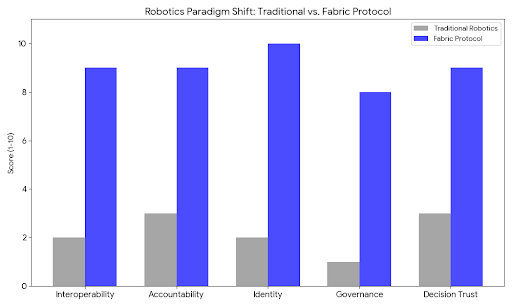
In traditional robotics, a robot is basically an advanced tool owned and controlled by a company or institution. In the Fabric ecosystem, the robot begins to resemble something closer to a digital agent. It can request computation from other systems, access shared datasets, and contribute information back into the network.
I find this concept particularly interesting when thinking about the data problem in robotics.
Training robots to operate effectively in the real world requires enormous amounts of data. Every environment introduces new variables—lighting conditions, obstacles, unpredictable human behavior. Gathering enough real-world experience for machines to learn these complexities is extremely expensive and time-consuming.
But if robots were connected through an open infrastructure, something remarkable could happen. The experiences of one robot could inform the learning of thousands of others.
When I imagine a warehouse robot navigating tight storage aisles, I realize that the navigation patterns it learns could help robots in completely different environments. A hospital robot moving carefully through crowded hallways might contribute insights that improve service robots in hotels. Delivery robots traveling through busy city streets could generate data that helps agricultural robots understand terrain movement patterns.
In this sense, Fabric Protocol is attempting to transform robotics into a system of collective intelligence.
Yet while I find this vision exciting, I also find myself questioning it from several angles.
One issue that rarely receives enough attention is data ownership. If robots continuously gather environmental information—images, sensor readings, movement patterns—who actually owns that data? The company operating the robot? The network hosting the infrastructure? Or the individuals whose environments are being recorded?
Privacy becomes a serious concern in a world filled with mobile sensors.
Fabric’s use of decentralized verification could help establish transparency about how data is used, but it does not automatically solve ethical questions surrounding surveillance or consent. As robotic networks expand, these issues may become central political debates rather than purely technical discussions.
Another dimension that interests me is governance.
Technology often evolves faster than regulation. Governments struggle to keep up with advances in artificial intelligence and robotics. Fabric attempts to address this by embedding governance mechanisms directly into the protocol. Participants in the ecosystem can theoretically influence the rules guiding the network’s evolution.
In theory, this decentralized governance could make robotic infrastructure more adaptable and democratic.
But I also recognize the risks. Governance systems are shaped by incentives and power structures. If large corporations dominate participation in the network, decentralized governance could quietly drift toward centralization again. If economic incentives reward quantity rather than quality, participants might flood the network with low-value data.
In other words, the social dynamics of the ecosystem will likely matter as much as the technology itself.
Perhaps the most intriguing idea I see in Fabric Protocol is the possibility of machine-to-machine economies.
As robots become more autonomous, they will increasingly interact with other automated systems. A delivery robot might negotiate energy access with a charging station. A warehouse robot could coordinate inventory storage with another automated facility. A fleet of agricultural machines might distribute tasks among themselves based on environmental conditions.
Fabric’s architecture is designed with this kind of interaction in mind. By enabling agents to share resources, verify computations, and exchange value across a decentralized infrastructure, the protocol creates the possibility of autonomous coordination between machines.
When I think about this long-term vision, I start to see robotics not as isolated devices but as participants in evolving digital ecosystems.
However, this also raises deeper philosophical questions.
If robots begin interacting economically and computationally within decentralized networks, the line between tool and participant becomes blurred. Machines will still be designed by humans, but their behavior could increasingly emerge from interactions within complex systems.
That kind of emergent intelligence could be incredibly powerful—but also difficult to predict.
Despite these uncertainties, I believe the broader idea behind Fabric Protocol reflects an important shift in technological thinking. Instead of building larger centralized platforms, developers are exploring decentralized infrastructure that allows intelligence to evolve collectively.
Whether Fabric itself becomes a dominant platform or simply one of many experiments remains uncertain. Technologies succeed not just because they are innovative but because communities choose to build around them.
If developers, robotics companies, and researchers begin contributing to the network, Fabric could become a foundational layer for collaborative robotic systems.
If they do not, it might still serve an important role as a prototype—an early attempt to imagine how autonomous machines could coordinate safely and transparently on a global scale.
What I find most compelling is the philosophical question it raises.
For decades, we have been teaching machines to learn. Now we are beginning to design systems where machines might also cooperate. The infrastructure we build today will shape how that cooperation unfolds.
#ROBO $ROBO @Fabric Foundation
