
Meta Description
Learn the difference between Artificial Intelligence and Robotics. Discover how AI and robots work, their applications, key differences, and future impact on technology.
Focus Keywords
Artificial Intelligence vs Robotics
Difference between AI and Robotics
What is Artificial Intelligence
What is Robotics
AI and Robotics applications
Introduction
Artificial Intelligence (AI) and Robotics are two of the most important technologies shaping the modern world. From smart assistants and self-driving cars to industrial robots and automated factories, these technologies are transforming how we live and work.
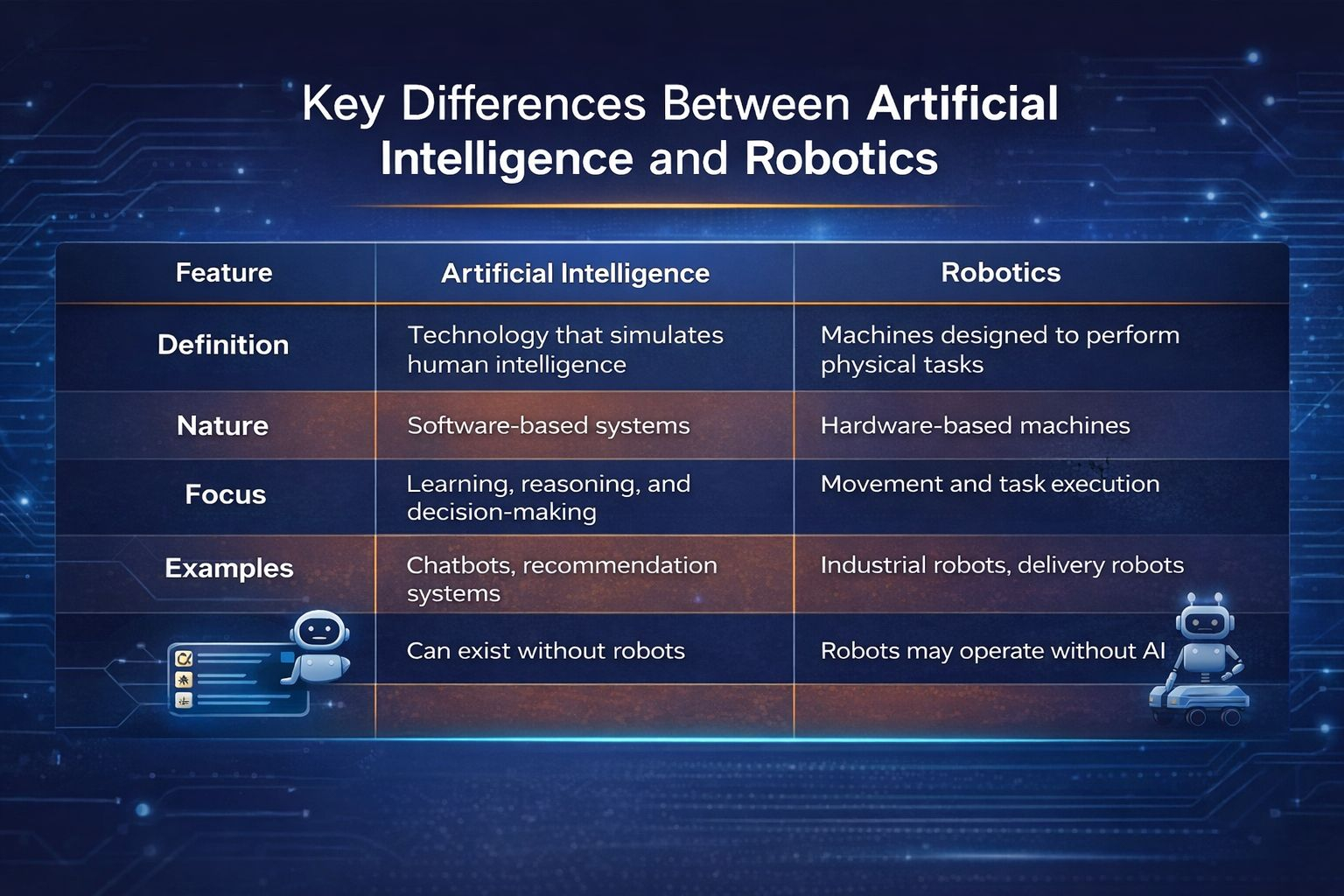
Although many people use the terms Artificial Intelligence and Robotics interchangeably, they are not the same. Artificial Intelligence focuses on creating intelligent systems capable of learning, reasoning, and decision-making, while Robotics focuses on building machines that can perform physical tasks automatically.
Understanding the difference between AI and Robotics helps us better understand how these technologies work individually and how they can work together to create powerful innovations.
What is Artificial Intelligence?
Artificial Intelligence is a field of computer science that focuses on creating machines and software capable of performing tasks that normally require human intelligence.
AI systems can analyze large amounts of data, learn from patterns, and make decisions without constant human guidance.
Key Technologies in AI
Some of the major technologies that power Artificial Intelligence include:
Machine Learning (ML) – Allows systems to learn from data.
Natural Language Processing (NLP) – Helps machines understand human language.
Computer Vision – Enables machines to interpret images and videos.
Deep Learning – Uses neural networks to mimic human brain functions.
Examples of Artificial Intelligence
Virtual assistants like Siri and Alexa
Chatbots used in customer service
Recommendation systems on Netflix and Amazon
Fraud detection systems in banking
Self-driving car software
AI mainly exists as software and does not necessarily require a physical machine.
What is Robotics?
Robotics is a branch of engineering and technology that focuses on designing, building, and operating robots. Robots are physical machines that can perform tasks automatically or with minimal human control.
Robots can be programmed to perform repetitive, dangerous, or highly precise tasks that humans may find difficult or risky.
Components of a Robot
A typical robot includes:
Sensors – Detect information from the environment
Actuators – Help the robot move or perform actions
Control System – Processes data and controls robot behavior
Power Source – Provides energy for operation
Examples of Robotics
Industrial robots in automobile manufacturing
Warehouse robots used by e-commerce companies
Surgical robots used in healthcare
Space exploration robots like Mars rovers
Service robots in hotels and restaurants
Unlike AI, robotics always involves physical hardware.
Key Differences Between Artificial Intelligence and Robotics
How AI and Robotics Work Together
Although AI and Robotics are separate fields, they often work together to create intelligent machines.
When AI is integrated into robots, the machines can analyze their environment, make decisions, and improve their performance over time.
Examples of AI-powered Robots
Self-driving cars that detect obstacles and navigate roads
Warehouse robots that sort and transport packages
Medical robots assisting surgeons with precision
Smart home robots that help with daily tasks
By combining AI with robotics, machines become more adaptive and capable.
Applications of AI and Robotics
AI and Robotics are transforming many industries around the world.
Healthcare
Robots assist surgeons while AI helps diagnose diseases and analyze medical data.
Manufacturing
Robots automate assembly lines while AI optimizes production processes.
Transportation
AI powers self-driving cars while robotics controls vehicle movement.
Agriculture
Robots help with harvesting crops and AI analyzes soil and weather data.
Customer Service
AI chatbots and service robots improve customer experiences.
Future of Artificial Intelligence and Robotics
The future of AI and Robotics is extremely promising. As technology advances, machines will become more intelligent, efficient, and autonomous.
Future developments may include:
Fully autonomous vehicles
AI-powered household robots
Advanced medical robots for complex surgeries
Intelligent robots for disaster rescue operations
Smart cities powered by AI and automation
Experts believe that AI and robotics together will reshape industries and create new opportunities across the world.
Conclusion
Artificial Intelligence and Robotics are closely connected but fundamentally different technologies. AI focuses on developing intelligent systems that can think, learn, and make decisions, while Robotics focuses on building machines capable of performing physical tasks.
When these two technologies work together, they create powerful solutions that improve efficiency, productivity, and innovation across industries. Understanding their differences helps us appreciate how both fields contribute to the future of technology.