

 The future of artificial intelligence is no longer defined only by how powerful models become. The real challenge today is trust. As AI begins to influence financial markets, decentralized finance, enterprise automation, and digital governance, a critical question emerges. How can we verify that AI outputs are reliable before they are executed in real systems?
This is where Mira Network introduces a powerful concept. Instead of relying on a single centralized authority to verify AI decisions, Mira builds a decentralized verification layer. However, technology alone cannot scale an ecosystem. Strategic partnerships and collaborations are the real engines that transform an innovative protocol into industry infrastructure.
From my perspective, Mira Network’s collaboration strategy is one of the most interesting developments in the emerging AI verification sector. Rather than positioning itself as just another AI platform, Mira is building a trust layer that other ecosystems can plug into. That difference matters because infrastructure projects succeed when they become the foundation for other builders.
Understanding Mira’s partnership strategy helps reveal how decentralized AI verification could become a core layer of the next generation internet.
Why Partnerships Matter in the AI Verification Economy
In traditional AI systems, model outputs are often accepted without independent verification. This approach works in low risk environments but becomes dangerous when AI interacts with financial systems, automated trading agents, or enterprise decision engines.
The crypto industry has already experienced how fragile automated systems can be. Smart contracts execute exactly what they are programmed to do. If the inputs are incorrect, the results can lead to major financial losses.
Mira attempts to solve this challenge by introducing decentralized verification for AI outputs. But for this system to function effectively, it needs three types of ecosystem participants.
AI model providers who generate outputs
Validators who verify results through the Mira network
Applications that rely on verified intelligence
This structure naturally creates the need for partnerships across multiple sectors. AI development platforms, DeFi protocols, blockchain ecosystems, cloud infrastructure providers, and developer communities all play a role.
The broader the collaboration network becomes, the stronger the verification economy grows.
Collaboration with AI Infrastructure Projects
One of the most logical collaboration paths for Mira Network is with AI infrastructure providers. These platforms focus on model training, data processing, and machine learning services.
However, most of them do not provide decentralized verification of outputs. This creates a natural integration opportunity.
By connecting AI platforms with Mira’s validation layer, developers gain the ability to confirm whether model outputs are trustworthy before triggering automated actions.
Imagine an AI powered trading agent analyzing market signals. Without verification, a flawed model prediction could trigger a massive incorrect trade. With Mira integrated, the output can be verified by decentralized validators before the execution step happens.
This kind of partnership transforms Mira from a standalone project into a security layer for AI driven automation.
DeFi Ecosystem Integrations
Another powerful area for Mira collaborations is decentralized finance.
DeFi is increasingly adopting AI for market analysis, liquidation management, risk monitoring, and automated trading strategies. However, DeFi protocols operate in an environment where incorrect data can cause immediate financial consequences.
A verified AI output layer can significantly reduce this risk.
Through partnerships with DeFi protocols, Mira can ensure that AI generated signals are validated before interacting with smart contracts. This reduces manipulation opportunities and improves system reliability.
From an ecosystem perspective, this type of collaboration creates a powerful feedback loop.
DeFi protocols gain safer automation
Mira gains real economic demand for its verification services
Validators earn rewards for maintaining network accuracy
In the long run, verified intelligence could become as essential to DeFi as price oracles are today.
Developer Ecosystem Partnerships
Technology adoption often depends less on the protocol itself and more on how easy it is for developers to build with it.
Mira Network appears to understand this dynamic by focusing on developer friendly integrations and SDK support. Partnerships with developer communities and infrastructure platforms allow builders to integrate verified AI into applications without needing deep expertise in machine learning or distributed systems.
This dramatically lowers the barrier for innovation.
A startup building a DeFi analytics tool could integrate AI insights while using Mira to validate results. A logistics company could rely on AI decision engines while ensuring outputs are verified by decentralized validators.
The more developer ecosystems Mira connects with, the stronger its network effects become.
Cross Chain and Blockchain Ecosystem Collaborations
Another important dimension of Mira’s growth strategy involves collaborations across blockchain ecosystems.
Different networks specialize in different strengths. Some chains focus on high performance trading. Others focus on decentralized applications or real world asset tokenization.
AI verification can benefit all of them.
Through cross chain integrations, Mira could function as a universal verification layer that supports AI powered applications across multiple blockchain environments.
This type of collaboration would dramatically expand the addressable market for the network. Instead of serving a single chain ecosystem, Mira could become a shared infrastructure layer for the broader crypto economy.
In my view, this cross ecosystem strategy is essential if the project aims to become a long term infrastructure provider rather than a niche application.
Where Visual Data Can Strengthen the Article
Chart Idea 1
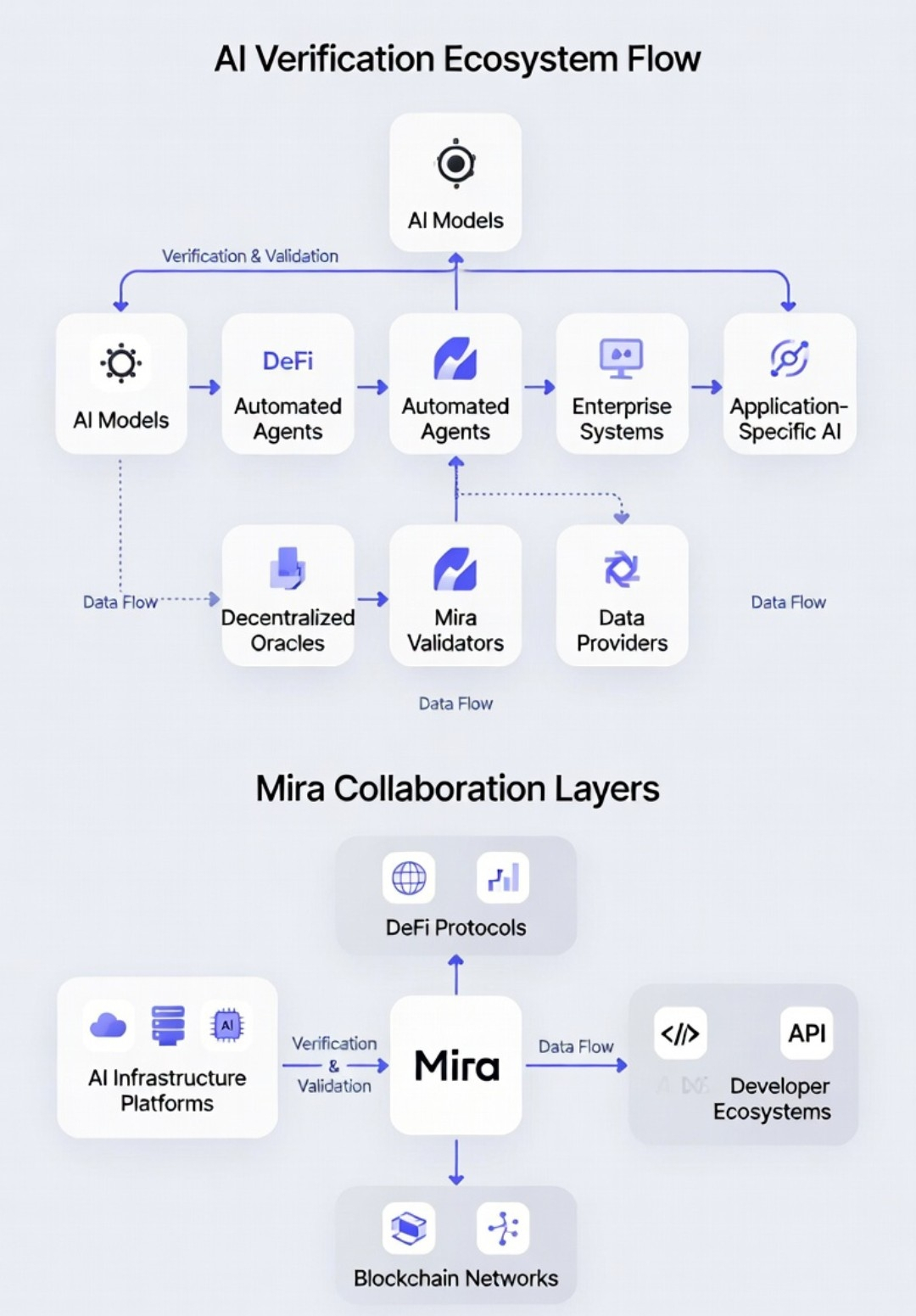
AI Verification Ecosystem Flow
A visual diagram showing the interaction between AI models, Mira validators, and applications such as DeFi protocols, automated agents, and enterprise systems. This helps readers quickly understand how partnerships fit into the verification architecture.
Chart Idea 2
Mira Collaboration Layers
A layered ecosystem chart illustrating four partnership sectors.
AI infrastructure platforms
DeFi protocols
Developer ecosystems
Blockchain networks
This visualization can show how Mira sits at the center as a verification layer connecting these sectors.
Opportunities Created by Mira’s Collaboration Model
If executed successfully, Mira Network’s partnership approach could unlock several important opportunities.
First, verified AI could become a new infrastructure category in the crypto economy. Just as oracle networks became essential for price feeds, AI verification could become essential for automated decision systems.
Second, validator incentives create a sustainable economic model. Node operators are rewarded for ensuring AI outputs remain accurate and trustworthy.
Third, developers gain a secure way to integrate AI into applications that handle real economic value.
These factors together create a powerful growth narrative around decentralized intelligence infrastructure.
Risks and Challenges
Despite its promising model, Mira Network also faces significant challenges.
AI verification is still an emerging sector. The industry has not yet fully defined the standard approach for validating machine generated outputs.
Adoption may also take time. Developers must see clear advantages before integrating verification layers into their applications.
Competition is another factor. As AI becomes more integrated with blockchain technology, other protocols may attempt to build similar verification systems.
Finally, the quality of validator incentives will play a critical role. If rewards are not balanced correctly, participation levels could affect network reliability.
These risks do not invalidate the concept, but they highlight why execution and ecosystem growth will be crucial.
Future Outlook for the Mira Collaboration Ecosystem
Looking ahead, the next phase of AI innovation will likely involve autonomous agents operating across financial systems, digital services, and enterprise automation.
When machines begin making economic decisions independently, trust becomes a non negotiable requirement.
This is why I believe the idea of decentralized AI verification is not just an experimental concept. It may become foundational infrastructure for the next wave of digital economies.
If Mira continues expanding partnerships across AI platforms, DeFi protocols, developer communities, and blockchain networks, the project could position itself as a trust layer for machine intelligence.
The success of that vision will ultimately depend on adoption, ecosystem collaboration, and the strength of its incentive design.
But one thing is becoming increasingly clear.
In a world where AI systems make decisions at machine speed, verified intelligence may become the most valuable infrastructure of all.
@Mira - Trust Layer of AI #Mira $MIRA
