I’ve noticed something interesting while spending time in the crypto space. Most conversations start with price and usually end with price. People talk about charts, short-term movements, and where a token might go next. But the longer I observe different projects, the more I realize that price alone rarely explains why some tokens survive multiple market cycles while others slowly disappear from attention.
That thought is exactly what pushed me to start looking at ROBO from a different perspective.
Instead of focusing only on short-term movements, I’ve been thinking about a bigger question: what role can a token play inside a growing network? Because in my experience, the tokens that remain relevant are usually the ones that become part of how the ecosystem around them actually works.
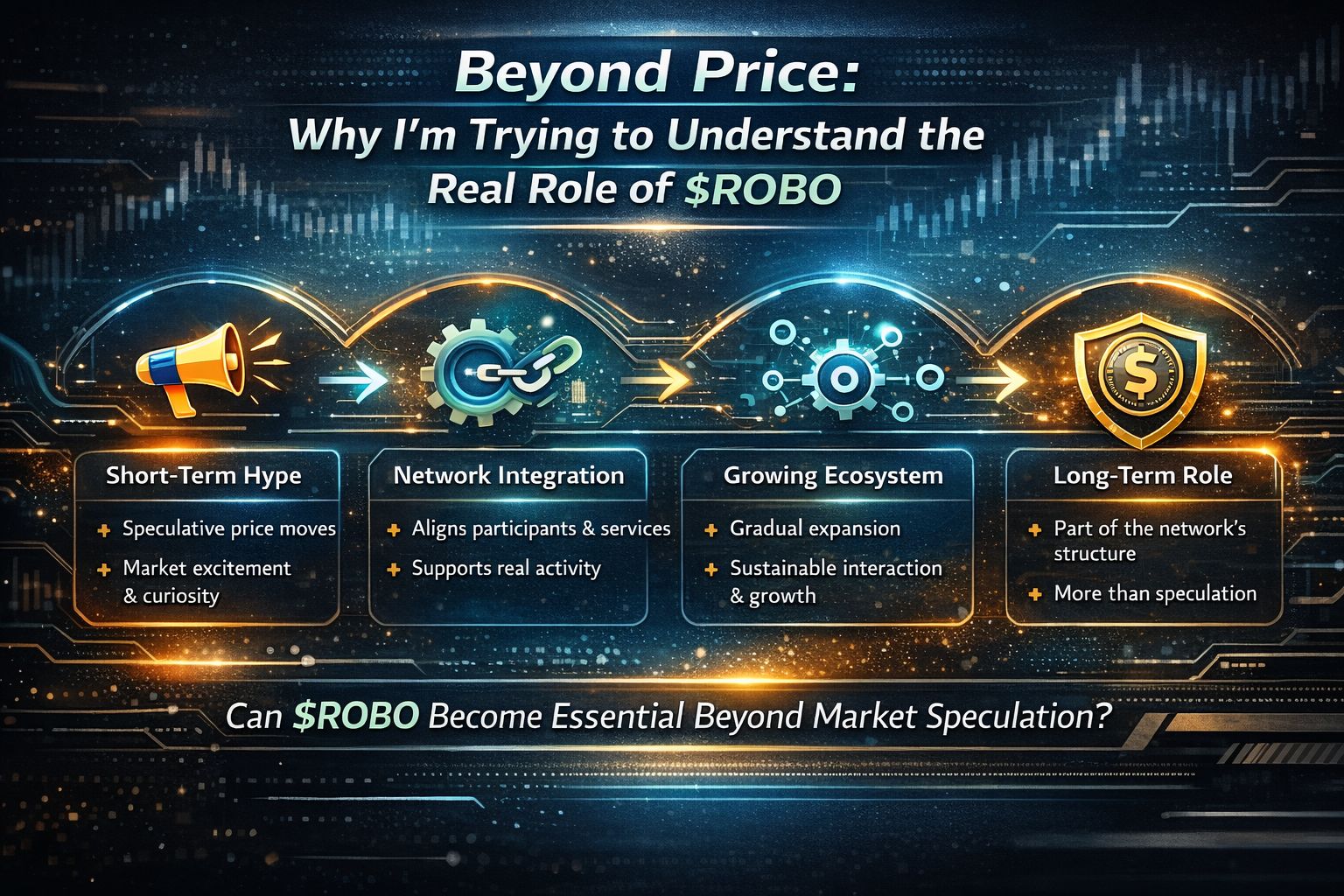
When a project is new, most of the activity around its token is driven by curiosity and speculation. Communities form quickly, discussions grow, and the market reacts to every update. But as time passes, the projects that continue to develop usually start showing something deeper than market excitement. Their ecosystems begin to organize themselves around participation, interaction, and gradual expansion.
This is the stage where tokens often begin to reveal their real purpose.
Instead of existing only on trading screens, they start appearing in the network’s daily activity. They become tools that connect participants, support interaction between services, and help align incentives within the ecosystem. In other words, the token slowly becomes part of the network’s infrastructure rather than just a tradable asset.
While observing $ROBO, this idea keeps coming back to me. If the ecosystem around it continues to evolve and expand, the token could eventually play a much larger role than simple speculation. In many successful networks, tokens become mechanisms that coordinate participation and help the ecosystem function smoothly.
Another pattern I’ve seen in strong crypto ecosystems is the way they grow over time. Sustainable networks rarely rely only on sudden bursts of attention. Instead, they expand gradually as more participants find reasons to stay involved. Communities become more active, liquidity becomes more stable, and interactions across the network begin to feel more consistent.
That type of development usually signals that the project is moving beyond its early phase.
Of course, every emerging ecosystem still faces challenges. Designing incentives that encourage meaningful participation while avoiding low-effort activity is never easy. Open networks must constantly balance growth with quality, and the strength of that balance often determines whether a project builds lasting momentum.
This is why I find the direction around $ROBO interesting to follow. The long-term story of any token is rarely defined by short-term volatility. It is defined by how deeply the token becomes integrated into the ecosystem that surrounds it.
If the network continues to grow and the token becomes increasingly connected to real activity inside that network, its importance can naturally increase alongside the ecosystem itself.
For now, I’m less interested in predicting the next market move and more interested in watching how the structure around $ROBO develops. Because in crypto, the projects that last are usually the ones where the token eventually becomes tied to something bigger than speculation.
And that’s the possibility I’m paying attention to as the ecosystem around ROBO continues to evolve.