

What makes Fabric Protocol interesting right now is not just the robot economy story. Traders have seen big narratives before. What catches my eye is the attempt to solve an older, uglier problem in a cleaner way: how do you actually connect data, compute, and human input without forcing developers to stitch together ten brittle systems first? Fabric is coming into focus because it frames that mess as a coordination problem, not just an AI problem. OpenMind unveiled Fabric in 2025 as a protocol for machines to verify identity, share context, and coordinate securely, and the Fabric Foundation has since positioned it as infrastructure for machine and human identity, decentralized task allocation, payments, and machine to machine data conduits. That matters because the real pain for builders is rarely the model alone. It is the plumbing around the model.
From a developer’s perspective, speed is the headline. Most teams lose time moving data between tools, proving that work happened, routing payments, and handling the ugly edge case where a human has to step in. Fabric’s pitch is that those pieces should live in one shared coordination layer. In its own materials, the network is designed to settle fees for data exchange, compute tasks, and API calls in one native system, while also giving robots and operators an auditable identity and history. In plain English, that means fewer adapters, fewer custom trust assumptions, and less reinvention of the same backend logic every time a team wants an AI agent or robot to do something useful in the world. For anyone who has built event driven systems, that reduction in integration friction is not a small detail. It is usually the whole game.
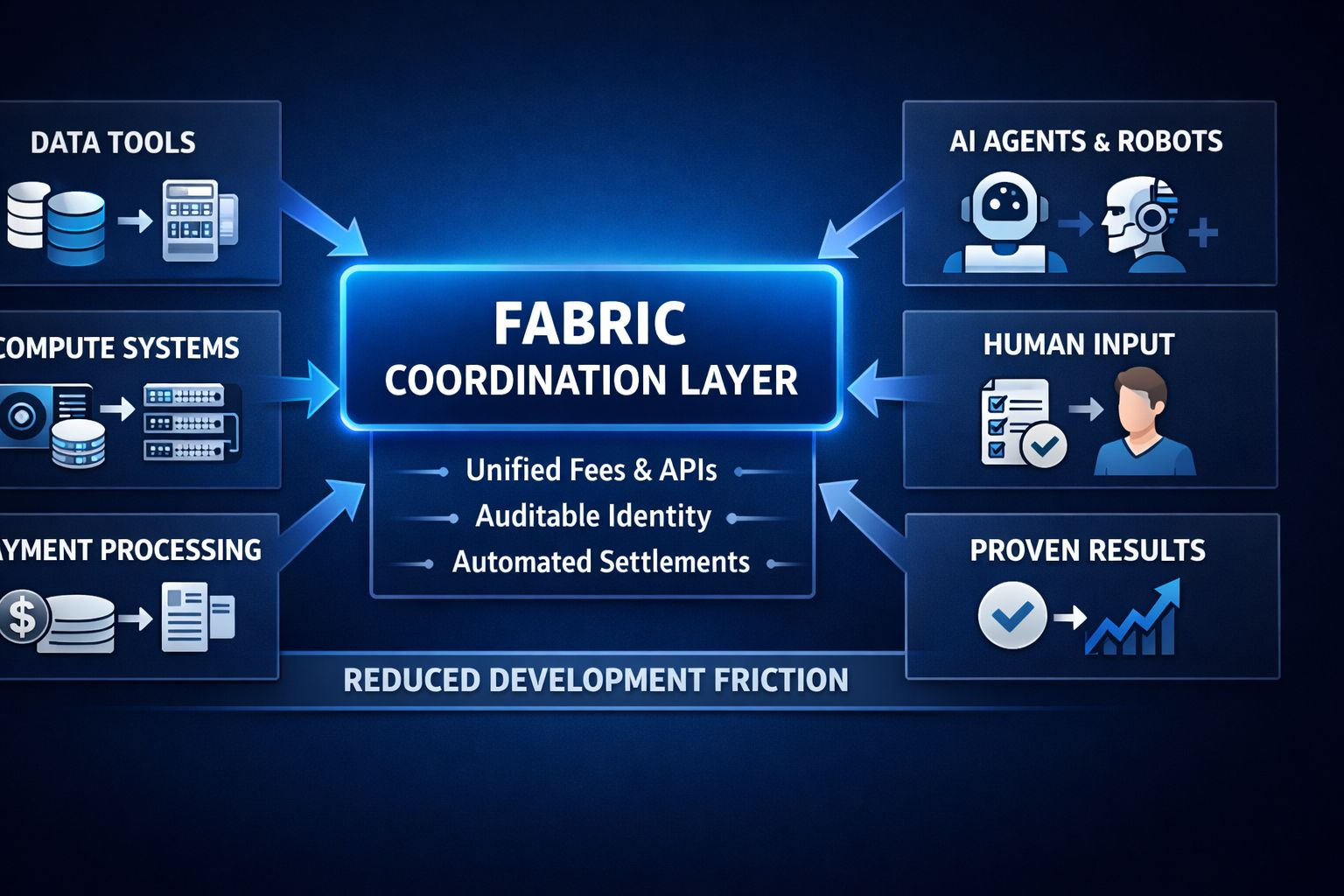
The human input piece is where Fabric gets more practical than it first sounds. A lot of projects talk about autonomy as if humans disappear. In the real world, they do not. Somebody labels the data, checks edge cases, verifies outcomes, or teaches a system a new skill when it gets confused. Fabric’s white paper leans directly into that. It describes reward structures for verified contributions that include task completion, data provision, compute provision, validation work, and skill development. It also outlines a “global robot observatory” idea, where humans observe and critique machine behavior, plus revenue sharing concepts for people who help robots acquire new skills. That is important because it treats human judgment as part of the system, not as a bug in the roadmap. Developers know that is closer to how robust products are actually built.
There is also a simplicity angle here that I think the market understands instinctively, even if the language around it gets dressed up. Fabric is trying to make three resources legible in one place: data, compute, and labor. The white paper literally describes markets for power, skills, data, and compute, and says humans with GPUs can provide compute to robots, while humans can also provide skills and real world support. When a protocol makes those contributions measurable and rewardable, development becomes less about building bespoke coordination logic and more about plugging into a common rail. That is why this is trending with both builders and traders. Developers hear “fewer moving parts.” Traders hear “clearer utility path.” Both groups are reacting to the same thing from different angles.
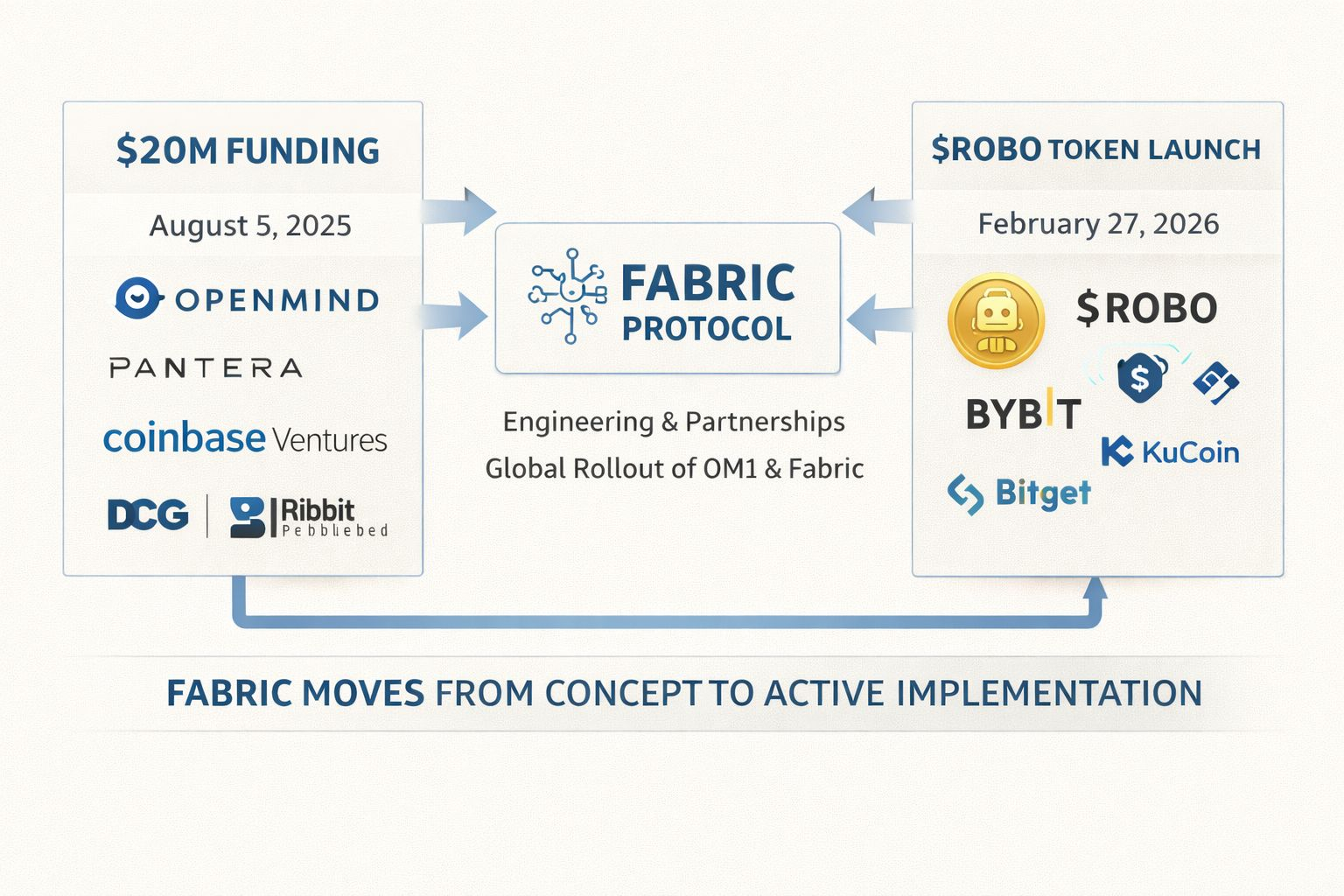
Progress has been real, not just conceptual. OpenMind announced a $20 million funding round on August 5, 2025, led by Pantera Capital, with backing from Coinbase Ventures, DCG, Ribbit, Pebblebed and others, and said the capital would help scale engineering and global partnerships around OM1 and Fabric. Then in late February 2026, the Foundation published the $ROBO rollout details, including token allocation and participation mechanics, while multiple major exchanges moved to list ROBO on February 27, 2026, including Bybit, KuCoin, and Bitget. I would not confuse listings with product maturity, but they do signal that the market now sees Fabric as more than a whiteboard idea. It has moved from concept stage chatter into something people are actively pricing, testing, and debating.
The other reason the story has legs is that Fabric is not pretending passive token holding equals contribution. Its documents repeatedly stress that rewards are tied to verified work, not idle ownership. That sounds technical, but it is really about reducing one more source of friction: incentive mismatch. If a developer contributes training data, validation, compute, or skill modules, the protocol is trying to measure and compensate that directly. If you have spent time around crypto infrastructure, you know how rare it is for projects to even attempt this cleanly. Many systems are still optimized around speculation first and useful work second. Fabric is at least trying to reverse that order. Whether it fully succeeds is another question, but the design choice is a serious one.
Personally, that is the part I find most worth watching. Not the slogan, not the exchange pop, not the AI robotics buzzword stack. The interesting test is whether Fabric can make development feel lighter. Can a builder onboard data, attach compute, bring in human validators, and settle outcomes without spending months writing custom glue code? Can the protocol turn messy coordination into a repeatable pattern? Those are not glamorous questions, but they are the ones that separate infrastructure that gets talked about from infrastructure that gets used. Markets eventually learn that lesson the hard way.
So when people ask why Fabric Protocol is gaining attention, I would put it simply. It is trending because it targets a real bottleneck: development friction in systems that need machines, data, compute, and humans to work together. It has made visible progress since 2025 through funding, public documentation, network design, and token launch steps. And it tells a story that developers, investors, and crypto traders can all understand without too much translation. Make the stack faster. Make the workflow simpler. Cut the number of trust gaps. In this market, that is a far more durable narrative than hype alone.