

That sounds small, but I think it is the harder problem inside a lot of AI verification narratives. If several models look at the same claim and reach the same answer, that can absolutely reduce random nonsense. It can filter out one-off hallucinations, sloppy reasoning, and obvious factual misses. But I do not think collective agreement, by itself, proves correctness. Sometimes it just proves that multiple systems are shaped by the same blind spots.@Mira - Trust Layer of AI $MIRA #Mira 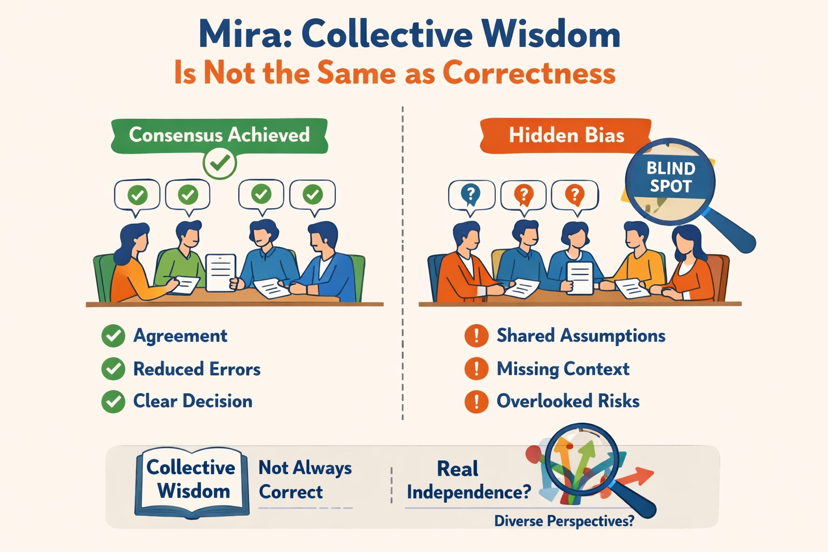
That is why Mira is interesting to me, but not in the easy “many models are better than one” sense.
The practical friction is obvious if you have used AI for anything even slightly high-stakes. A single model can sound fluent, confident, and wrong at the same time. So the instinct to move from generation toward verification makes sense. Instead of trusting one output, compare multiple judgments. Force disagreement into the open. Add coordination, incentives, and some economic weight behind the review process. In crypto terms, that is a much more serious design choice than simply shipping another model wrapper.
Mira’s consensus design can reduce random hallucinations, but systemic bias may remain if model diversity is weaker than it looks. That distinction matters. Random error and structural error are not the same thing. The first one gets better with aggregation. The second one can survive aggregation almost untouched.The mechanism is what gives Mira its real relevance. If the network is set up so multiple evaluators or models assess a claim, then noisy outputs can be filtered through comparative judgment. A weak answer that slips past one model may get challenged by others. A fabricated citation may not survive repeated inspection. A vague statement may be broken into smaller claims and tested more cleanly. This is the part I find genuinely strong. Consensus, used well, is a way to compress uncertainty and punish low-quality outputs.But there is a catch that I do not think people should wave away.Consensus only helps as much as the participants are meaningfully independent. If the model set is diverse in branding but not in worldview, training data, or failure patterns, the network may produce a cleaner version of the same mistake. Five judges are not really five judges if they were trained on similar corpora, optimized toward similar benchmark behavior, and shaped by the same internet priors. That is not decentralization in the deeper sense. That is correlated validation.This is where model selection bias becomes the hidden issue. On paper, “many perspectives” sounds robust. In practice, who chose those perspectives? What got excluded? Which models are considered reliable enough to enter the consensus layer in the first place? The selection process can quietly define the boundaries of acceptable truth before the network even begins scoring anything.
That matters even more when the answer is contextual rather than purely factual.If the question is something like “What is the capital of Japan?”, multi-model agreement is useful and usually enough. But crypto is full of questions that are not so clean. Was a token distribution fair? Is a governance proposal credible? Does an ecosystem partnership actually change long-term value capture? These are not binary facts in the same way. They contain interpretation, framing, incomplete evidence, and timing sensitivity. A consensus layer can organize opinions, but it cannot magically turn contested judgment into objective truth.That is the deeper assumption I keep coming back to. Mira may be strongest when verifying narrow claims, but less decisive when reality becomes political, contextual, or adversarial.A simple example shows the problem more clearly.Imagine a research desk using Mira to verify a fast-moving market narrative around a token unlock. Several models review wallet flows, prior announcements, treasury behavior, and exchange deposits. They all converge on the same conclusion: the unlock is probably manageable and not immediately bearish. That looks strong. Consensus achieved.
But what if every model is overweighting the same historical pattern? What if they all underprice one context variable, like a weak liquidity environment or insider behavior not visible on-chain yet? What if they are all drawing from a similar public information surface, while the real risk sits in off-chain coordination? In that case, consensus reduces noise without capturing the real danger. The answer becomes cleaner, not necessarily truer.
This is why I think Mira’s crypto angle is more serious than an ordinary AI product pitch. In crypto, we already understand that distributed coordination can improve resilience without guaranteeing perfect outcomes. A validator set can raise the cost of attack, but it cannot eliminate social capture. A prediction market can aggregate information, but it can still be wrong. Governance can formalize participation, but it can still reflect the incentives of whoever shows up with the most power. Mira sits close to that same tradition. It is not just asking, “Can models answer?” It is asking, “How do we coordinate trust around answers?” That is a much more valuable question.
The evidence that supports the optimistic case is real. More perspectives can catch edge-case errors.Disagreement signals are useful. Reputation and staking layers can make lazy verification more expensive. Structured review is better than blind acceptance. All of that improves the odds of reliability.Still, none of it erases the risk of shared bias.And this is the core tradeoff: the more Mira depends on consensus for trust, the more important the composition of that consensus becomes. If diversity is genuine, the system may become meaningfully better at reducing hallucinations. If diversity is superficial, the network may simply industrialize a common mistake and certify it with more confidence.That is not a small implementation detail. It is the whole game.What I’m watching next is not whether Mira can show agreement. Plenty of systems can do that. I want to see whether it can prove independence of judgment inside that agreement. How different are the models, really? How are evaluators selected?What happens when the answer depends on context, is still debated, or changes fast?What happens when minority disagreement turns out to be right? And how expensive is it to preserve real diversity instead of just performing it?
I like the direction because verification probably does matter more than another round of generation hype. But collective wisdom is not the same as correctness, and consensus is not the same as truth. Mira may reduce random hallucinations. I think that part is plausible. The harder question is whether it can resist coordinated blind spots when the models appear diverse but think in roughly the same lane.
The architecture is interesting, but the operating details will matter more.@Mira - Trust Layer of AI $MIRA #Mira