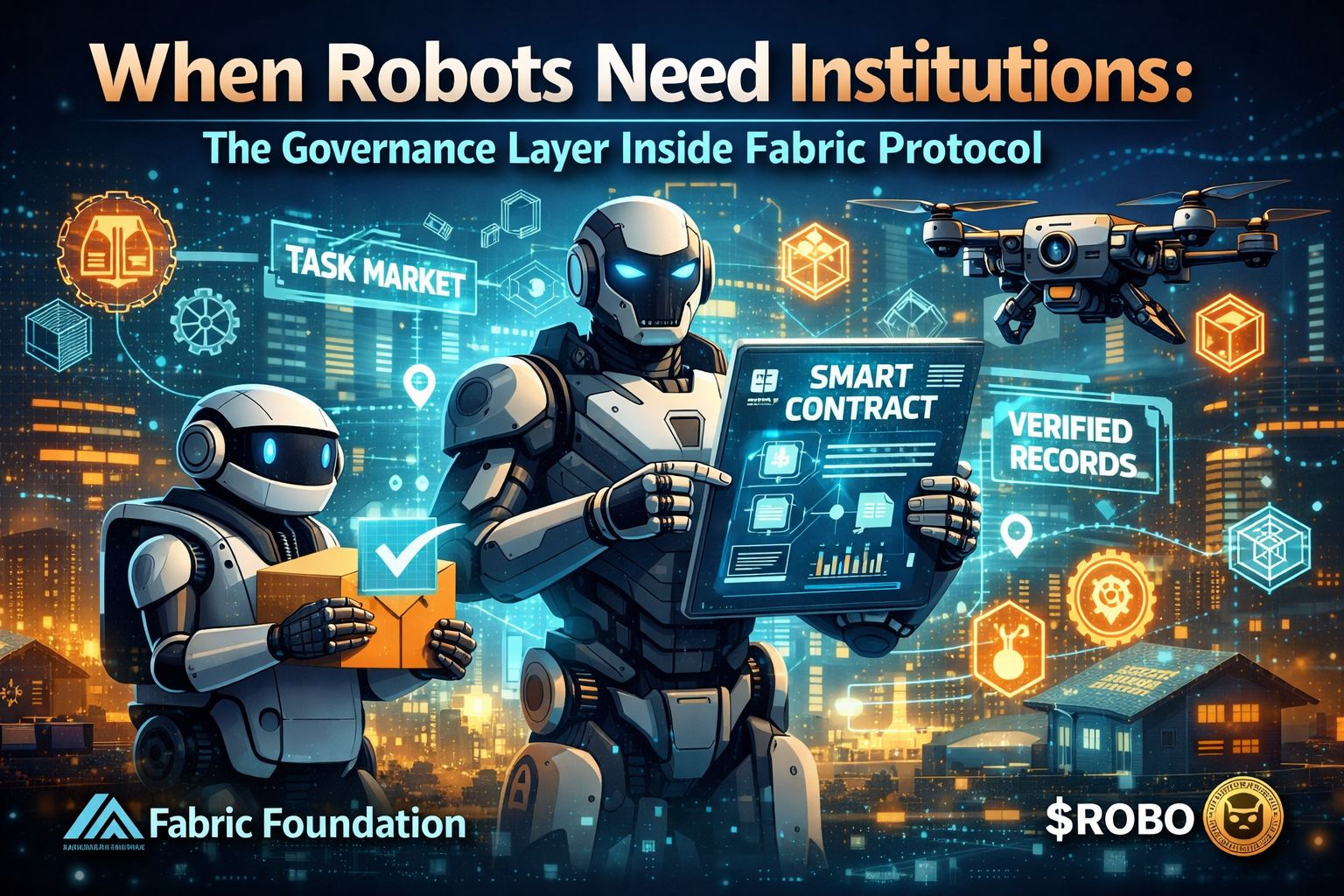
When I first started exploring Fabric Protocol, I realized it’s not just about robots, tokens, or distributed computing. The real innovation lies deeper in governance.
But this isn’t the usual governance we see in blockchains where token holders vote on proposals. Fabric introduces something far more fundamental: a rule-based system that allows machines to cooperate without needing to trust each other.
Most discussions about Fabric focus on robot identity, payments, or data sharing. Those things matter, but they’re not the real breakthrough.
Fabric is essentially building institutions for machines.
Human societies rely on institutions like contracts, property rights, accounting systems, and legal records to enable large-scale cooperation. Without them, global economies wouldn’t exist.
Fabric attempts to recreate a similar structure — but for robots.
Instead of simply connecting machines, the protocol builds a rules-based environment where robots can plan tasks, verify outcomes, and settle obligations automatically.
And in my opinion, this governance layer is what many people overlook.
The Cooperation Problem of Robots
One of the biggest silent challenges in robotics today is lack of trust between machines.
A delivery robot built by one company usually can’t coordinate with a warehouse robot from another company. Each operates with different software, protocols, and centralized control systems.
As a result, robots remain locked inside isolated ecosystems.
This fragmentation slows innovation and prevents large-scale robotic collaboration.
Fabric addresses this by introducing a shared protocol.
Through Fabric, robots can verify identities, communicate state, and coordinate tasks using cryptographic guarantees instead of trust.
A robot doesn’t have to “believe” another robot is telling the truth.
The network verifies it.
Identity is confirmed through cryptography. Location can be validated through multiple signals. Task outcomes become verifiable events recorded across the network.
What emerges isn’t just communication between machines.
It’s a system with rules and memory.
Turning Robot Actions Into Verifiable Records
Think about how traditional companies verify work.
If a worker completes a task, there are reports, supervisors, or audits that confirm it actually happened.
Fabric replaces these intermediaries with cryptographic verification and network consensus.
Every robot connected to Fabric has a unique cryptographic identity tied to secure hardware.
When a robot performs a task — such as delivering goods, scanning infrastructure, or inspecting a building — it generates a record containing:
Time of execution
Location data
Task details
Sensor evidence
This data isn’t kept privately by the robot.
It’s shared across the Fabric network where other nodes and devices can validate it.
For example, if a robot claims it scanned the second floor of a warehouse, nearby sensors or other robots can verify that claim.
If inconsistencies appear, the record can be corrected before being finalized on the ledger.
This process turns robot actions into official, verifiable records.
And those records become the foundation for:
Payments
Reputation systems
Future task assignments
Multi-robot collaboration
From Command Systems to Robot Task Markets
Most robotics systems today operate under centralized command structures.
A server assigns tasks, monitors progress, and decides whether the job was completed correctly.
Fabric flips this model entirely.
Instead of command systems, it introduces open task markets.
Tasks can be posted on the network for any compatible robot to discover.
Robots can choose to accept the task and lock a small deposit as proof of commitment.
Once the task is completed, the network verifies the results through sensor data and consensus.
If the work checks out:
Payment is automatically released
Deposits are returned
The event becomes part of the robot’s verifiable record
This process resembles human contracts, but enforced by code rather than trust.
That’s why I see Fabric less as a robot network and more as a programmable rule system for machine cooperation.
Machine Economies and Why Institutions Matter
The importance of this architecture becomes clear when we think about scale.
Centralized systems work fine inside a factory with a limited number of robots.
But when robots start operating across cities, companies, and countries, coordination becomes exponentially harder.
Machines need answers to simple but critical questions:
Who is this robot?
Did it really complete the task?
Can I trust the data it provides?
Fabric answers these questions through:
cryptographic identity
shared context
automated settlement systems
In essence, it creates the same type of institutional infrastructure that allows humans to trade globally.
Without these systems, robots will remain trapped inside closed corporate ecosystems.
The Long-Term Vision: Programmable Machine Institutions
One of the most powerful aspects of Fabric’s design is that its governance rules are programmable.
Traditional institutions evolve slowly because they rely on legal frameworks, policies, and bureaucracy.
Fabric embeds cooperation rules directly into protocol code.
For example:
Smart contracts could automatically distribute revenue when multiple robots complete a task together.
Rules can determine which devices are allowed to perform specific jobs.
Insurance deposits can be programmed to activate if something goes wrong.
This flexibility allows machine ecosystems to evolve far faster than traditional organizations.
Instead of rewriting institutions through policy, developers can upgrade them through code.
Conclusion
What makes Fabric Protocol fascinating isn’t just its token, robotics software, or decentralized infrastructure.
The real innovation is the idea of machine institutions.
Fabric transforms robot activity into verifiable records, converts tasks into programmable contracts, and replaces centralized control with rule-based collaboration.
In human societies, institutions are the invisible structures that enable cooperation at massive scale.
Fabric is an attempt to bring that same structure into the machine world.
If enough robots eventually connect to this network, Fabric could become the bookkeeping and governance system of a future machine economy.
And even if it doesn’t fully succeed, it will still represent an ambitious step toward understanding how autonomous machines might cooperate in the decades ahead.