
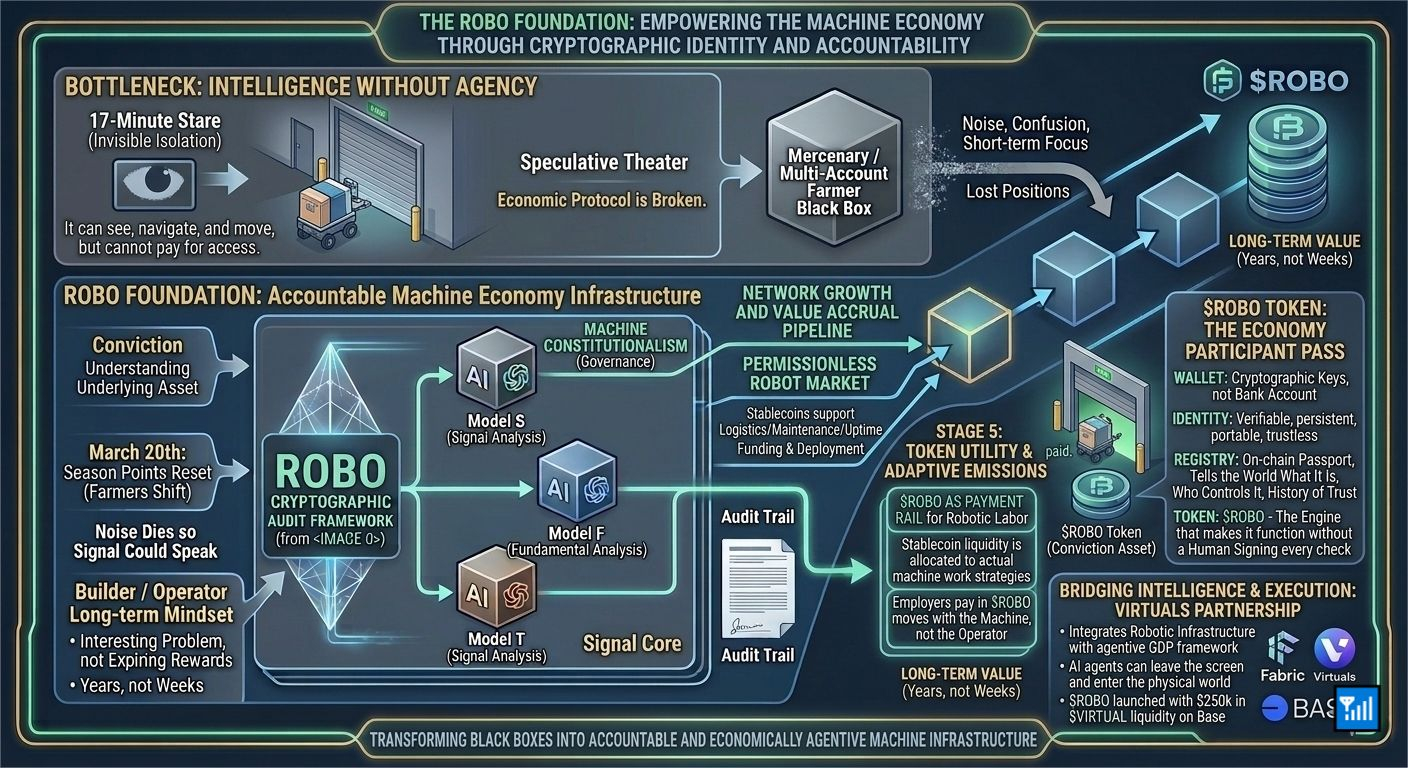
Last month I watched a delivery robot get stuck outside a loading area. The delivery robot had been on time. The loading door is automated. The robot could see the door, and the door could see the robot. And for 17 minutes, they looked at each other doing nothing because neither was able to “pay” the other for access.
The robot was not stuck. The door was not malfunctioning. Economic protocol is broken.
That 17-minute stare is where the machine economy goes to die.
After a few hundred cycles in crypto, people learn to see the difference between infrastructure and theater. Theater addresses problems that feel big until the lights go down. Infrastructure, on the other hand, solves problems that you could only realize existed. The delivery robot staring at the door it couldn't cross was the absence of infrastructure made visible.
What people get wrong about the robotics revolution is that the intelligence of the robots is not the barrier anymore. Models can navigate. Sensors can see. The actuators can move. The only remaining barrier is economic. Robots from different manufacturers, deployed by different operators, for different customers, have no means to economically interact or transact with each other or the world.
They're brilliant minds trapped inside bodies that cannot pay for anything.
Fabric Protocol aimed straight at this blindness. Not by building better robots—that's someone else's war—but by building the economic identity layer that robots were never given. What made me pause was how they framed it: not as a payment rail, not as a coordination protocol, but as the first system asking a question nobody else thought to ask: what does a machine need to participate in an economy?
The answer is simple. The implementation is not.
A robot needs a wallet—cryptographic keys, not a bank account, because banks were designed for humans with birthdays and signatures and branch managers who ask questions. A robot needs an identity—verifiable, persistent, portable across jurisdictions and employers, tracking permissions and performance without requiring trust. A robot needs a registry—an on-chain passport that tells the world what it is, who controls it, what it's allowed to do, and whether its history suggests it can be trusted.
And a robot needs a token—ROBO—that makes all of this function without a human signing every check.
This isn't perfect prediction of a future that may never arrive. It's honest infrastructure for a future that's already stalling in loading bays across the world.
But infrastructure is only valuable if it gets used. And here's where the Fabric thesis meets its first real test.
The current model for robot fleets is closed-loop inefficiency masquerading as control. A single operator raises private capital. Purchases hardware. Manages operations internally—charging, maintenance, route planning, compliance monitoring. Signs bilateral contracts with customers. Settles payments through traditional rails. And repeats this process for every fleet, every geography, every use case .
This model is structurally mismatched with reality: the demand for automation is global, but access to robot networks is limited to well-capitalized institutions. The rest of the world watches from outside the fence.
Fabric replaces this with something radically different: permissionless markets. Transparent participation mechanisms. Programmable incentives. Verifiable contribution tracking. On-chain identity that moves with the machine, not the operator.
Decentralized communities can now fund and deploy robot fleets together. Stablecoins deposited by participants support charging logistics, route planning, maintenance, and uptime guarantees. Employers pay for robotic labor in ROBO. And a portion of protocol revenue flows back into open market purchases of the token, creating persistent buy pressure tied to real economic activity, not speculation.
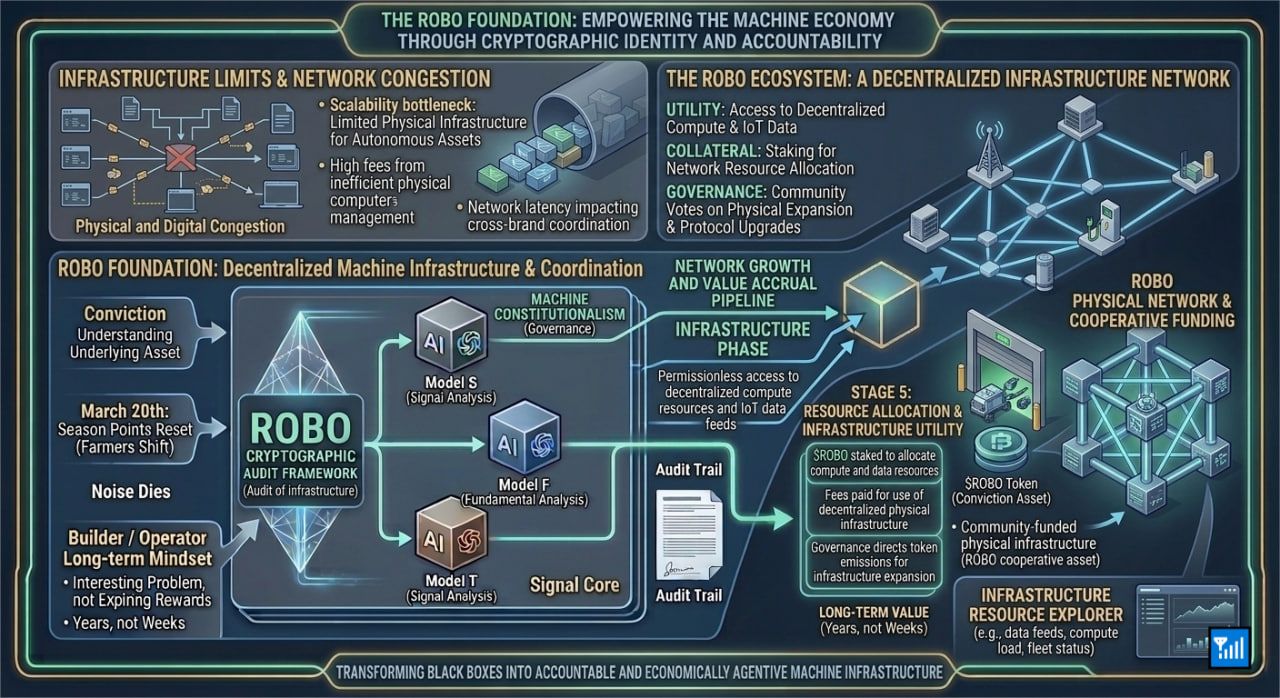
The closest analogy isn't another crypto project. It's how modern financial protocols allocate stablecoin liquidity to yield strategies—except here, the "yield" is actual work performed by actual machines in the actual world.
But if you talk about robot economies and ignore governance, you're building a castle on sand.
The hardest problems aren't technical. They're constitutional. When machines operate as economic participants without legal personhood, who decides what they're allowed to do? Who sets the rules for cross-border deployment? Who resolves disputes when a robot from one fleet damages property owned by another? Who ensures that the benefits of automation spread broadly rather than concentrating in the same institutional hands that dominated the last industrial cycle?
Fabric's answer is ROBO staking and DAO governance. Token holders participate in decisions about network fees, operational policies, and ecosystem direction. Developers and OEMs must stake ROBO to access the machine labor pool, aligning builders with the network's long-term success. Validators and node operators stake tokens as collateral against accurate participation, with slashing mechanisms that punish bad actors and reward honest work.
The Adaptive Emission Engine adjusts token issuance based on network utilization and quality metrics, ensuring that supply responds to genuine demand rather than algorithmic rigidity. This isn't governance theater—it's the first attempt at machine constitutionalism, written in code and secured by economics.
No one expects the hardest part to be waiting for the world to catch up to the vision.
The robots are coming. They're already here—in warehouses, hospitals, delivery fleets, manufacturing lines. But they arrive as isolated tools, each tethered to a single operator's balance sheet, unable to transact, unable to coordinate, unable to participate in the economy they're helping to build.
Fabric's partnership with Virtuals Protocol bridges the gap between intelligence and execution, integrating robotic infrastructure with the agentive GDP framework so that AI agents can finally leave the screen and enter the physical world. The $ROBO token launched with $250,000 in $VIRTUAL liquidity on Base, ensuring deep public markets from day one. Early liquidity providers received proportional shares of the total supply, rewarding those who believed in the machine economy before it arrived.
But the question that keeps me watching isn't whether Fabric can build the infrastructure. It's whether the world is ready to let machines participate.
Will regulators permit autonomous economic agents to hold assets and sign contracts? Will manufacturers open their hardware to cross-brand coordination? Will operators trade closed-loop control for network effects? Will communities step forward to fund and deploy fleets together, sharing in the returns from automation?
Or will the delivery robots keep staring at loading bay doors, brilliant and broke, waiting for permission that never comes?
In the end, the lesson I carry from years of watching infrastructure emerge is simple:
Intelligence without economic agency is just a prisoner with a better view.
The robots don't need better brains. They need wallets. They need identities. They need registries. They need a token that lets them pay for access, settle for work, and participate in the economy they're helping to scale.
$ROBO isn't betting on smarter machines. It's betting on machines that can finally transact.
The seventeen-minute stare in that loading bay was a preview of every bottleneck we haven't yet learned to see. Fabric is building the infrastructure that makes those bottlenecks irrelevant.
Now the question is whether we're ready to let machines into the economy—not as tools, but as participants.
@Fabric Foundation #ROBO