

I stopped treating Mira like a clean “AI verification” story the first time I thought through what actually happens under load. Not in the whitepaper abstract way. In the ugly workflow way. A request comes in, the output gets broken into claims, those claims get fanned out to verifier nodes, votes come back, consensus gets tallied, and only then do you get the certificate that makes the word verified mean anything. That’s the moment the trade looked different to me. The problem isn’t whether Mira can verify. On paper, it can. The real question is what happens when too many people want that proof at once.
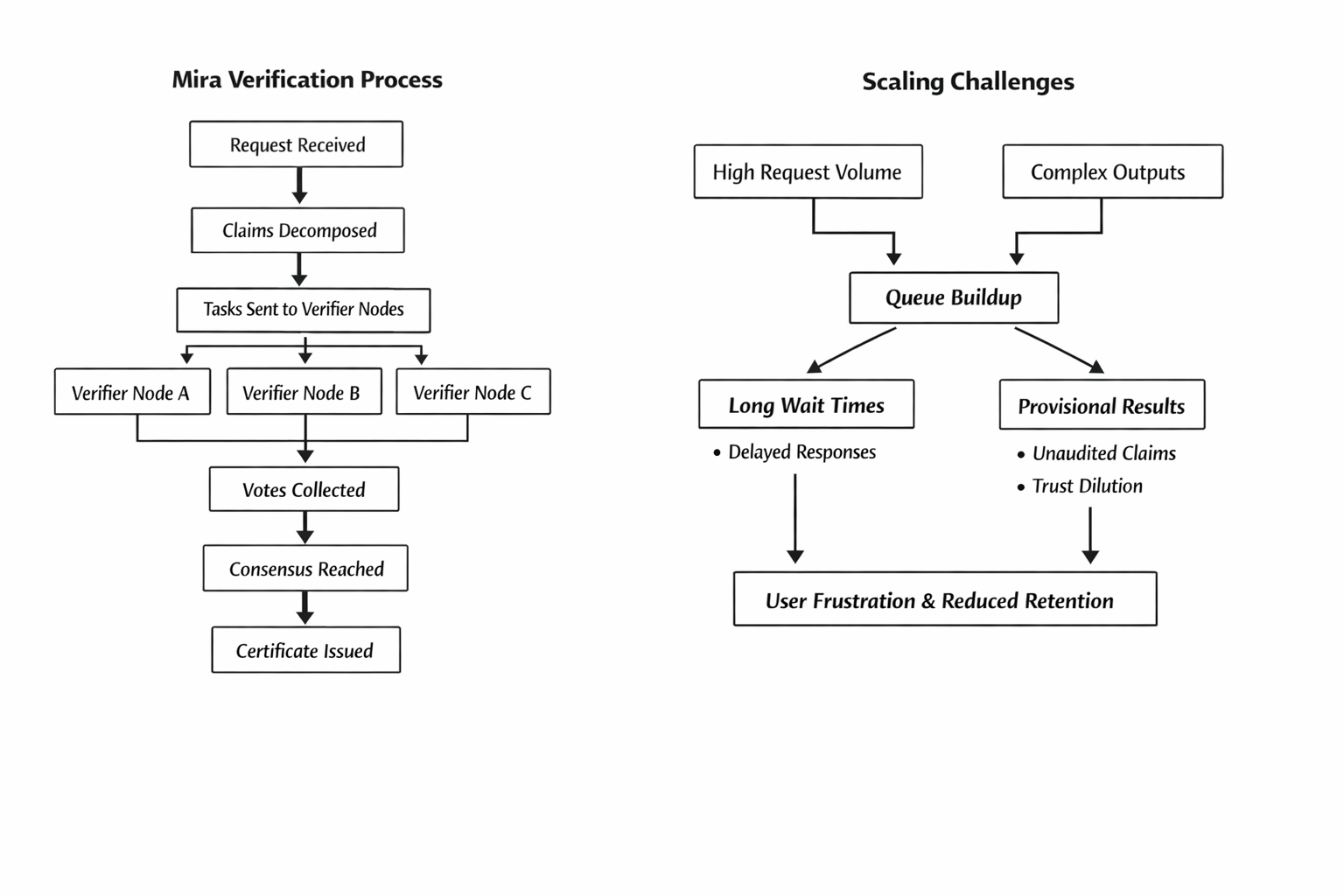
That matters more than most traders first assume, because congestion here is not just “higher gas” or “a bit more latency.” It goes straight at the product promise. Mira’s own architecture depends on decomposition into independently verifiable claims, distribution across diverse verifier nodes, and a consensus threshold before a cryptographic certificate is issued. The recent developer commentary around Mira gets right to the pain point: user-facing apps want instant responses, but distributed consensus finalizes in rounds, not vibes. So if the queue backs up, one of two things happens. Either users wait longer, or developers start showing provisional outputs before the cert hash exists. And once that starts, the trust layer gets diluted by its own UX shortcuts. Think of it like an exchange with perfect settlement logic but one clogged matching engine. You can brag all day about fairness after the trade, but if orders hang at the gate, traders stop caring about your elegant backend. They route elsewhere. Mira’s SDK docs actually hint at this operational reality more than the marketing pages do. They emphasize routing, load balancing, and flow management, which is basically the stack admitting that traffic coordination is part of the business, not a side note. When a system has to balance requests across nodes and manage flow patterns efficiently, that’s usually where the next bottleneck shows up once the novelty phase passes. And this is where the retention problem stops being abstract. A lot of crypto investors still get trapped by adoption snapshots. New wallets, new integrations, some exchange listings, a burst of volume, maybe a few weeks of everyone posting the same AI narrative. Fine. But retention is where the truth leaks out. If developers or end users keep hitting friction at the verification queue, they don’t announce a dramatic exit. They quietly reduce how often they call the system. They verify less. They reserve it for higher value actions. Or they bypass it entirely when speed matters more than certainty. That kind of behavior doesn’t always show up immediately in token chatter, but it shows up later in repeat demand. And repeat demand is what traders should care about most. The market side is interesting, but I wouldn’t over-romanticize it. MIRA’s token on Base currently shows roughly 13,005 holders and 383 transfers over 24 hours on BaseScan, with CoinMarketCap data surfaced there showing about 244.9 million circulating supply, roughly $21.9 million market cap, and around $9.8 million in 24-hour volume. That tells me attention is real. It does not tell me that usage quality is durable. High turnover in the token can coexist with fragile retention in the product. I’ve made that mistake before in other sectors of crypto, reading liquidity as proof of sticky utility when it was really just proof that the narrative had found a temporary bid. What I’m watching now is pretty narrow. Not whether Mira can explain verification beautifully. It already can. Not whether certificates are auditable. They are. I’m watching whether the network can preserve meaningful time-to-certificate as usage broadens, especially when requests become more complex and outputs decompose into more claims. More claims means more node work, more aggregation, more opportunities for queue buildup. The whitepaper makes the system sound orderly, but orderly systems can still jam. Especially when every extra layer of trust adds another step before finality. That’s the tradeoff nobody should hide from. Better assurance usually costs time, and time is exactly what mainstream AI users are least willing to spend. Still, I’m not bearish just because the bottleneck exists. I’m cautious because the bottleneck is the business. If Mira solves congestion well, the verification story gets stronger with scale instead of weaker. If it doesn’t, the network risks becoming a premium feature for occasional high-stakes checks rather than a default trust layer used constantly across products. That would change the size of the long term opportunity and, for traders, it would change how seriously to take retention, fee potential, and token demand. So don’t just watch the badge, the volume, or the headline partnerships. Watch the queue. Watch whether developers keep waiting for the certificate. Watch whether users come back after the first impressive demo. That’s where the real verdict sits, and that’s where the market will be decided.