
One thing on Binance kept annoying me more than it should have. I would make what looked like a simple rebalance, and a few minutes later there would still be some awkward leftover sitting in the account.
In one case, a basket adjustment turned into 3 orders and still left a remainder below the next valid step size.
Not enough to fix immediately. Not small enough to forget. 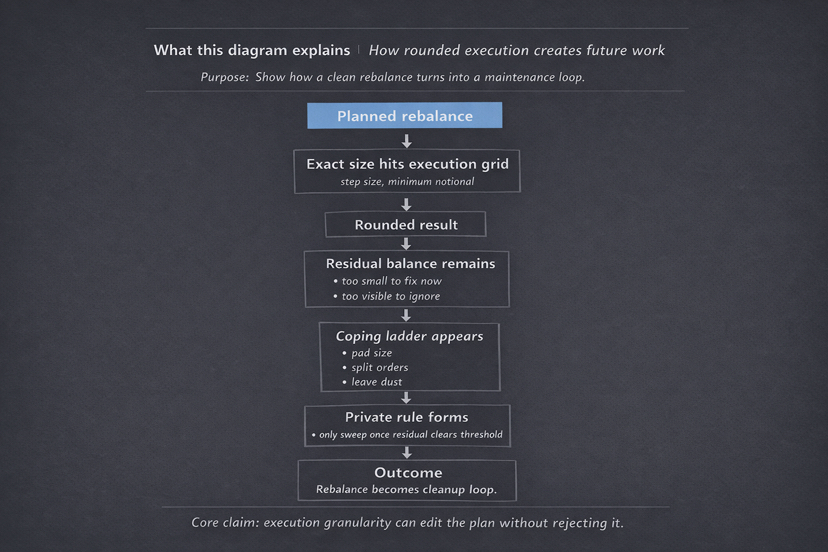
After it happened a few times, I stopped thinking of it as noise.
Most people file this under boring exchange mechanics. Minimum size. Step size. Precision. Allowed increments. Fine. Every venue has rules. That part is not interesting by itself.
What gets interesting is what those rules do to you when you use the venue over and over.
Because in your head, the plan is smooth. You think in target exposure, target allocation, how much you want to trim, how much you want to add back, where you want the hedge to sit. None of that thinking happens in little boxes.
Execution does.
That gap is where the mess starts.
You enter the number you actually want, and the system nudges you into something close enough. Then close enough leaves a remainder. The remainder creates another decision. That decision creates one more small intervention. Then another one. By the end of it, the trade still works, but the workflow is no longer clean.
That is the part I care about.
Not whether Binance has precision rules. Obviously it does. The real question is whether those rules quietly turn a clean plan into a maintenance routine.
I think they can.
Not in a dramatic way. More in the way habits form. You stop typing the exact number you want and start padding it because you already know the exact size probably will not survive contact with the grid. You split actions before the platform forces you to. You leave small leftovers alone because dealing with them now feels like more trouble than they are worth. Then a private rule shows up. Only sweep dust once the residual clears the next usable threshold. Then later you do a manual cleanup and tell yourself you will sort the account properly next time.
Next time becomes the process.
That is when it stops being a small technical detail.
The platform is not only executing your intent anymore. It is editing it. Quietly, but still editing it.
And to be fair, I get why the grid exists. Looser granularity would create other problems. Matching gets messier. Tiny fragmented activity becomes harder to manage. A cleaner system at the venue layer usually means someone else has to absorb the mismatch somewhere.
A lot of the time, that someone else is just the user.
Not in fees. In attention.
That is the hidden cost here. A few extra seconds checking the size again. A second attempt because the first one did not land the way you meant. A mental note to come back for the dust later. One more small choice. One more small correction. One more quiet translation between what you meant and what the system was willing to accept.
Individually, none of those feel serious.
Stack enough of them together and you end up supervising a workflow that was supposed to be straightforward.
That is why I do not put precision in the boring plumbing bucket. It shapes behavior. If execution granularity stays close enough to what the strategy actually needs, people keep operating through the original idea. If it does not, people slowly start designing around the grid.
And once that happens, the plan changes even if the thesis does not.
You see it in little ways first. Overshoot slightly so you do not leave residue. Delay a rebalance because the amount still feels awkward. Combine 2 actions because neither one alone feels worth the friction. Ignore a mismatch today because fixing it properly means starting another chain of small decisions.
This is also where the usual cheap fee story around Binance feels incomplete to me.
Cheap execution helps, obviously. But cheaper actions do not remove extra decisions. They just make those extra decisions easier to tolerate.
That is the only place $BNB fits in this story for me. 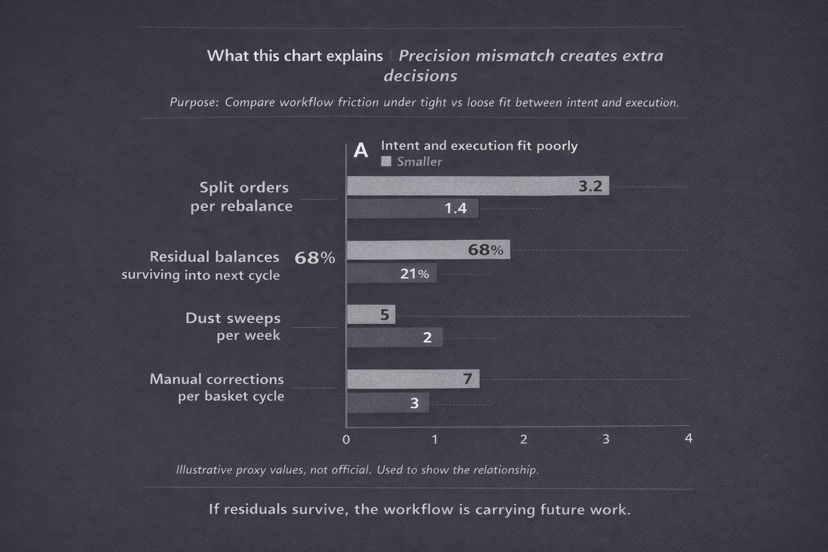
Not as some broad thesis. Just as part of the correction economy inside Binance. When every extra touch costs less, it becomes easier to keep polishing small mismatches instead of confronting the fact that the workflow is producing them in the first place. That can help if you are disciplined. It can also make the cleanup loop feel normal.
So the way I judge this now is more practical than philosophical.
If I rebalance the same basket again and again, do split orders per rebalance fall instead of rise. Do residual balances get cleared inside the same cycle or survive into the next one. Do dust sweeps per week shrink instead of accumulate. Do private thresholds for “leave it until it is worth fixing” fade instead of spreading.
That is where the cost shows up.
Not in one rejected order. Not in one awkward quantity.
In the point where the platform starts deciding how much cleanup work a clean idea is allowed to create.