


𝗧𝗵𝗶𝘀 𝗜𝘀 𝗪𝗵𝗲𝗿𝗲 𝗙𝗮𝗯𝗿𝗶𝗰 𝗔𝗻𝗱 $ROBO 𝗘𝗻𝘁𝗲𝗿 𝗧𝗵𝗲 𝗣𝗶𝗰𝘁𝘂𝗿𝗲
When people imagine the future of robotics, the conversation usually focuses on intelligence.
How smart will AI become?
How capable will autonomous machines be?
But intelligence is only one part of the equation.
The bigger challenge is coordination and accountability.
As autonomous systems begin operating in logistics, manufacturing, security, and public infrastructure, a new question emerges:
How do we verify what machines are doing?
The Real Infrastructure Problem
Imagine a future city where delivery robots, industrial machines, and autonomous drones operate simultaneously.
Thousands of machines performing tasks without direct human control.
In such an environment, networks must answer critical questions:
• Which machine performed a specific action?
• Can that action be verified?
• Who is responsible if something goes wrong?
Traditional robotic systems were never designed for this level of coordination.
Most machines operate in closed software ecosystems, isolated from other systems.
This fragmentation makes large-scale machine collaboration extremely difficult.
Fabric’s Approach
Fabric is exploring a different path.
Instead of building robots themselves, the protocol focuses on machine coordination infrastructure.
The idea is simple but powerful:
Autonomous systems need a shared layer of identity, verification, and interaction.
Within the Fabric ecosystem, machines or systems can potentially:
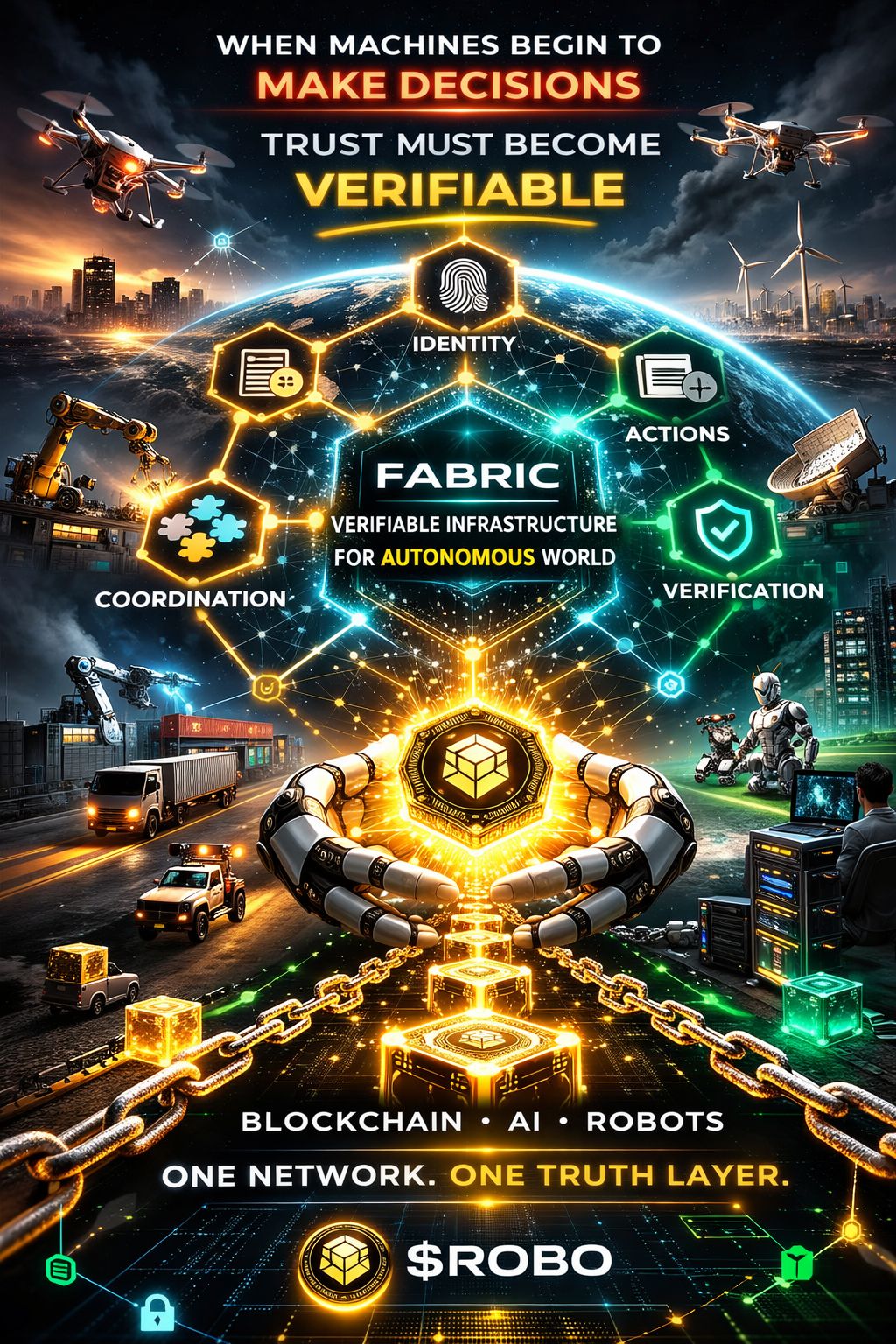
• register verifiable machine identities
• record actions performed by autonomous systems
• create transparent histories of machine activity
• interact within a shared coordination network
This transforms machines from isolated devices into participants in a verifiable digital system.
Why ROBO Matters
Infrastructure networks require incentives to function.
This is where ROBO becomes important.
The token acts as a coordination mechanism inside the Fabric ecosystem.
Possible roles include:
• incentivizing network participation
• supporting ecosystem governance
• aligning developers building on the protocol
• enabling economic coordination between participants
Rather than simply being a speculative asset, $ROBO is designed to support the operational layer of the network.
As more systems and developers interact with the protocol, the token becomes part of the mechanism that keeps the ecosystem functioning.
The Signal That Will Matter
Ideas alone do not create infrastructure.
Real adoption does.
For Fabric, meaningful progress will likely be visible through signals such as:
• developers building applications on top of the protocol
• autonomous systems registering identities within the network
• integrations with robotics or AI platforms
• increasing on-chain coordination activity
These signals would indicate that the network is evolving from concept into real infrastructure.
The Bigger Question
The world is moving toward a future where machines make more autonomous decisions.
But intelligence alone cannot sustain that future.
Trust must exist between machines, systems, and networks.
And trust requires verifiable infrastructure.
Projects like Fabric are exploring whether decentralized networks can provide that missing layer.
The real question is not whether robots will become more capable.
The real question is whether the systems coordinating them will be trustworthy enough to scale.