
went deep on the sub-economy evolution section last night. everyone skips it. and honestly? it's the most underrated mechanic in the entire whitepaper and also the one with the sharpest edge 😂
most people think ROBO is one unified network. it isn't.
Fabric's network naturally decomposes into subgraphs. distinct market segments organized by geography, task type, or operator identity. each subgraph operates as its own mini economy with its own pricing models, quality thresholds, and operational parameters. global robotics network serving wildly different use cases needs this kind of local flexibility. smart architecture.
here's where it gets genuinely interesting.
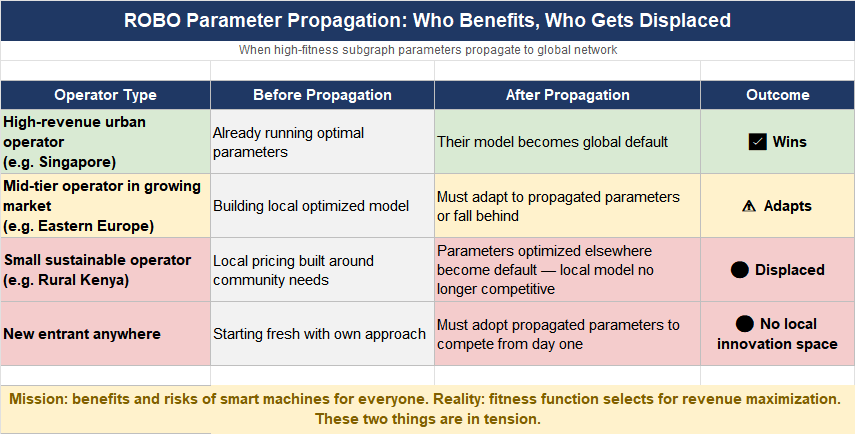
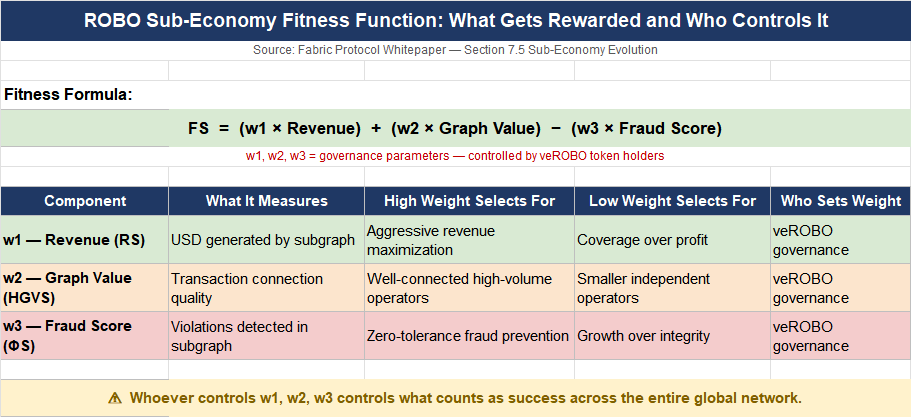
each subgraph has a fitness score. revenue generated, hybrid graph value, fraud score combined. protocol identifies highest fitness subgraphs and propagates their operational parameters to the broader network. operators in one market crack a pricing model that maximizes revenue with minimal fraud. that model automatically becomes the new global standard.
distributed learning from real deployments instead of central team theorizing optimal parameters. empirical optimization. this is genuinely better than how most protocols handle network-wide parameter updates.
fraud score component is particularly well designed. pure revenue optimization without fraud penalty creates race to bottom. including fraud score in fitness calculation means sustainable honest operation gets rewarded alongside growth. not just maximizing throughput but maximizing trustworthy throughput.
geographic and task type decomposition gives local markets real space to develop before any propagation happens. system doesn't force uniformity immediately. local adaptation comes first. that's thoughtful sequencing.
but here's what i keep coming back to.
fitness function weights are governance parameters. w1 for revenue. w2 for graph value. w3 for fraud score. whoever sets those weights controls what counts as success across the entire network.
sub-economy optimized for revenue looks completely different from one optimized for operator diversity or geographic coverage. foundation sets initial weights. veROBO governance adjusts over time.
and parameter propagation isn't a suggestion. it shifts operational defaults network-wide. operators who built sustainable local businesses around parameters that don't score highest on fitness function face a choice. adapt to propagated optimal parameters or get competed out by operators who already run them.
evolutionary optimization that selects purely for revenue maximization has winners and losers. the losers are operators in underserved markets. the same markets the whitepaper's opening pages say Fabric exists to serve.
fitness function defines evolution direction. evolution direction is controlled by governance. governance is concentrated. that chain matters.
honestly dont know if sub-economy evolution delivers the genuinely adaptive global robotics network the whitepaper describes or creates centrally directed optimization dressed as distributed innovation.
watching whether fitness function parameters get published publicly and whether governance votes on those weights happen transparently.
what's your take - distributed optimization that actually serves global markets or evolutionary pressure that concentrates success where it already exists?? 🤔
#ROBO #FabricFoundation @Fabric Foundation $ROBO
