
We are living in the era of artificial intelligence. Large Language Models can now write poetry, develop software, analyze data, and generate incredibly realistic images. Yet despite this rapid progress, one major gap still remains: the connection between intelligence and real-world action.
In other words, AI can think—but what happens when it needs to act?
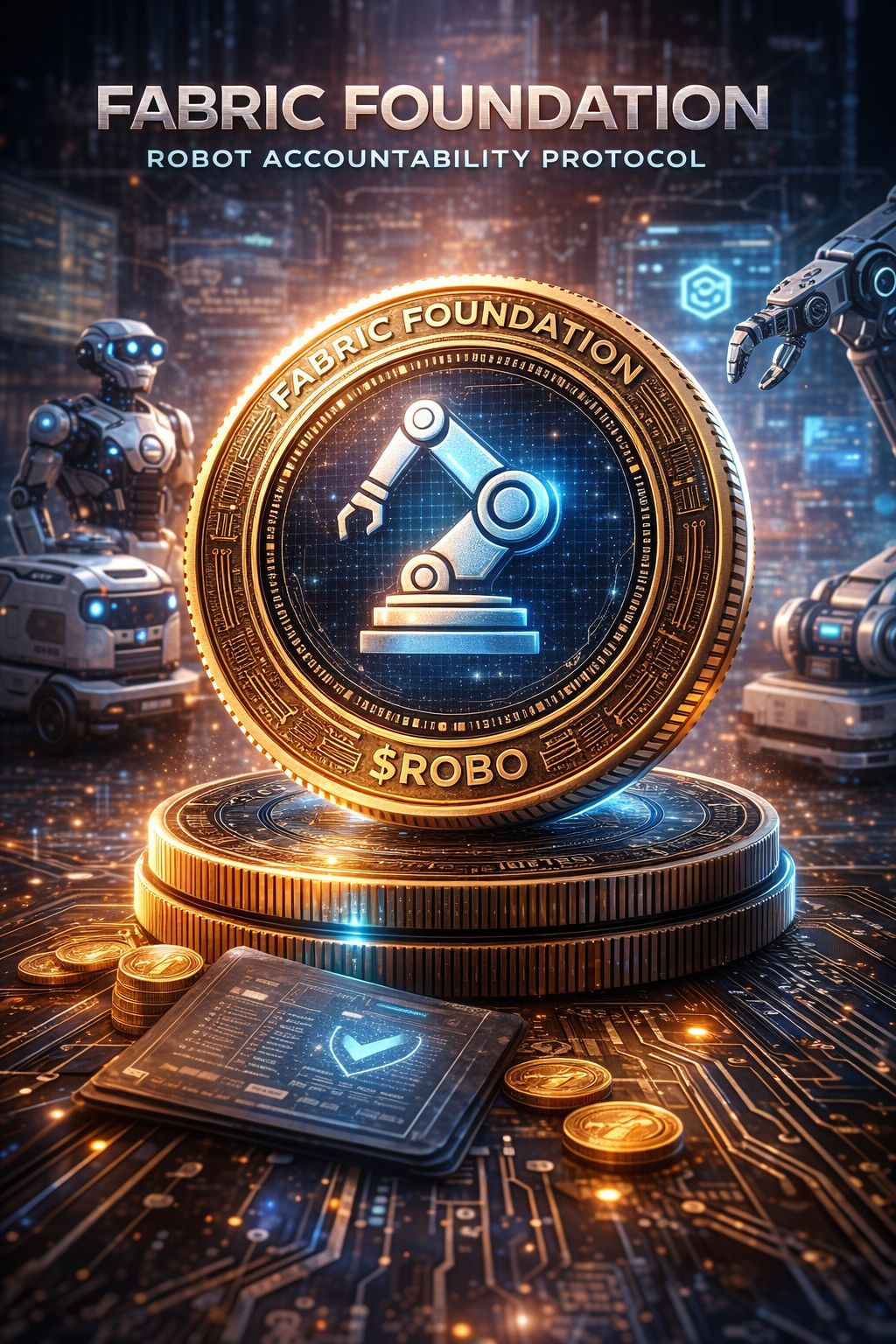
This is the challenge the Fabric Foundation is addressing. While much of the crypto market is focused on short-term hype cycles, a deeper transformation is quietly emerging at the intersection of robotics, decentralized infrastructure, and verifiable computing. At the center of this vision is $ROBO, the token designed to power a new coordination layer for intelligent machines.
The Problem: Robots That Cannot Speak the Same Language
Imagine a future filled with autonomous delivery drones, warehouse robots, industrial machines, and home assistants working together. In theory, this future is close. In practice, however, today’s robots operate in isolation.
Most robotic systems rely on proprietary software, rigid rules, and closed environments. They cannot easily communicate with machines from other manufacturers, share real-time information, or coordinate safely in complex environments.
Without a shared infrastructure, large-scale collaboration between robots becomes extremely difficult. Questions quickly arise:
How can we verify that autonomous machines are operating safely?
How can robots from different systems coordinate without conflict?
Who ensures that machines follow agreed rules in shared environments?
For robots to become truly general-purpose, they need something similar to a global coordination system—a trusted framework where machines can communicate, verify actions, and cooperate safely.
This is where Fabric Protocol enters the picture.
Fabric Protocol: A Coordination Layer for Machines
Developed with support from the Fabric Foundation, Fabric Protocol introduces a new model for managing robotic activity in the physical world. The core idea is simple but powerful: apply the transparency and trust of decentralized networks to real-world machine behavior.
Instead of relying solely on manufacturers or centralized platforms, Fabric creates a system where data, computation, and regulation are coordinated through decentralized infrastructure.
The key enabling technology behind this system is verifiable computing.
Verifiable Computing: Creating Trust for Machine Actions
Verifiable computing allows robotic actions to be cryptographically proven and validated. In practical terms, this means that the decisions and actions taken by machines can be recorded and verified on a public ledger.
Rather than asking users to blindly trust a device or company, Fabric allows the network itself to verify machine behavior.
Think of it as the difference between a private agreement behind closed doors and a contract publicly recorded for everyone to see. By bringing transparency to machine operations, Fabric creates a trustworthy environment where humans and robots can safely interact and collaborate.
This is not just about security—it is about enabling scalable human-machine ecosystems in the real world.
$ROBO: Powering the Agent-Native Economy
Like any decentralized system, Fabric Protocol requires economic incentives to function efficiently. This is where ROBO plays a central role.
ROBO is the native asset that powers the ecosystem’s agent-native infrastructure—an economic framework where intelligent agents and machines can interact autonomously.
The token supports several key functions:
Computation
ROBO helps pay for the computational resources required to verify robotic actions and process proofs on the network.
Coordination
Machines can use the network to bid for tasks, negotiate shared environments, or coordinate physical operations.
Governance
Token holders participate in protocol governance, helping determine updates, safety standards, and network parameters as the ecosystem evolves.
In this sense, ROBO Is more than a digital token—it acts as the economic engine behind a decentralized operating system for the physical world.
Why This Matters Now
The crypto landscape is evolving rapidly. Earlier cycles focused heavily on digital assets such as DeFi and NFTs. Today, a new narrative is gaining momentum: Decentralized Physical Infrastructure Networks (DePIN).
Fabric Foundation sits at the intersection of several transformative trends:
Artificial Intelligence
Robotics
Blockchain infrastructure
Decentralized coordination systems
By combining these elements, Fabric aims to create the foundational infrastructure required for autonomous machines to safely interact with the real world.
While much of the AI industry is focused on improving how machines think and communicate, Fabric is addressing the next critical step: enabling AI systems to move, build, and collaborate in the physical environment.
The Road Ahead
The development of general-purpose robotics is no longer a distant science-fiction concept. The core technologies already exist. What remains is solving the coordination challenge—ensuring that millions of intelligent machines can safely operate within shared environments.
Fabric Protocol is positioning itself as the decentralized infrastructure capable of solving that challenge.

If successful, it could become the nervous system for the next generation of intelligent machines, connecting AI with the physical world through trust, transparency, and decentralized coordination.