

I started thinking about scalability in systems like MIRA, I realized the conversation often begins in the wrong place.
People immediately talk about transactions per second.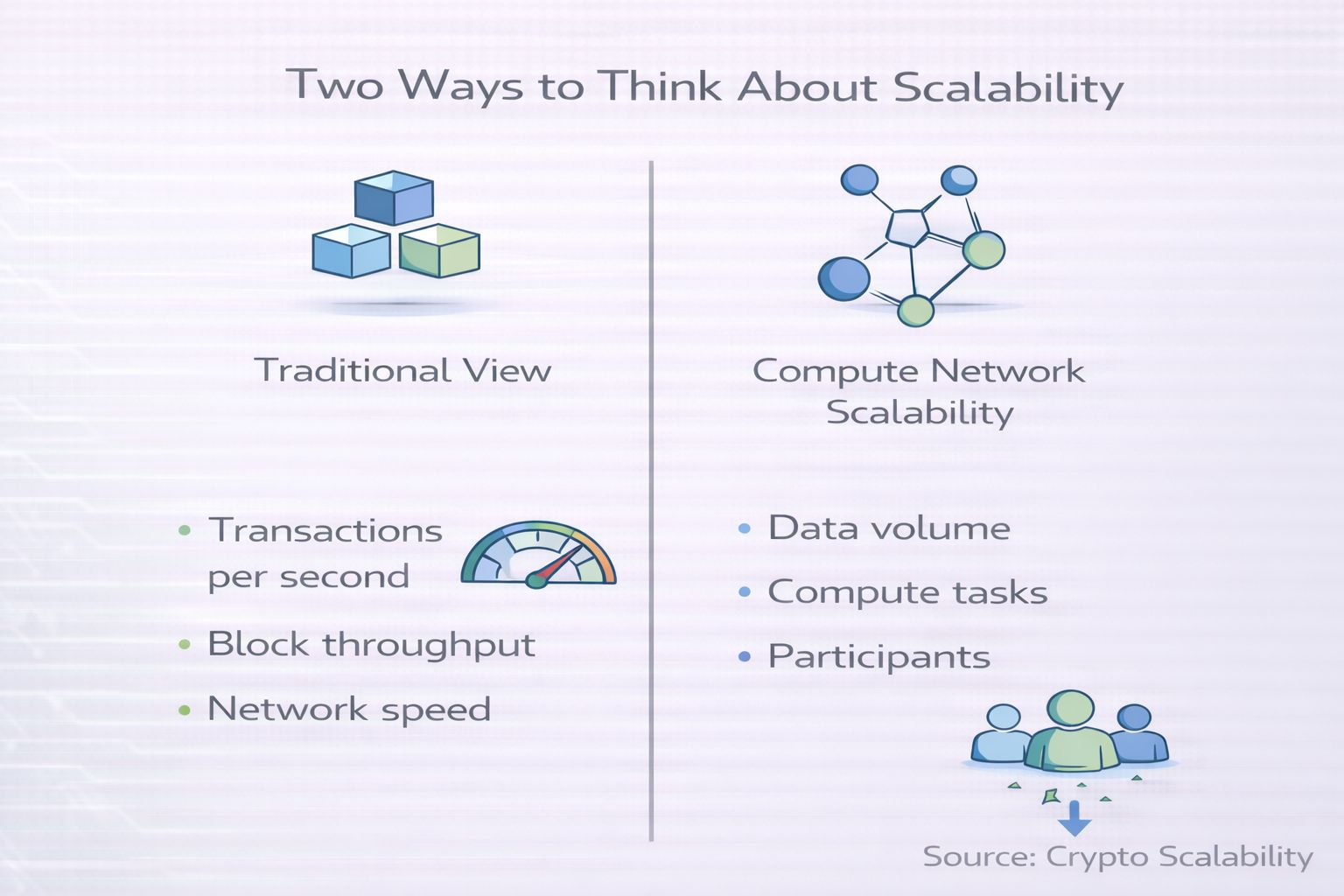
But scalability in networks that coordinate computation isn’t just about processing more transactions. It’s about handling more work — more data, more compute tasks, more participants — without the system collapsing under its own complexity.
And that kind of scalability is harder to measure.
Traditional blockchains struggle here because they try to do everything inside the chain itself. Every transaction, every contract interaction, every state update competes for the same block space. That design creates a natural bottleneck. As demand grows, fees increase and latency becomes a problem.
For financial transactions, that tension is manageable.
For computational workloads, it becomes restrictive.
MIRA seems to approach the problem differently. Instead of forcing all activity directly onto the blockchain, it treats the chain more like a coordination layer. The heavy computational work — model inference, data processing, complex calculations — can happen off-chain across distributed nodes.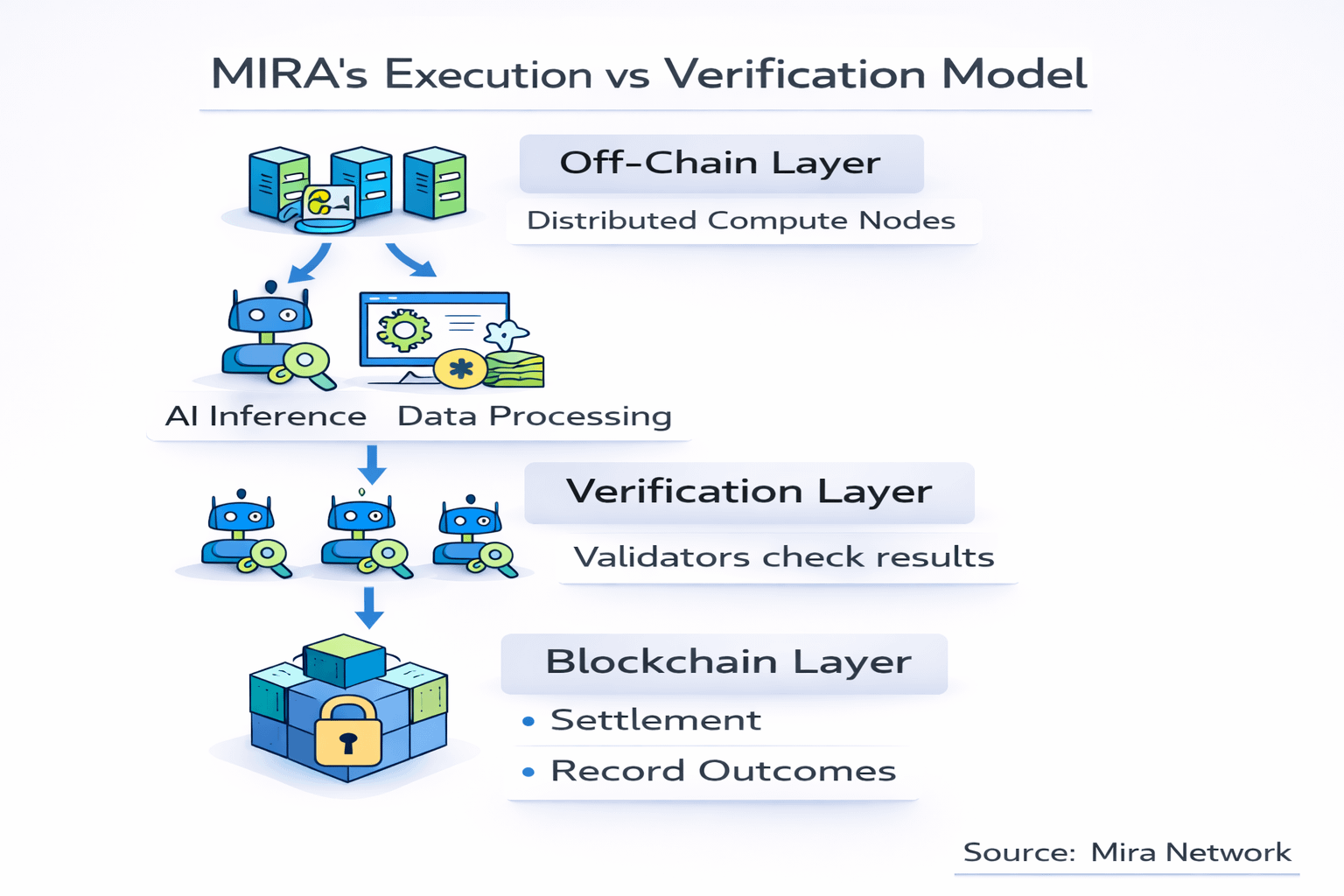
What the network focuses on is verification and settlement.
That distinction matters because computation is far more resource-intensive than transaction ordering. If every piece of compute had to be executed and validated inside a blockchain environment, scalability would collapse almost immediately.
By separating execution from verification, MIRA attempts to distribute the workload.
Nodes perform tasks off-chain. Results are submitted. Validators confirm that the outputs match expected parameters, potentially using cryptographic proofs or verification mechanisms. The blockchain records outcomes and economic settlement rather than raw computation itself.
In theory, this allows the network to scale more gracefully.
But theory is always the easy part.
Distributed systems introduce their own challenges. Coordinating independent nodes means dealing with inconsistent performance, network delays, and varying hardware capabilities. Some nodes will be faster than others. Some will behave unpredictably. Some may attempt to manipulate results.
A scalable system has to account for those realities.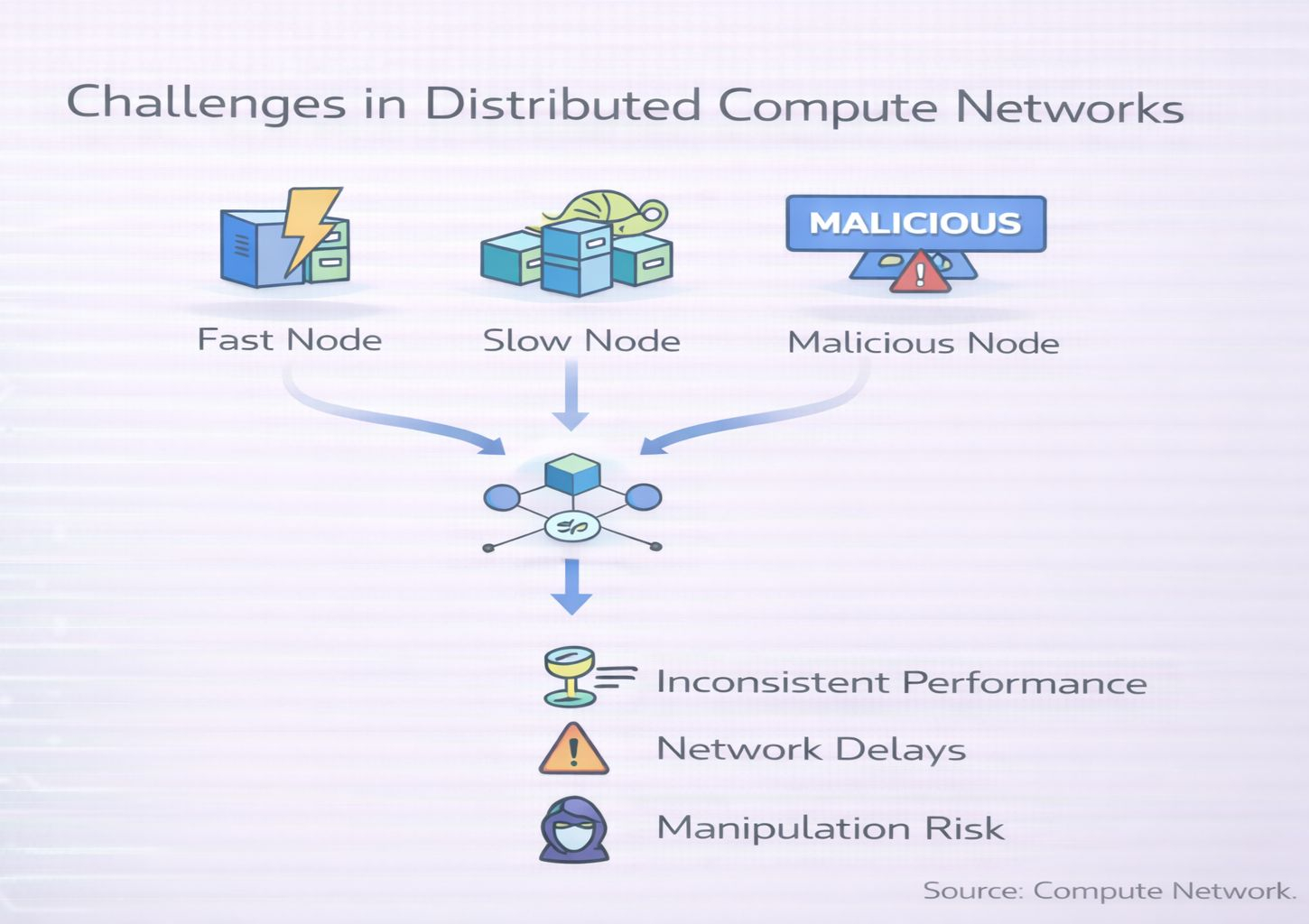
MIRA’s design appears to rely on economic incentives and verification structures to maintain integrity. Nodes are rewarded for contributing compute resources. Validators confirm results. Participants who behave maliciously risk penalties or exclusion from the network.
That incentive structure is meant to keep the system reliable even as participation expands.
Still, scalability isn’t just technical — it’s economic.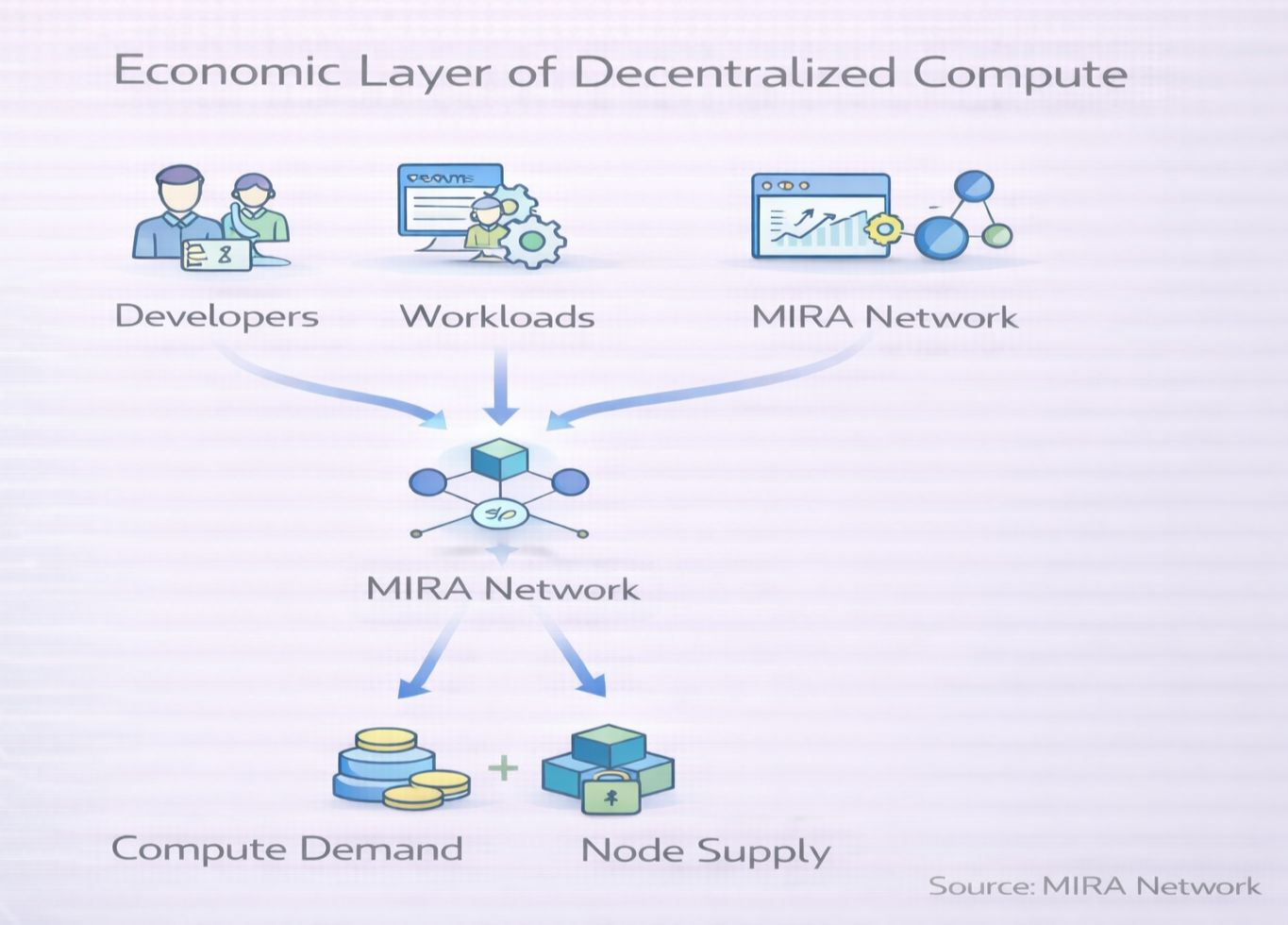
For a decentralized compute network to grow, tasks must actually exist. Developers need workloads to submit. AI teams need reasons to outsource computation to a distributed network rather than relying entirely on centralized cloud providers.
If the network has capacity but limited demand, scalability becomes theoretical.
Another subtle challenge is coordination overhead. As the number of participants increases, communication complexity rises. Nodes must discover tasks, validate results, and synchronize with the network. Efficient coordination protocols are critical, otherwise the system spends more time organizing itself than doing useful work.
MIRA seems aware of this balance.
Rather than trying to outcompete traditional cloud infrastructure purely on speed, the network appears to emphasize verifiability and distributed trust. The value proposition isn’t just raw performance. It’s the ability to prove that computation happened correctly in an open environment.
That trade-off changes how scalability should be evaluated.
A centralized cloud provider can scale massively by adding hardware under unified control. A decentralized network has to coordinate independent actors who may have different incentives and capabilities. The architecture must scale socially as well as technically.
That’s the real challenge.
Another layer is governance. As networks scale, parameters often need adjustment — reward structures, validation thresholds, node requirements. If governance mechanisms are slow or contentious, scalability improvements become difficult to implement.
Infrastructure doesn’t just need capacity. It needs adaptability.
What stands out about MIRA’s approach is that it doesn’t seem to promise instant massive throughput. The design looks more like a gradual expansion model: distribute computation across many nodes, verify results efficiently, and allow the system to grow as real workloads appear.
That patience might frustrate people expecting immediate performance breakthroughs.
But sustainable scalability rarely comes from a single technical trick.
It usually emerges from a combination of architecture, incentives, and real-world usage patterns evolving together.
MIRA’s approach suggests that scalability isn’t about making the blockchain do more.
It’s about letting the blockchain do less — while coordinating a much larger system around it.