
As we move deeper into 2026, the artificial intelligence industry is entering a new phase. The early excitement around AI creating impressive content and solving complex problems has gradually shifted toward a more serious challenge: trust. While AI systems have become extremely powerful, they still suffer from a critical flaw — they can produce confident answers that are completely incorrect. This issue, often described as AI hallucination, has become a major barrier to using AI in sensitive sectors like finance, healthcare, and legal services.
To unlock the next stage of AI adoption, the ecosystem needs a reliable way to verify whether AI-generated information is actually correct. This is where Mira Network enters the picture, aiming to become a foundational trust layer for decentralized AI systems.
Building Verifiable Intelligence
Mira Network is designed as a decentralized verification protocol that focuses on validating AI outputs through cryptographic assurance. Instead of relying on centralized authorities or opaque systems, Mira introduces a transparent mechanism that evaluates AI-generated claims through a network of independent validators.
Traditional AI models operate like closed systems where users must simply trust the results they produce. Mira approaches this differently by breaking down AI responses into individual claims that can be independently verified. These claims are then analyzed by a distributed set of validator nodes that cross-check the information using multiple AI models and external data sources.
At the core of this mechanism is Proof of Verification, a system that replaces energy-heavy mining or arbitrary computational puzzles. Validators participate by confirming the accuracy of AI outputs. Those who provide reliable verification are rewarded with $MIRA tokens, while validators who submit incorrect validations risk losing their staked assets. This economic incentive structure encourages accuracy and honesty across the network.
Expanding Real-World Applications
The network reached a significant milestone in early 2026, when its mainnet began processing over 3 billion tokens daily. This level of activity highlights growing demand for verifiable AI infrastructure.
Several practical tools are already being built within the ecosystem. Klok serves as a multi-model AI interface that integrates different AI systems into a single environment. Meanwhile, WikiSentry focuses on fact-checking by using the network’s verification process to confirm the accuracy of AI-generated information.
Internal testing has also demonstrated major improvements in AI reliability. In some cases, the verification layer has helped increase output accuracy from approximately 70% to nearly 97%, showing how decentralized verification can dramatically improve AI trustworthiness.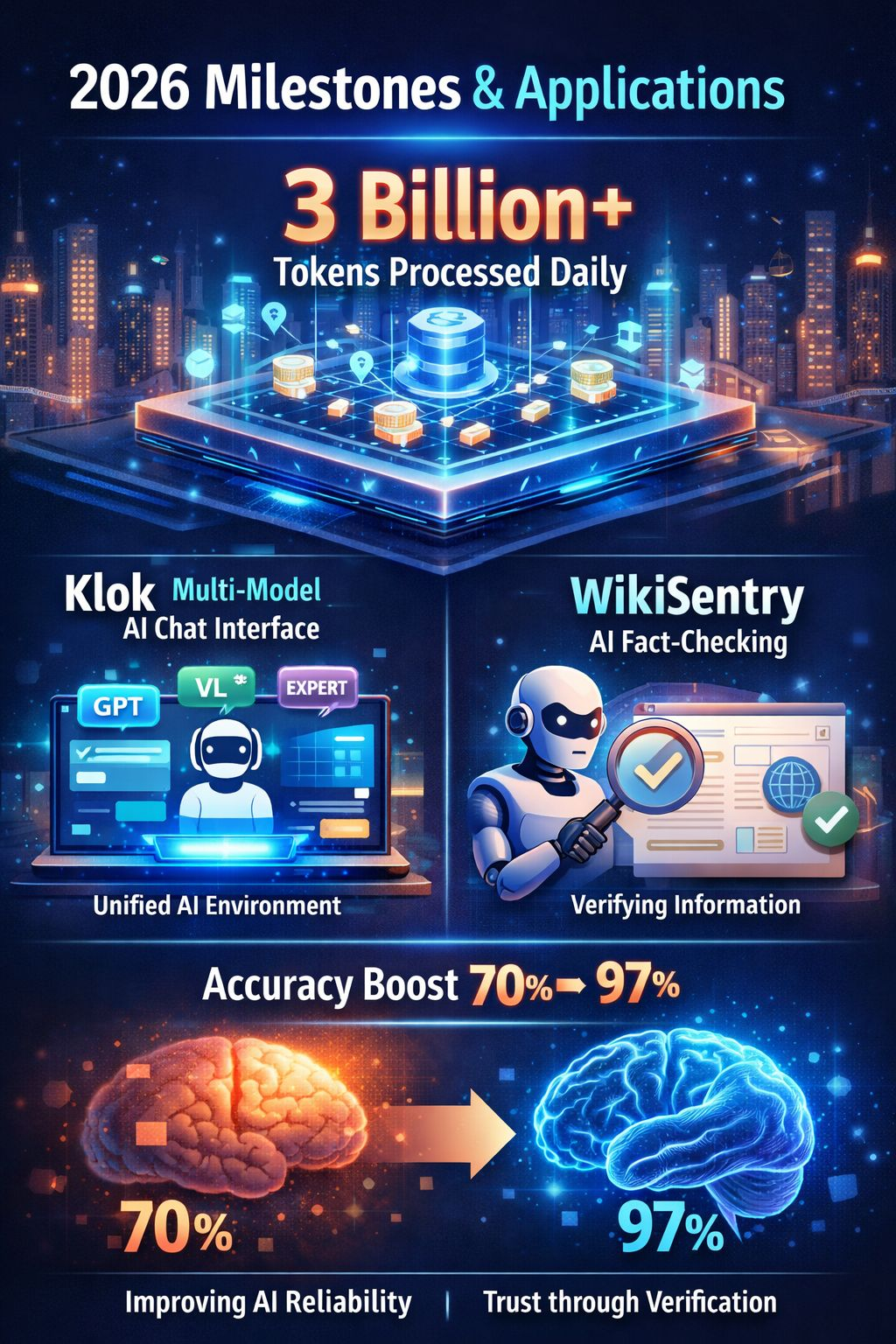
Strengthening the Ecosystem
Mira has continued expanding its developer ecosystem through multiple initiatives.
The Mira SDK, introduced toward the end of 2025, allows developers to build AI-powered applications using Web3 infrastructure. The development experience aims to feel similar to modern deployment platforms, enabling teams to launch AI tools with integrated blockchain-based payments and verification layers.
In addition, Mira has partnered with decentralized storage solutions to ensure that verified AI proofs remain permanently accessible on-chain. This guarantees transparency and creates an immutable record of AI verification processes.
The Vision: Verified Autonomous Systems
Looking ahead, Mira’s long-term vision revolves around verified autonomy. As AI agents begin handling financial transactions, managing digital assets, and executing smart contracts, ensuring their decisions are trustworthy becomes critical.
By transforming probabilistic AI outputs into verified and traceable information, Mira Network aims to establish a system where both humans and autonomous AI agents can operate with confidence. In such an environment, decentralized verification acts as a safeguard, ensuring that intelligent systems remain accountable and reliable.
If successful, Mira could become a core infrastructure layer for the future of decentralized AI — enabling collaboration between humans and machines in a system built on transparency, accuracy, and trust.