There’s something a little strange about the way we talk about Web3.
Spend enough time around the space and you’ll hear the same phrases over and over again. Decentralization. Self-sovereignty. The future of ownership. It all sounds impressive, and in theory, a lot of it makes sense. But the longer you look at how things actually work, the more you notice a pretty uncomfortable gap.
We talk about freedom a lot in Web3.
What we don’t talk about nearly enough is responsibility.
Because once you step past the slogans, a simple question shows up: who is actually accountable when something breaks?
Right now, the honest answer is… not many people.
The promise of Web3 has always been appealing. You control your assets. You participate in governance. Middlemen disappear. Everything runs through code instead of institutions. In theory, that should make systems more trustworthy.
But in practice, things are a lot messier.
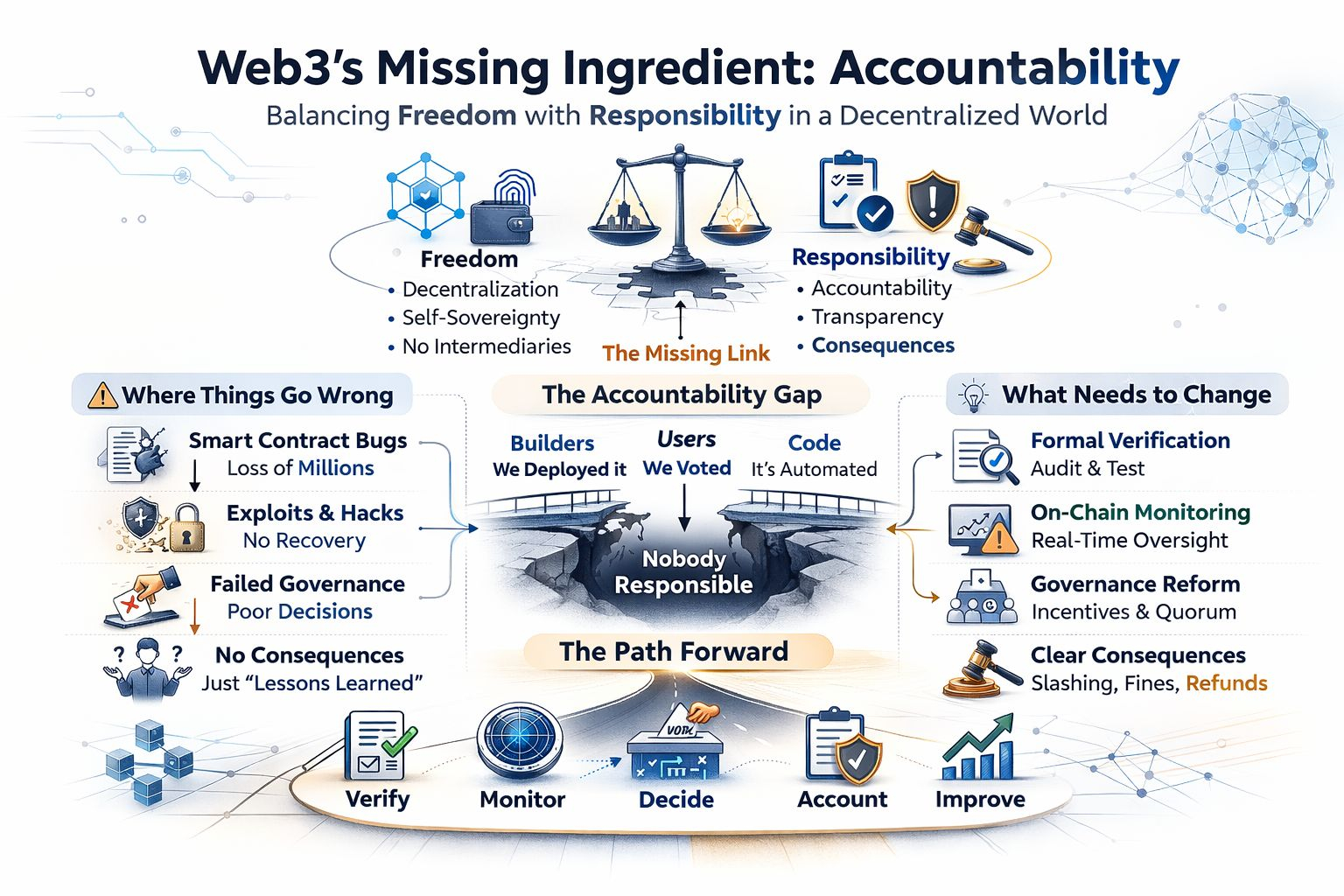
A bug in a smart contract can wipe out millions before anyone even realizes what happened. Protocols get exploited. Bridges collapse. Data feeds fail. And when that happens, the response is often the same: people argue for a few days on Twitter, someone posts a thread explaining what went wrong, and eventually the whole thing fades into the background.
No refunds. No real consequences. Just another lesson learned.
It’s not exactly the kind of stability you’d want if these systems are supposed to support real economies someday.
DAOs are a good example of this strange dynamic. They were introduced as a kind of digital governance experiment. The idea was simple enough: token holders vote, decisions happen collectively, and the system runs without centralized control.
And sometimes it works.
But other times voting barely happens at all. Or decisions get pushed through by a handful of large holders. Or proposals pass that nobody fully thought through.
And when things go wrong, there isn’t really a clear place where responsibility lands.
The code executed the vote exactly as written. The voters technically approved it. The builders say they only implemented the system. Everyone was involved, but no one is really accountable.
It creates a strange kind of vacuum.
Meanwhile, the bigger ecosystem keeps growing. More DeFi platforms. More automated systems. More infrastructure layered on top of infrastructure. Billions of dollars moving through software that, in many cases, still behaves like an experiment.
That’s where the conversation about accountability starts to matter.
Not in a dramatic way. Not as some philosophical debate about decentralization. Just in a practical sense: if systems are going to coordinate money, data, and decisions at scale, there has to be some way to verify that things are actually working the way they’re supposed to.
And more importantly, there have to be consequences when they aren’t.
This is the kind of problem a project like Fabric Protocol is trying to focus on.
It’s not particularly flashy, which might actually be the point. Instead of promising a brand-new financial universe or some revolutionary platform, the goal is much more basic: making sure the underlying coordination between systems is verifiable.
Fabric, through the Fabric Foundation, tries to align data, computation, and regulatory logic through a shared ledger. In simple terms, it creates a structure where claims about what happened in a system can actually be checked.
That might sound boring compared to the usual Web3 narratives. But boring infrastructure is usually what keeps systems from falling apart.
The space probably needs more of that.
For a long time, the culture around Web3 borrowed a lot from startup culture: move fast, experiment constantly, break things if you have to. That approach made sense when the stakes were small and everything was still new.
But things are different now. There’s too much value moving through these systems to treat them like permanent prototypes.
If Web3 is going to mature into something people actually rely on, the conversation has to shift a little. Less focus on slogans. More focus on whether the systems we’re building can stand up to real pressure.
Decentralization by itself isn’t enough.
Coordination without accountability eventually stops working.
And the future of Web3 will probably depend less on bold promises and more on the quiet infrastructure that makes those promises hold up in the real world.
$ROBO @Fabric Foundation #ROBO