STONfi and the Stablecoin Surge on TON — why liquidity, routing, and real-time settlement matter
Stablecoins don’t become powerful simply by existing on a chain — they become powerful when they move. On TON, that movement has been rapid: USDT’s rollout and integration into Telegram-driven payments created both rising supply and continuous transactional flow — the two ingredients that turn a deployed token into a functioning payments rail. Tether’s support for USDt on TON and the TON Foundation’s integration efforts have driven broad accessibility and many third-party integrations.
That traffic creates instant practical needs. When users receive USDT, they don’t want to sit on it — they want to convert, hedge, route into apps, or use it to buy tokenized shares and in-app goods. Protocols and applications, in turn, need reliable, low-slippage execution and deep liquidity to handle those flows. Without it, rising supply plus fast usage means fragmentation, poor pricing, and failed UX.
Why STONfi matters
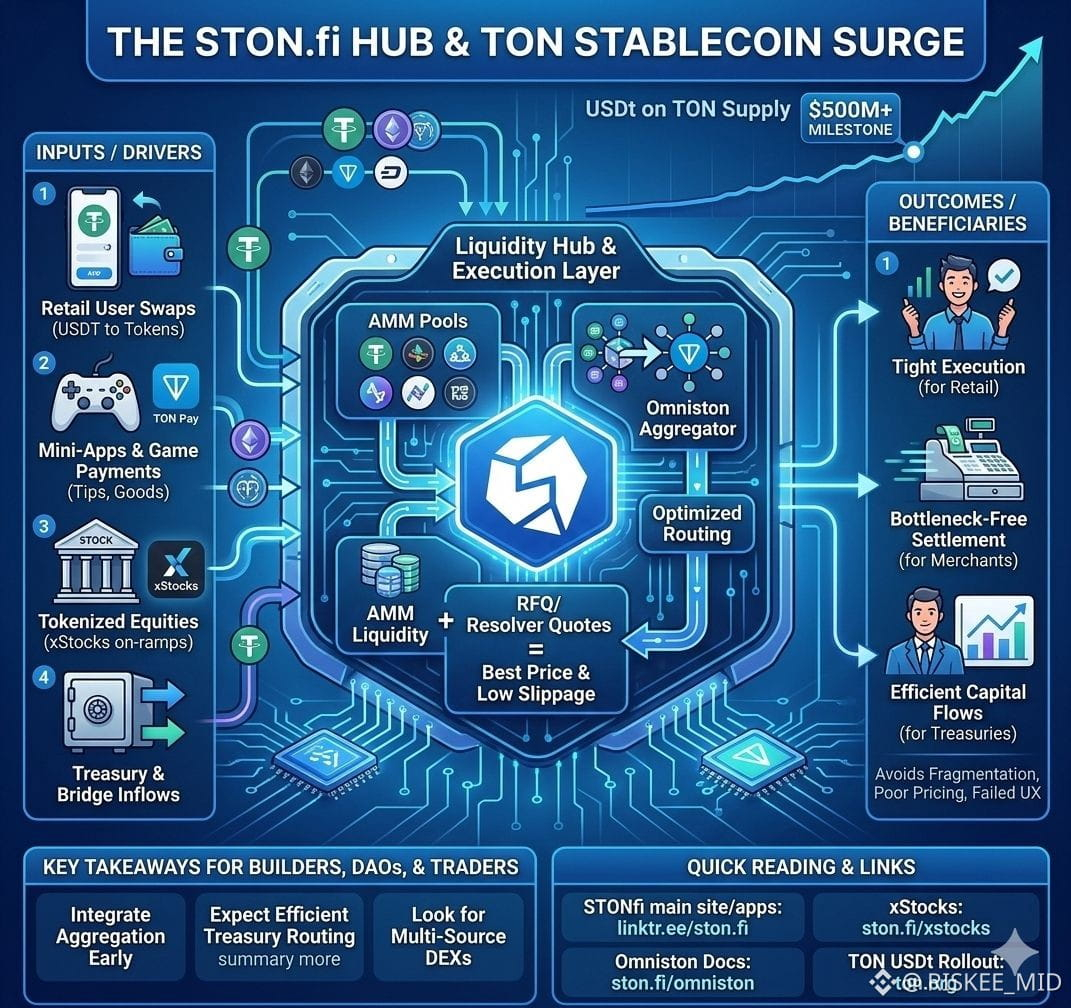
STONfi is no longer just an AMM interface — it’s evolved into a liquidity hub and an execution layer for TON flows. Through its on-chain pools and the Omniston aggregation engine, STONfi can combine on-chain AMM liquidity and RFQ/resolver quotes into a single execution path, giving traders and apps better prices and less slippage on large or frequent transfers. This aggregation is exactly what a high-velocity stablecoin rail needs to avoid fragmentation and to act as a dependable settlement layer.
Practical outcomes:
Retail users swapping USDT into ecosystem tokens see tighter execution because routing can pull liquidity from multiple pools automatically.
Games, mini-apps, and merchants using TON payment primitives can convert incoming stablecoins into local liquidity or treasury assets without creating a bottleneck for settlement.
Treasury managers and bridges routing capital in and out of TON get access to aggregated liquidity that reduces slippage on larger rebalancing trades.
One concrete data point: USDT supply on TON crossed early milestones quickly (reports noted the supply passing $500M in the months after rollout), which illustrates both demand and the volume of capital that needed efficient routing.
Where tokenized equities and stablecoins intersect
Tokenized stocks and ETFs — represented on TON as projects like xStocks — create natural on-ramps for stablecoins. Users and apps that receive stablecoins can instantly route value into tokenized equity exposure (or vice versa). That interoperability increases the number of on-chain market participants and the velocity of stablecoins, further raising the bar for execution quality and liquidity aggregation. Industry launches of xStocks and similar tokenized equities make this use case tangible.
The payments layer: Telegram + TON Pay
A major reason for velocity on TON is the messaging network itself. Telegram is the distribution channel: wallet UX, mini-apps, and the recently publicized TON Pay SDK make micro-payments practical at scale inside the chat experience. That means billions in small transactions (tips, in-app purchases, merchant checkouts) can flow through stablecoins on TON — and those flows require STONfi-class routing to stay efficient.
What this means for builders and users
Builders (apps, games, marketplaces): Integrate routing and aggregation early. Don’t assume a single pool will be enough — connect to aggregators or Omniston to ensure users get consistent pricing.
Treasuries & DAOs: Expect to route stablecoin inflows through liquidity hubs to avoid slippage when reallocating to yield, staking, or tokenized assets. Aggregation protects large rebalances.
Retail traders and power users: Look for DEXs and aggregators that support multi-source routing — this materially lowers execution cost as volumes grow.
Quick reading & links
STONfi — main site / Linktree (apps, social, widgets): linktr.ee/ston.fi.
Omniston (liquidity aggregation docs & integration): ston.fi/omniston.
xStocks on TON (tokenized equities overview): ston.fi/xstocks.
TON Foundation — USDt on TON rollout and integrations: ton.org (USDt on TON articles).
Coverage of USDT supply milestones on TON: The Block reporting on supply crossing $500M after rollout.
Bottom line
If TON is becoming a high-velocity stablecoin rail, that velocity needs a deep, reliable settlement surface — not a set of fragmented pools. STONfi, by combining AMM liquidity with Omniston-style aggregation, is shaping up to be that surface: routing, pricing, and final settlement for a growing universe of payments, tokenized assets, and on-chain commerce.
#StockMarketCrash #MarketRebound