

Last month I was helping a friend understand decentralized finance. He asked a simple question that actually made me pause: “Why do I have to do everything manually?”
He was talking about the typical DeFi experience. If prices move, you adjust positions. If liquidity changes, you react. If a strategy needs rebalancing, you open the platform again and confirm another transaction.
In a system that claims to be technologically advanced, this constant manual interaction can feel surprisingly old-fashioned.
That conversation pushed me to explore projects focused on automation inside Web3, and one project that stood out was @fabric_protocol.
Instead of building another trading platform or token utility, Fabric Protocol is working on something more structural: programmable automation for blockchain activity.
The Core Idea Behind Fabric Protocol
Fabric Protocol is built around the idea that blockchain interactions should not always require human timing.
Markets move continuously. Liquidity shifts. Prices fluctuate within seconds. Yet most users must still monitor these changes and manually respond.
Fabric attempts to change this dynamic through its ROBO infrastructure, which allows users and developers to create automated on-chain actions based on predefined conditions.
In simple terms, the system enables something like smart operational rules for blockchain transactions.
Rather than reacting manually, users can design instructions such as:
Execute a transaction when a certain price level is reached
Rebalance assets when portfolio allocation changes
Adjust liquidity positions automatically
Trigger protective actions when volatility increases
These rules can then operate continuously through Fabric’s infrastructure.
From my perspective, this approach brings an important concept into Web3: predictable automation.
The ROBO Infrastructure Layer
The most distinctive feature of Fabric Protocol is its ROBO system.
ROBO acts as an automation layer that connects user-defined logic with blockchain execution. Instead of users signing every transaction individually, the system can handle processes according to programmed instructions.
This architecture introduces a few interesting possibilities.
First, it reduces the need for constant monitoring. DeFi users often spend time checking positions and waiting for the right moment to act. Automation could remove much of that friction.
Second, it allows developers to build more advanced financial strategies directly into decentralized applications.
Instead of offering only static tools, platforms could integrate automated logic powered by Fabric’s infrastructure.
In this sense, Fabric does not compete with DeFi protocols. Instead, it tries to enhance how those protocols operate.
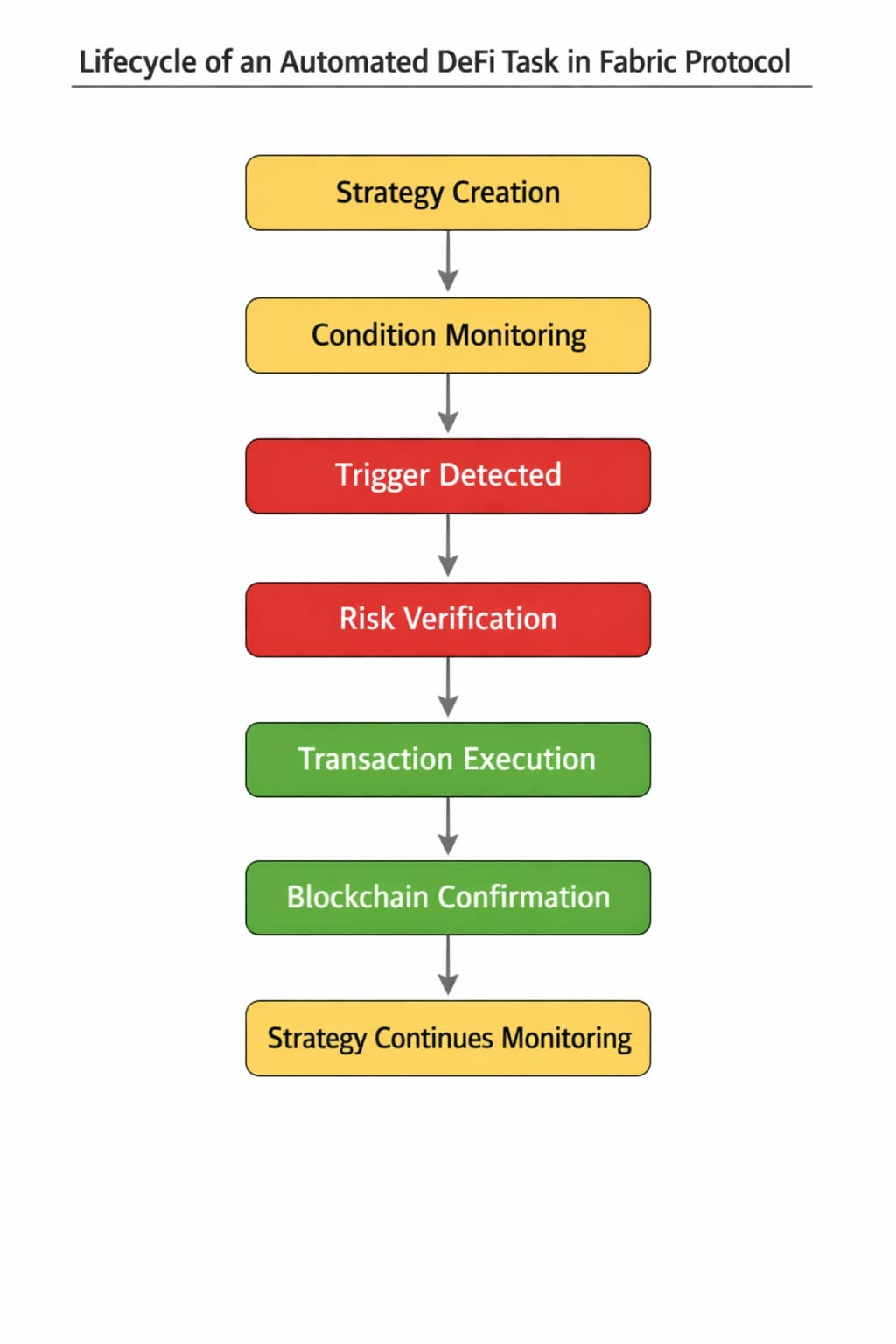
Practical Use Cases
To understand the value of Fabric Protocol, it helps to imagine real scenarios.
Consider a liquidity provider participating in multiple pools. Normally, that user must watch yield rates and manually move liquidity when returns decline.
With automation, the system could shift liquidity automatically when yield conditions change.
Another example involves risk management. Traders often use stop-loss mechanisms in traditional markets. Similar strategies could be implemented in decentralized environments through automated rules.
Fabric’s system could allow users to define conditions where protective actions are triggered during sudden price movements.
Even long-term investors might benefit. Portfolio rebalancing which typically requires manual adjustments could happen automatically according to predefined asset allocations.
These examples illustrate how automation could make DeFi feel less reactive and more structured.
Opportunities for Developers
While automation benefits users, it may be even more significant for developers.
Building automation tools from scratch can be complex. It requires handling transaction triggers, security considerations, and execution logic across different networks.
Fabric Protocol offers the possibility of integrating automation as a shared infrastructure layer.
Developers could focus on building their applications while relying on Fabric to manage automated execution processes.
This could accelerate development cycles and encourage more sophisticated decentralized applications.
If this model gains adoption, Fabric might gradually become a foundational layer supporting multiple Web3 services.A Broader Ecosystem Perspective
One thing I find interesting about infrastructure projects like Fabric Protocol is that they often operate quietly in the background.
Consumer applications attract attention because users interact with them directly. Infrastructure layers, however, become important only after many projects begin integrating them.
If automation becomes a standard expectation within decentralized finance, systems like Fabric could gradually become part of the normal operational stack.
In other words, Fabric’s success may not depend on flashy announcements but on steady integration across different platforms.
Personal Thoughts
After spending time reading about automation tools in Web3, I realized something simple: the future of decentralized systems may depend not only on innovation but also on reducing friction.
People are more likely to adopt technologies that simplify their workflows rather than complicate them.
Fabric Protocol addresses a practical issue many users experience but rarely articulate the need for smarter interaction with blockchain systems.
Instead of constantly watching screens and reacting to market movements, automation could allow users to focus on strategy rather than execution.
From my perspective, that shift alone could make decentralized finance feel far more accessible.
Projects like #Fabric_Protocol may not always dominate headlines, but they contribute to something equally important: making the Web3 ecosystem more efficient, structured, and user-friendly.
And sometimes, the quiet infrastructure improvements are the ones that shape the future the most.
@Fabric Foundation #ROBO $ROBO