

There are plenty of projects in crypto that sound ambitious when you first hear about them. Fabric Protocol was one of those names for a while something people referenced in threads and discussions about the future of robotics, automation, and decentralized coordination. But recently, it has started to feel less like an abstract idea and more like something the market actually has to think about.
Not because another token launched. Tokens launch every day.
What makes Fabric interesting is that it’s trying to tackle a problem most crypto projects quietly avoid: coordination in the physical world. And when coordination happens in the physical world, failure carries consequences that go beyond price charts or sentiment cycles.
If a decentralized exchange fails, users lose money. That’s painful, but it’s contained.
If a network coordinating robots fails, something much more tangible can break delivery routes collapse, warehouse systems stall, inspections go unfinished, and physical operations grind to a halt. The stakes are simply different.
That difference is what makes Fabric’s thesis worth examining.
Robotics Isn’t Just a Hardware Problem Anymore
For years, robotics conversations revolved around hardware limitations sensors, motors, navigation systems, compute. But those curves have been steadily improving. Hardware is becoming more capable, cheaper, and increasingly modular.
What’s emerging as the real bottleneck isn’t mechanical capability.
It’s coordination and accountability.
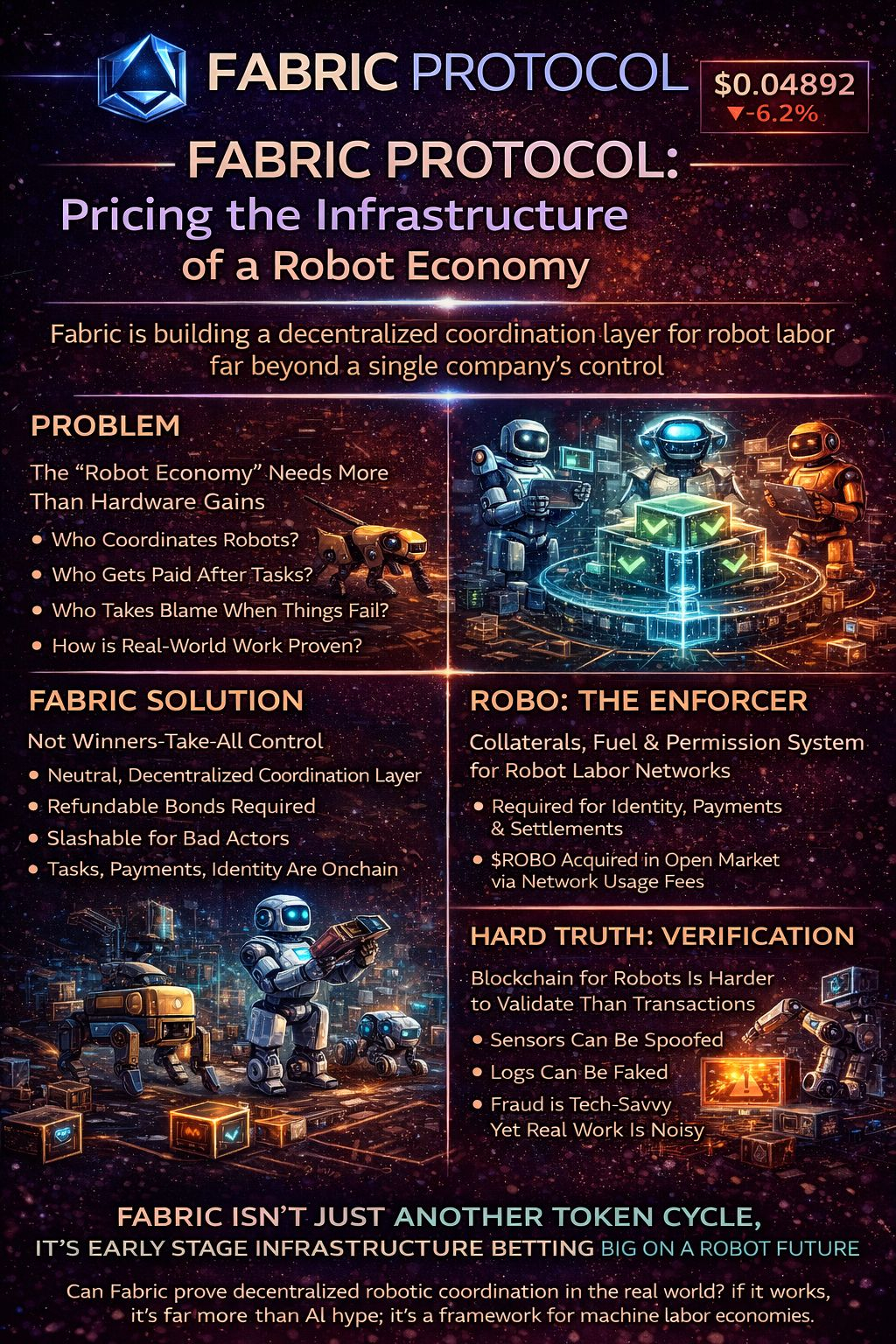
Once robots start performing meaningful work deliveries, warehouse operations, facility inspections, security patrols, tele-operated tasks, or environmental data collection a new set of questions appears:
Who coordinates the machines?
Who assigns work?
Who gets paid when a task is completed?
Who gets blamed when something fails?
And how do you prove what actually happened?
Traditional platforms solve these questions with centralized control. One company owns the network, controls participation, collects the data, and arbitrates disputes. That approach scales quickly, but it also produces predictable outcomes: a handful of companies end up controlling the entire operational stack.
Fabric’s premise is a rejection of that model.
Instead of building another closed platform, the protocol is attempting to construct a neutral coordination layer — a shared infrastructure where robots, operators, and clients can interact under transparent rules. Identity, economic commitments, and verifiable work records become the mechanisms that hold the system together.
It’s a very crypto-native answer to a very real-world coordination problem.
Robots Can’t Open Bank Accounts But They Can Hold Keys
One of Fabric’s simplest ideas is also one of its most powerful.
Robots can’t open bank accounts. But they can hold cryptographic keys.
If a machine can hold a key, it can sign messages. If it can sign messages, it can interact with smart contracts, receive payments, record activity, and settle obligations.
From that foundation, the rest of the system begins to make sense.
A robot identity registry links machines to cryptographic identities. Those identities can request tasks, verify work, receive payments, and establish reputational history. Operators manage machines, but the machines themselves can participate in the network.
On top of that identity layer sits everything else: task coordination, permissions, economic commitments, verification processes, and dispute resolution.
Fabric isn’t trying to sell artificial intelligence as its core product.
It’s trying to sell structure.
And structure, if it works, tends to outlast hype.
The Bonding Model: A Necessary Friction
Open networks have a predictable weakness: they get abused.
Anyone who has watched decentralized marketplaces evolve knows how quickly bad actors show up. Spam identities appear, fake task completions are reported, sybil accounts farm rewards, and low-effort operators degrade reliability.
Fabric’s response is straightforward: participation should require economic commitment.
Operators interacting with the network must post a refundable bond. That bond acts as collateral — something that can be slashed if an operator behaves dishonestly, fails to meet reliability standards, or attempts to exploit the system.
It’s not a glamorous mechanism, but it’s realistic.
By forcing participants to put something at risk, the network creates an economic filter. Access to demand comes with responsibility, and damaging the system becomes costly.
In that context, the ROBO token stops looking like a speculative accessory and starts looking more like infrastructure.
ROBO as Enforcement, Not Just Incentive
Tokens in crypto often serve as incentives. They attract early participation and reward users for interacting with a protocol.
Fabric’s design pushes the token into a more operational role.
ROBO sits inside several core flows of the network:
Identity registration and interaction
Participation permissions
Bonding and collateral commitments
Settlement of payments
Potential governance and protocol-level coordination
If Fabric succeeds in attracting real-world task volume, ROBO becomes something closer to a utility asset part fuel, part permission layer, part collateral instrument.
That distinction matters.
Many tokens derive value primarily from speculation. Their economic role begins and ends with trading.
Fabric’s model suggests a different possibility: value emerging from network activity rather than narrative cycles.
Of course, that only works if activity actually materializes.
The Value Capture Question
Fabric’s documentation hints at another mechanism that could shape its long-term economics.
Protocol revenue, generated from real network activity, is expected to be used to acquire ROBO from the open market. In theory, this creates a feedback loop: usage generates revenue, revenue supports token demand, and the token continues to function as infrastructure inside the system.
It’s a compelling structure on paper.
But there’s an obvious caveat.
Revenue has to be real.
Crypto history is full of projects claiming “buy pressure” without clarifying where that pressure actually comes from. Circular token flows, internal rewards, and speculative trading often masquerade as economic activity.
For Fabric’s model to work, revenue must originate from external demand organizations paying for robotic coordination, automation services, or machine labor facilitated through the network.
If that demand exists, the economics become meaningful.
If it doesn’t, token mechanics alone won’t save the system.
The Hardest Problem: Verifying Real-World Work
The real battle for Fabric isn’t token design.
It’s verification.
Blockchain transactions are easy to verify. The data exists entirely within the system. Consensus rules determine truth.
Real-world work is different.
Sensors can be manipulated. Logs can be fabricated. Environments introduce noise and ambiguity. Outcomes aren’t always binary.
A delivery robot might reach the correct location but fail to complete the handoff. An inspection robot might capture data that later turns out to be incomplete. A security patrol might cover most of its route but skip a segment.
These edge cases aren’t theoretical they’re everyday operational realities.
If Fabric leans too heavily on off-chain verification, critics will argue that the system depends on trusted intermediaries. If it attempts to force everything on-chain, it risks becoming impractical for real machines.
The only workable approach is layered.
Cryptographic proofs make manipulation harder. Economic penalties make cheating expensive. Practical integrations with sensors, logs, and operators provide operational context.
It’s not a quick solution.
It’s an engineering challenge that unfolds over years.
Early Days, Real Questions
Right now, Fabric sits at an early stage.
The market is being asked to evaluate something unusual: not just a token, but the possibility of a decentralized coordination layer for machine labor.
That’s a specific bet.
The question isn’t whether automation will grow. That trend is already visible.
The question is whether robots and operators will need open systems for identity, task assignment, payment, and dispute resolution systems that aren’t controlled by a single platform.
If Fabric can demonstrate reliable coordination under adversarial conditions honest reporting, enforceable bonds, consistent uptime, fair dispute outcomes it could become foundational infrastructure for an emerging machine economy.
If it can’t, the pattern will look familiar.
Speculation arrives first. Attention follows. Reality takes longer to catch up. Eventually, the gap between narrative and execution becomes impossible to ignore.
Watching for the Boring Signals
At this stage, the signals worth watching aren’t dramatic announcements.
They’re small operational milestones:
Bonds that actually deter bad actors
Verification mechanisms that withstand manipulation
Real task volume moving through the network
Dispute systems that resolve conflicts transparently
These are quiet indicators of infrastructure taking shape.
If Fabric delivers them consistently, it won’t need marketing theatrics. The system will speak for itself.
And in crypto where noise often overwhelms substance quiet infrastructure can sometimes carry the most weight.
For now, the market is being asked to price a possibility.
Machines performing real work will eventually need coordination, settlement, and enforcement mechanisms that extend beyond individual companies.
If Fabric becomes that layer, the implications stretch far beyond one token or one protocol.
If it doesn’t, it will join the long list of ideas that sounded compelling before the friction of reality set in.
Either way, the experiment has begun.