
I learned the hard way that the flashiest crypto dashboards can also be the most misleading. A few cycles ago, I bought into a “real usage” story because the numbers looked flawless—wallets climbing, volume spiking, everyone celebrating. But once the incentives faded, the project quietly turned into a ghost town. The wallets were still there, but nothing meaningful was happening.
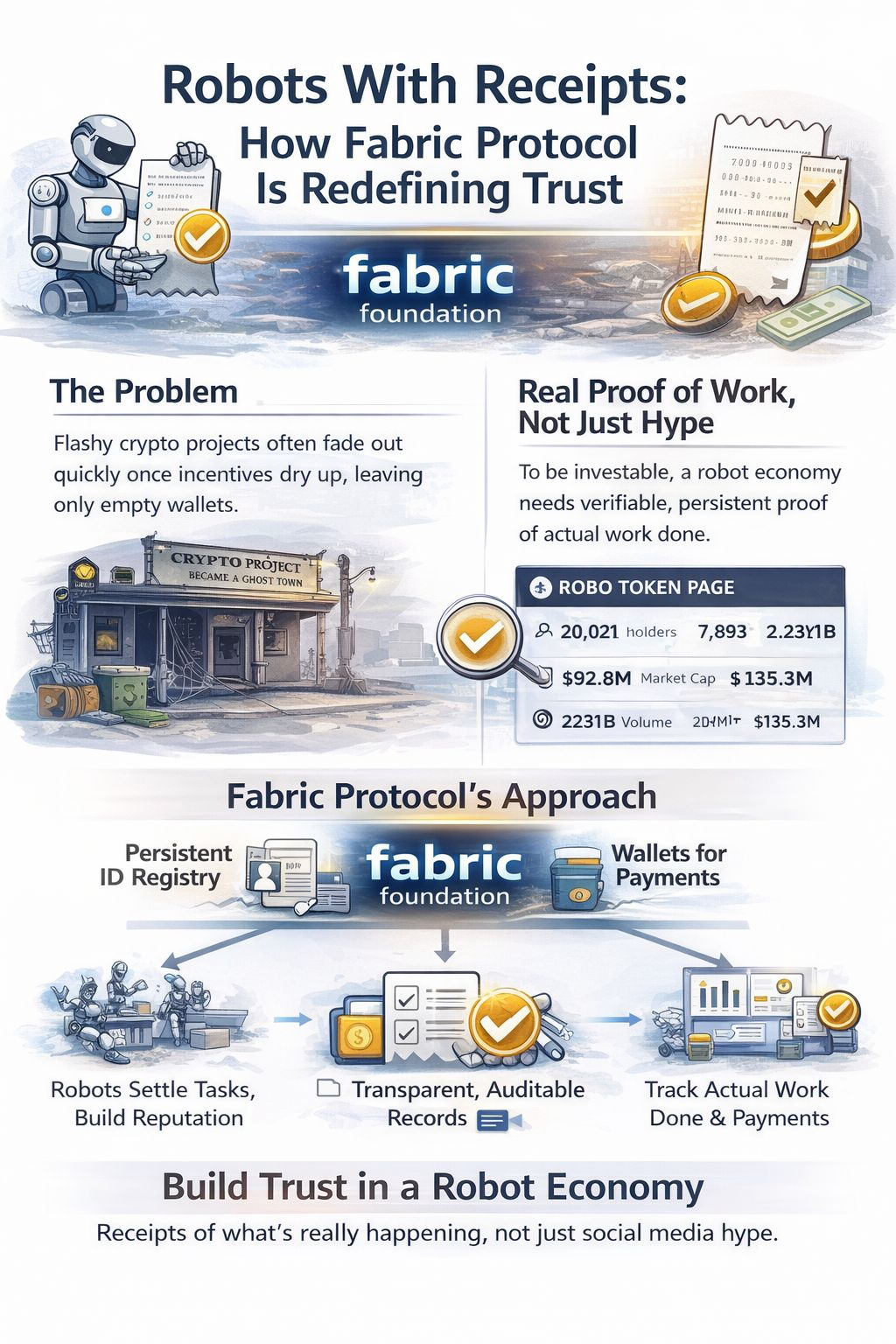
That’s why the phrase “robots with receipts” resonates differently for me. If you’re going to believe in a robot economy story, you need actual proof: evidence that work was done, proof of who did it, and confirmation that the activity persists even after the marketing push disappears.
This is what Fabric Protocol is aiming to make feel ordinary. The way I see it, robots don’t just need software—they need accountability. Fabric frames it as giving robots persistent identity, wallets for settling payments, and a transparent coordination layer so that participation is consistent and auditable. The protocol proposes an on-chain registry to track identity and history, along with on-chain settlement that lets machines get paid or cover services like maintenance or compute without a human in the loop. If you’re trading, the easy trap is to treat this like any other story—just attach a multiple to “AI plus robotics” and move on.
I think that misses the real question: can this generate verifiable, repeatable usage that lasts beyond the first wave of attention? As of March 6, 2026, the token activity isn’t imaginary. The Ethereum token page shows roughly 20,021 holders and about 7,893 transfers in the past 24 hours, with a market cap near $92.8M and 24-hour volume around $135.3M, while circulating supply sits at 2.231B ROBO. That’s a lot of surface-level action—but surface activity is exactly where people get misled. The retention problem is simple: early liquidity and initial transfers can be genuine, yet still mostly churn from onboarding new participants.
A robot economy only becomes truly investable when the same participants return repeatedly to handle the routine work—settling tasks, registering identities, paying for services, building reputation—and keep doing it long after the initial wave of listings and social hype fades. Fabric’s own blog acknowledges the hardest part: real-world deployment partnerships, operational maturity, insurance coverage, and reliable service contracts. That’s exactly where most DePIN projects either prove themselves or fall apart. What could go wrong? Plenty, even if the underlying idea is solid. You can generate “receipts” showing transactions occurred, but that doesn’t guarantee they represent meaningful work. You can end up with a fragmented system where identity exists on-chain while actual deployments remain permissioned and off-chain.
You can end up with governance being captured, where incentives shift toward speculation instead of supporting the network itself. Even the most well-planned roadmap can stall if integration turns out harder than expected, or if real operators resist sharing transparent performance data. And now that ROBO is in the exchange spotlight, Binance’s listing announcement brings both higher visibility and the usual risks: volatility and rapid rotation. What I’m tracking is deliberately mundane. Holder growth that isn’t just scattered airdrops, transfer activity that doesn’t collapse after the first month, and signs that protocol-level actions actually tie to task completion, not just trading cycles. If those patterns persist over weeks and stretch into quarters, that’s when I start to feel more confident.
If activity drops the second incentives cool off, I pivot quickly. If you’re trading ROBO, think of it as an engineering wager, not a catchy slogan. Open the token page, track holders and transfers, read the foundation’s statements on identity and settlement, and decide for yourself what counts as real retention. In a robot economy, trust isn’t a feeling—it’s a tangible receipt you’re willing to stake on.$ROBO @Fabric Foundation #ROBO