
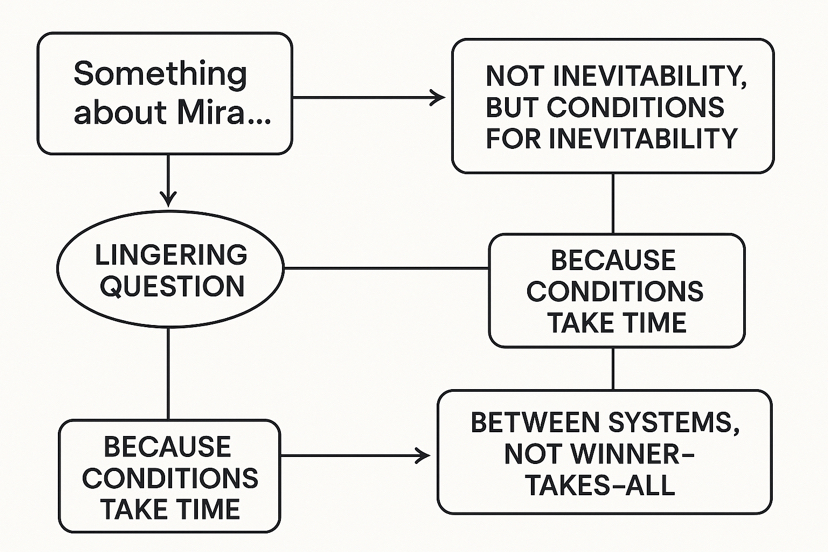
Something about Mira keeps pulling my attention back — not excitement, not conviction… more like a lingering question.
And honestly, I think that’s the right emotional state for infrastructure.
If something is obviously brilliant this early, it usually isn’t infrastructure. It’s marketing.
Mira doesn’t market inevitability. It feels like it’s trying to build conditions for inevitability. That’s a very different strategy, and it’s harder to evaluate from the outside.
Because conditions take time.
Right now most people still look at Mira through the wrong lens. They’re asking whether it will “win.” Whether it will outperform other chains. Whether the token narrative will catch momentum.
But Mira doesn’t look like a “winner-takes-all” design to me.
It looks like something that wants to sit between systems rather than replace them.
That positioning is subtle, but powerful if executed properly. Infrastructure that connects layers tends to survive longer than infrastructure that tries to dominate them.
Still… that’s theory.
And crypto has a long history of beautiful theory that never became economic reality.
The uneasy part for me is this: Mira’s success probably won’t be visible in price first. It will show up in dependency patterns — other protocols quietly building around it, routing through it, relying on it without constantly announcing it.
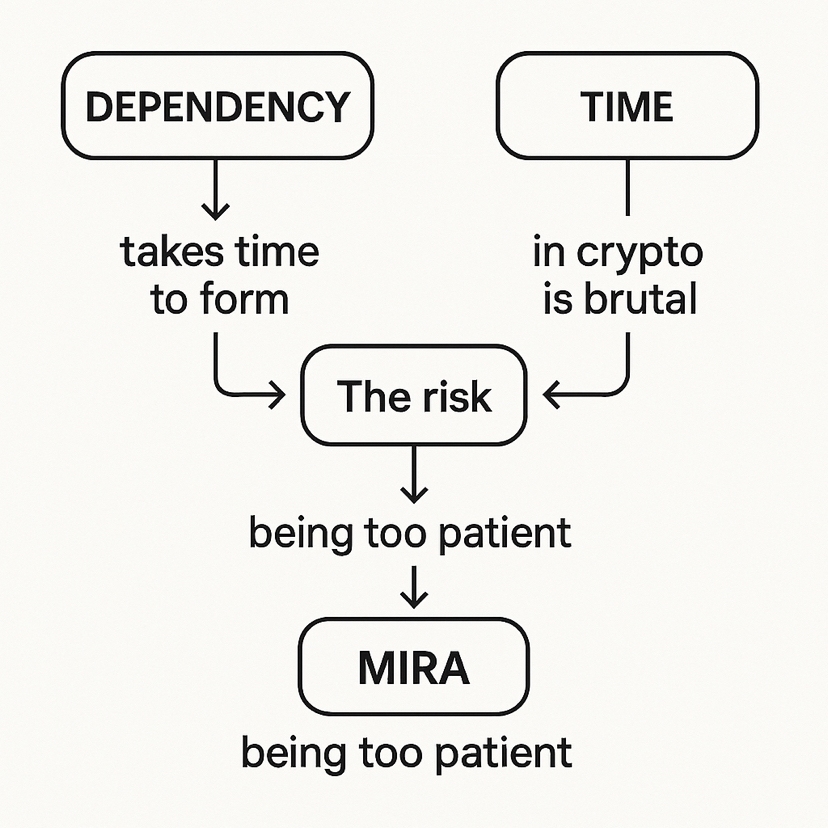
But dependency takes time to form.
And time in crypto is brutal. Narratives rotate faster than architecture matures. Liquidity moves faster than ecosystems stabilize. Projects that require patience often struggle to hold attention long enough to prove themselves.
That’s the real risk here.
Not that Mira is poorly designed — quite the opposite. The risk is that it might be too patient for a market addicted to immediate validation.
And yet, patience is exactly what infrastructure requires.
So I keep coming back to the same uncomfortable middle ground: Mira might be building something meaningful… but meaningful doesn’t automatically become necessary.
The gap between those two states is where most projects stall.
What I’m watching isn’t announcements or partnership graphics. I’m watching whether the ecosystem starts behaving as if Mira is already part of its default stack.
When that shift happens, people usually notice too late.
Until then, the signals remain faint.
Which leaves the whole thing feeling slightly unresolved — like a system that hasn’t decided how visible it wants to be yet.
#Mira @Mira - Trust Layer of AI $MIRA
