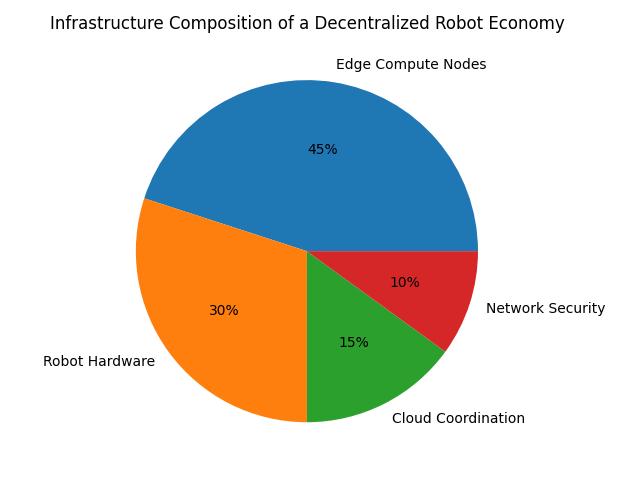
Latency is the silent killer of physical labor. As we navigate the early hours of March 6, 2026, the ROBO chart is showing a fascinating consolidation phase near the $0.0413 level after its explosive launch volatility. Traders are fixated on the turnover ratio, which remains remarkably high at 1.40, but the real story for long-term investors isn't in the 24-hour volume of $121 million. Hmmm... no, the real story is about how these machines actually "think" when they are operating in the world of atoms. We have spent the last decade building a cloud-centric world, yet the Fabric Foundation is betting everything on the opposite: edge computing. This isn't just a technical preference; it is a fundamental requirement for a decentralized robot economy that actually functions without breaking things.
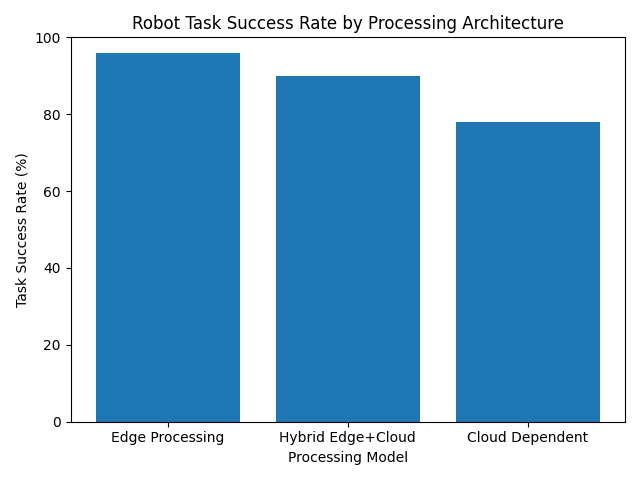
Think about the physical reality for a second. If a bipedal robot using the OM1 operating system is carrying a heavy crate in a crowded warehouse and it loses its Wi-Fi connection for even half a second, what happens? In a cloud-dependent model, that machine becomes a multi-thousand-dollar paperweight or, worse, a safety hazard. It is a puppet with a severed string. This is why the Fabric Protocol prioritizes local processing at the "edge." By allowing robots to process sensory data and execute logic locally, the foundation ensures that autonomy is literal, not metaphorical. The machine needs to own its thoughts to earn its rewards.
For us in the trading community, this technical choice translates directly into the Proof of Robotic Work or PoRW mechanism. You see, the network doesn't just pay for "effort"; it pays for verified outcomes. If a robot lags and fails a task, its Service Quality Score (Q^*) drops. If that score falls below the 95 percent threshold, the Adaptive Emission Engine automatically throttles the token rewards for that operator. Yes, the math is that cold. By moving the "brain" to the edge, Fabric minimizes the risk of quality-based slashing, making the $ROBO token a more stable asset backed by reliable mechanical labor rather than a speculative bet on cloud uptime.
Today is actually a milestone day for the community as it marks the first Global Project Leaderboard snapshot on Binance Square. Many are grinding for a share of the 8,600,000 $ROBO pool, but the most successful contributors are the ones looking at the infrastructure depth. We are seeing a circulating supply of 2.23 billion tokens against a 10 billion cap, and the market is starting to realize that "Edge Autonomy" is the only way to scale toward the 70 percent network utilization target (U^*) laid out in the December 2025 whitepaper. Hmmm... yes, if the machines had to wait for a round-trip signal to a data center in Virginia just to take a step in Tokyo, the "Robot Economy" would be a ghost town.
I believe we are witnessing the end of "Puppetry Finance." We have spent years trusting centralized servers to run our lives, but physical machines require a different kind of sovereignty. When a robot has its own Robot Identity (RID) and processes its own data at the edge, it becomes a first-class economic actor. It doesn't ask for permission; it executes. This creates a level of trust that no cloud-based API can ever match. As an analyst, I look for projects where the technology dictates the economics, not the other way around. Fabric Foundation has built the "Nervous System" of this new era, and the edge is where the real value is being captured.
So, while the market sentiment index sits in "Extreme Fear" globally, I find myself focusing on the "Trust Fabric" being woven right now. Machines don't care about fear; they care about latency and logic. By moving the intelligence to the physical location of the work, we are finally building an economy that is as fast as a human reflex. No, it isn't hype. It is physics. Trust the edge, because in a world of autonomous labor, the one who thinks the fastest and the most locally is the one who wins the ROBO rewards. March 2026 is just the beginning of this flywheel.
@Fabric Foundation #ROBO $ROBO