 I have noticed something about technology industries over time.
The most valuable systems are not always the ones that perform the most work. They are often the ones that control the information about the work.
Data becomes power slowly. At first it looks like a technical detail. Logs, reports, performance records. Over time it becomes the thing that determines who actually controls an ecosystem.
This is where Fabric Protocol becomes interesting to me.
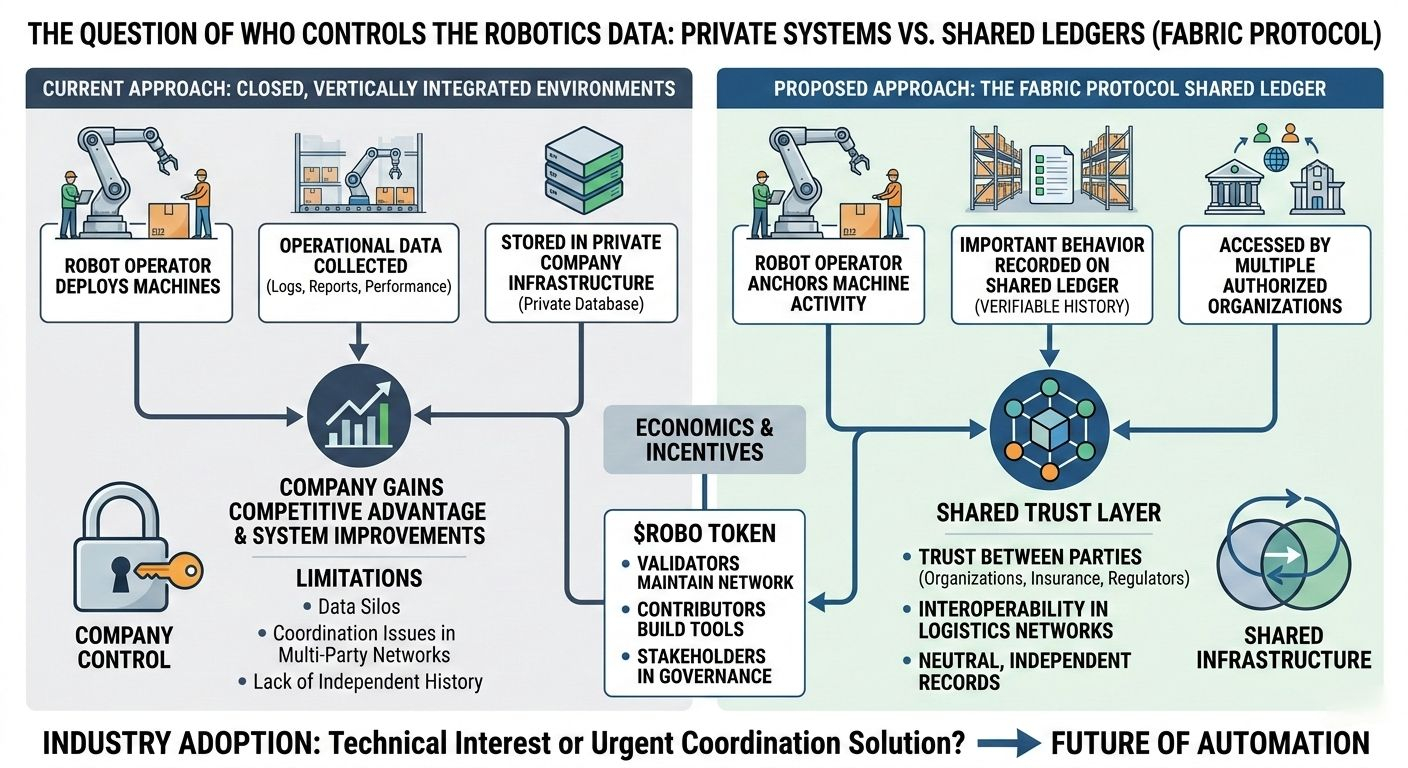
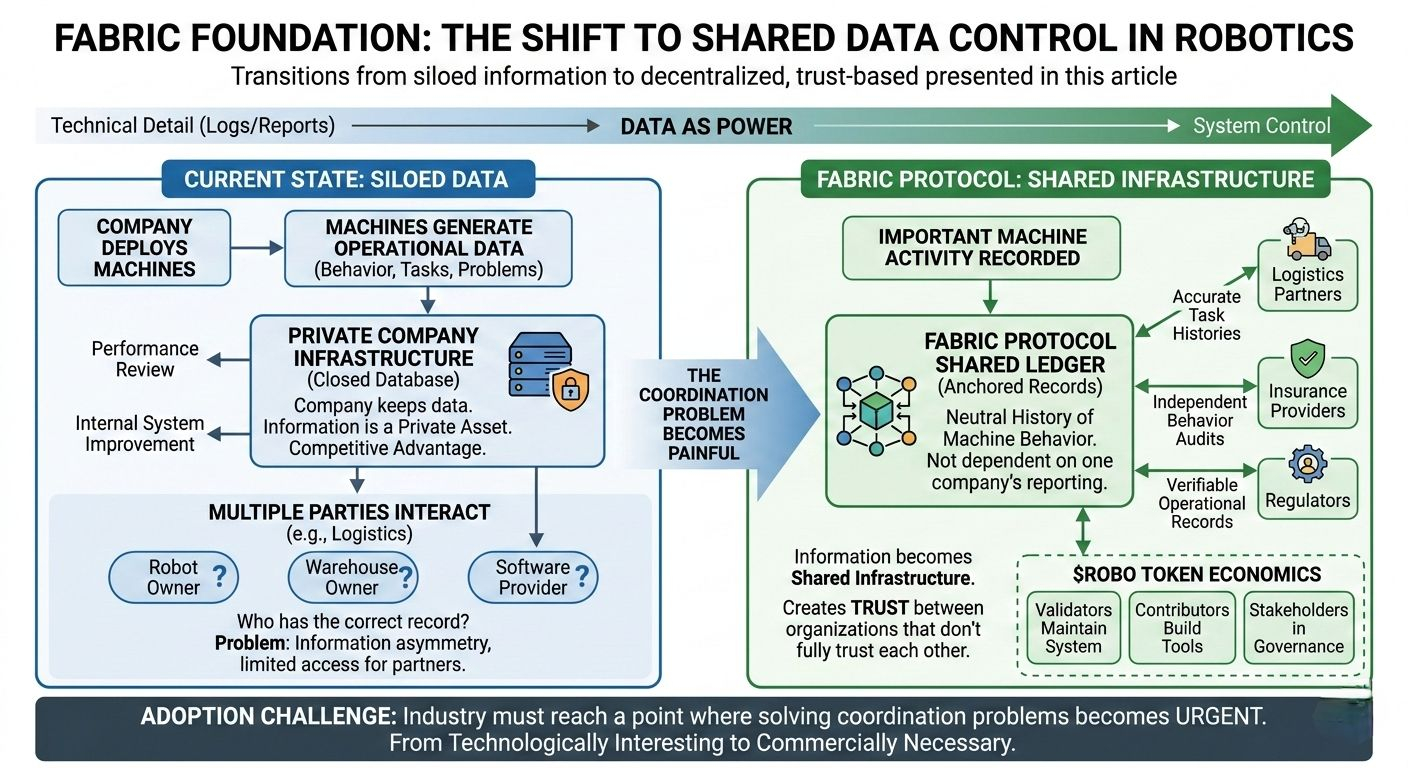
Most robotics systems today are built as closed environments. A company deploys machines, collects operational data, and stores that information in its own infrastructure. The behavior of the robots, the tasks they complete, and the problems they encounter all become part of a private database.
For the company operating the robots this makes sense.
The information is valuable. It reveals how the machines perform and how the system can improve. Sharing it openly does not feel like a competitive advantage.
But the moment multiple organizations interact with the same automated systems, the question of who controls that information becomes more complicated.
Imagine a logistics network where robots move inventory between companies. One company owns the machines. Another owns the warehouse. A third company builds the software that directs the robots.
If something goes wrong, each of those parties wants access to the same information.
Who has the correct record of what happened?
Right now the answer is usually simple: whoever operates the system keeps the data.
Fabric’s idea challenges that assumption.
Instead of behavior records living inside private company infrastructure, the protocol suggests anchoring important machine activity to a shared ledger. In that system the history of what machines did would not depend entirely on one company’s internal reporting.
The concept is not about transparency for its own sake.
It is about trust between organizations that do not fully trust each other.
Shared infrastructure often appears when multiple parties depend on the same system but cannot rely on a single participant to control it. Financial markets solved this problem through clearing houses. The internet solved it through open protocols.
Fabric is exploring whether robotics will eventually require something similar.
The challenge is that industries rarely adopt shared infrastructure until coordination problems become painful.
Right now many robotics deployments remain vertically integrated. One company builds the system and runs it. In that situation a shared record layer may feel unnecessary.
But automation trends rarely stay contained.
As robots begin interacting across organizations, the value of neutral records becomes easier to understand. Insurance providers may want independent histories of machine behavior. Regulators may want verifiable records of how automated systems operate. Business partners may want assurance that task histories are accurate.
In those environments information stops being a private asset.
It becomes shared infrastructure.
This is where the economic layer of Fabric enters the conversation. The $ROBO token functions as the mechanism through which participants interact with the network—validators maintaining the system, contributors building tools, and stakeholders participating in governance.
But the presence of a token does not automatically create usefulness.
The important question is whether robotics operators eventually see value in recording machine behavior on a shared system rather than storing everything internally.
If they do, Fabric’s architecture could become part of the coordination layer for automation.
If they do not, the idea remains technically interesting but commercially unnecessary.
This is the uncertainty most infrastructure projects face.
The problem they are trying to solve may be real. The challenge is whether the industry reaches the point where solving it becomes urgent.
Fabric Protocol is building as if that moment will arrive.
Whether it arrives soon enough to justify today’s attention is something only time and adoption will answer.