
When I first started looking into the robotics angle around @Fabric Foundation , I tried to ignore the usual crypto instinct to jump straight to token narratives. Instead, I went back to the mechanisms described in the documentation and asked a simpler question: if robots and autonomous systems become part of everyday infrastructure, what kind of coordination layer do they actually need?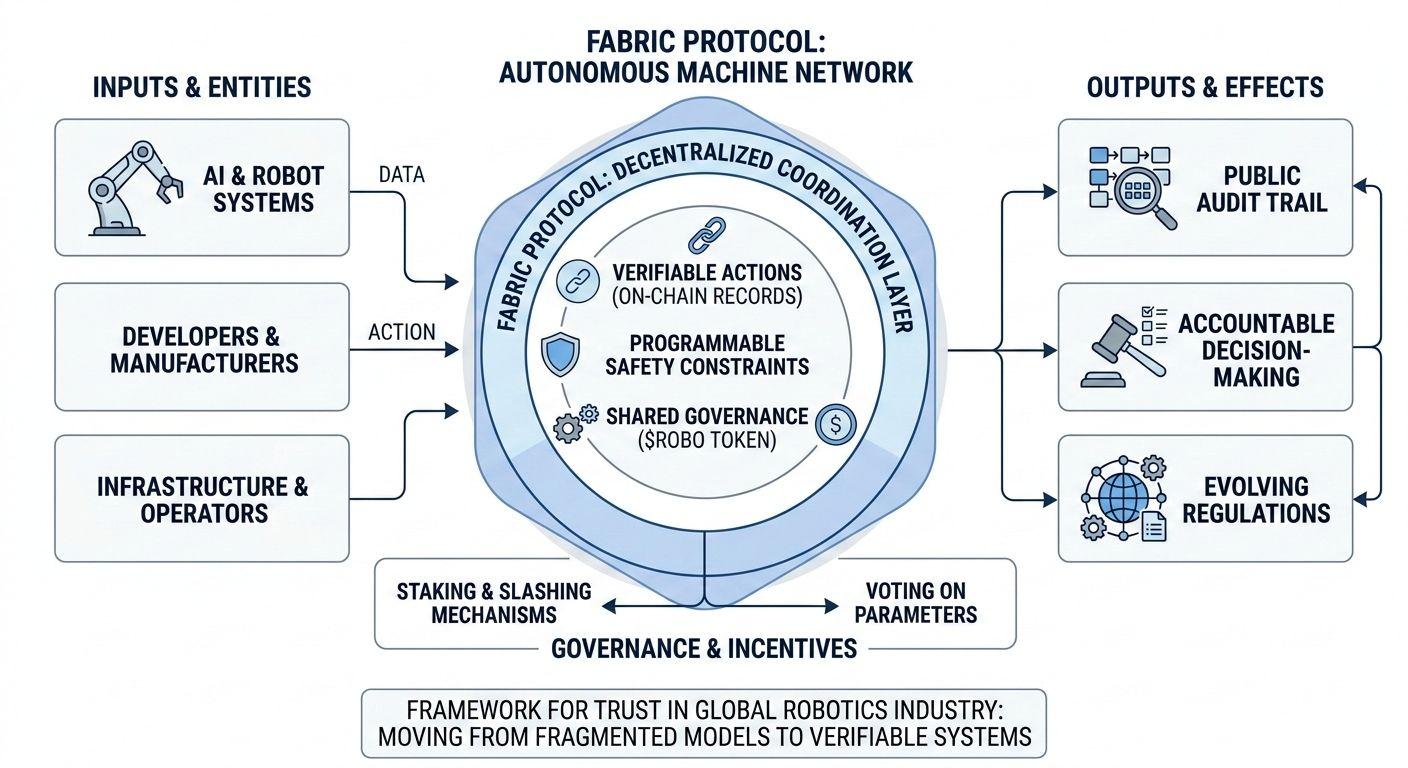
The global robotics industry is already massive estimates put it well above $40B and growing every year. But what I’ve noticed is that most of this ecosystem still runs on fragmented trust models. Different manufacturers, operators, and software layers interact with each other, yet accountability often sits behind closed systems. When something goes wrong, tracing responsibility becomes complicated.
What caught my attention with Fabric Protocol is that it approaches the problem from a blockchain native perspective. Rather than just improving robot intelligence, the protocol focuses on making autonomous actions verifiable. In practice, that means decisions made by AI agents or robotic systems can be tied to an on chain record creating a public audit trail of what happened, when it happened, and under what rules.
In my view, this is where the protocol becomes interesting for the robotics sector. If autonomous machines begin interacting across companies, supply chains, and physical environments, trust cannot rely purely on reputation. It has to rely on verifiable systems.
Fabric’s architecture suggests a model where machine actions, safety constraints, and governance parameters can all be anchored to transparent rules. That includes things like programmable safety constraints, slashing mechanisms for misbehavior, and governance participation through the $ROBO token. The idea isn’t just to run robots faster. It’s to make them accountable inside a shared coordination layer.
I’ve noticed that this reframes the incentive structure in a subtle but important way. In traditional robotics deployments, responsibility often sits with the manufacturer or operator. But in decentralized robotic networks, accountability may need to be distributed across multiple actors developers, infrastructure providers, and operators. Fabric appears to be exploring how blockchain mechanisms such as verifiable ledgers and token governed parameters could support that model.
Of course, the real test will be execution. Robotics systems operate in milliseconds, while blockchains operate with network latency and consensus delays. Bridging that gap without slowing down real world operations is not trivial. It raises practical questions about architecture, hybrid systems, and where on chain enforcement should actually sit.
Still, I think the direction is worth paying attention to. The robotics industry is moving toward more autonomy, more interconnection, and more AI driven decision making. If machines are increasingly acting without direct human input, the systems that record and govern those actions become critical infrastructure.
That’s why I find the broader idea behind @FabricFND compelling. It’s less about building smarter robots and more about building accountable machine networks systems where actions can be verified, rules can be enforced, and governance can evolve alongside the technology.
In a world where robots and AI systems may eventually interact with each other as much as they interact with humans, the question of trust becomes unavoidable. Not just technical trust, but economic and governance trust as well.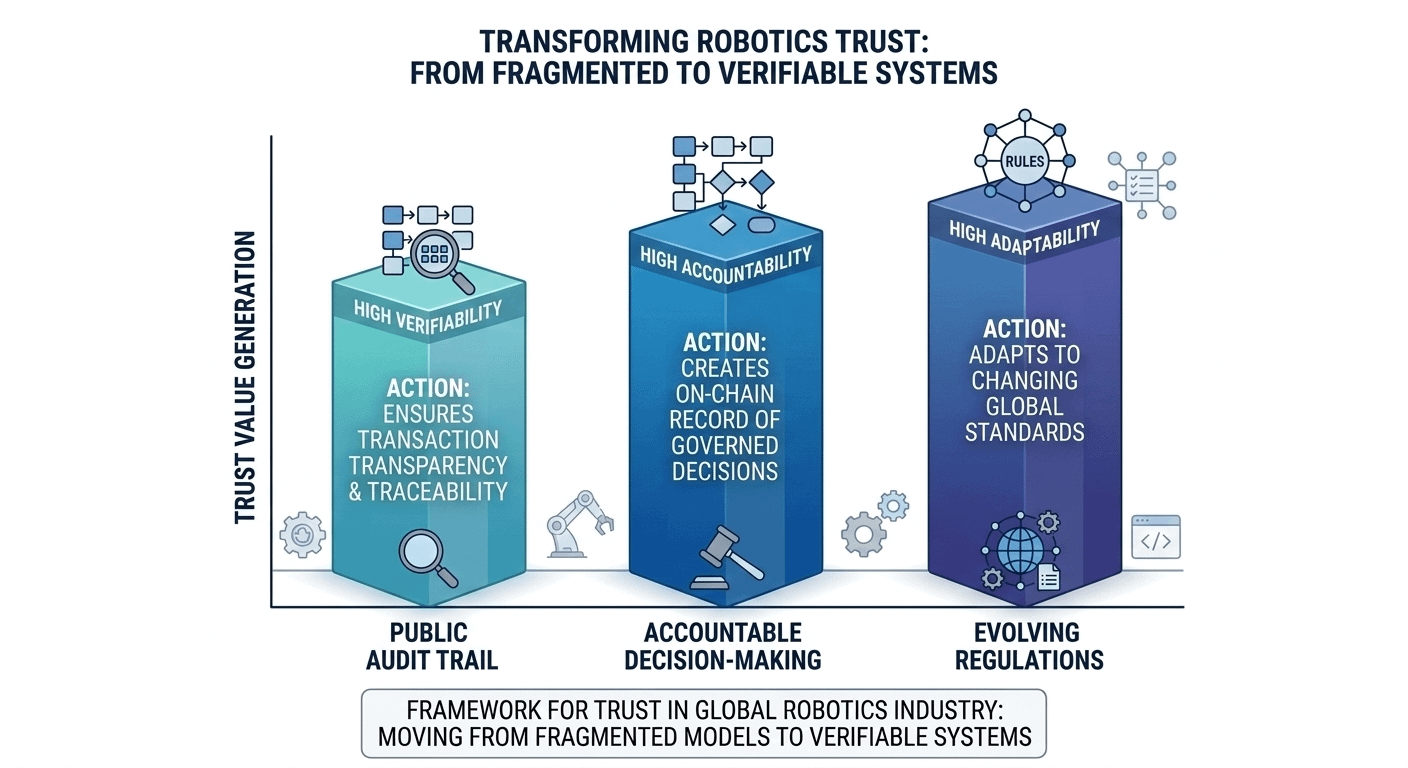
My take is that protocols like Fabric are experimenting with how blockchain might serve as that coordination layer.
But it also leaves me wondering something bigger.
If autonomous machines become part of global infrastructure, who ultimately governs the rules they follow corporations, governments, or decentralized networks? And could token based governance models like $ROBO realistically scale to that level of responsibility?
Curious to hear how others are thinking about this. Anyone else looking at the robotics angle behind ROBO from a governance and accountability perspective?