

I’ve watched enough “smart” automation fail in boring, expensive ways to stay cautious. The failures rarely come from a lack of intelligence; they come from missing incentives, unclear accountability, and messy handoffs between systems that don’t share the same definition of truth. When people ask for “reliable AI,” I usually hear a quieter request underneath: they want an output they can defend when something goes wrong.
The friction is that AI outputs are cheap to generate and costly to trust. A model can sound certain and still be wrong, biased, or inconsistent across runs. In regulated environments, that becomes a settlement and liability issue. If an AI-driven decision touches fraud monitoring, trade controls, or reporting, someone has to justify the result without turning every input into a permanent disclosure. Most organizations respond with patchwork: review queues, duplicated checks, and “just in case” retention. It works until volume rises, or until a dispute forces everyone to reconstruct intent from logs that were never designed as evidence.
It’s like trying to run an accounting system where receipts appear instantly, but signatures are optional and the ledger can be quietly edited under pressure.
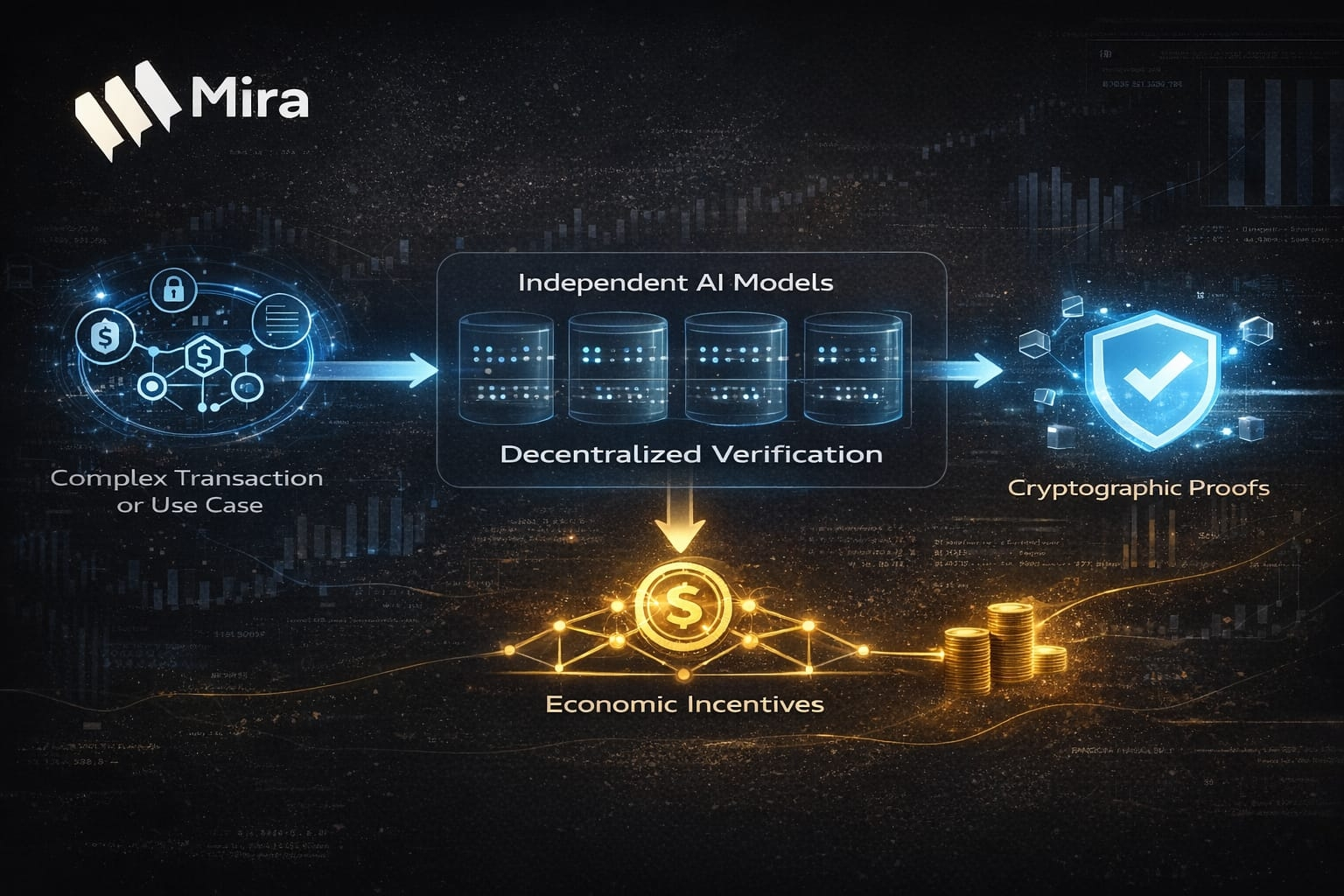
This is why Mira Network interests me as infrastructure, not as a story. The core idea is to turn verification into a first-class activity, and to make it economically accountable. Instead of treating an AI answer as one blob you accept or reject, the network breaks complex outputs into smaller claims that can be evaluated independently. That matters because it creates a surface for incentives and consensus: verification becomes work with consequences, and the final result becomes closer to evidence than opinion.
Mechanically, this only holds if the selection rules are hard to game. Verifiers need to be assigned to claims in a way that’s unpredictable and resistant to capture, with stake and randomness coordinating most of the process. The model layer matters too: independence only helps if verifiers aren’t all drawing from the same assumptions or the same upstream model behavior. The state model then records the minimum necessary facts: what was claimed, which verifiers attested, what quorum was reached, and how disagreement resolved. If a challenge happens later, there needs to be a durable reference that doesn’t depend on someone’s private database.
The cryptographic flow is what keeps this from turning into “trust the committee.” A practical pattern is to commit to each claim via hashes (often aggregated in a Merkle structure), collect signed attestations within a defined window, then finalize an outcome once a threshold is met. If penalties exist, signatures must be attributable so slashing or reputation decay isn’t political. If rewards exist, the system needs to discourage lazy herding. And finality rules should allow bounded disagreement, because forced unanimity often hides uncertainty.
Where blockchain economics connects to reliability is in how verification is priced and how risk is allocated. Verification consumes compute and attention, so fees become a negotiation mechanism between demand (applications) and supply (verifiers). In busy periods, it should cost more to verify, and that pressure should encourage better claim selection rather than indiscriminate logging. Staking is the second lever: verifiers lock value so careless behavior has teeth. Governance is the third: thresholds, eligibility, dispute processes, and updates have to evolve as models and adversaries change.
I’m not fully certain where the boundary will land between what stays on-chain and what remains off-chain, and that boundary matters for privacy and auditability. Too much detail creates new leakage. Too little anchoring sends you back to “trust me” compliance.
There’s also an honest limit: protocol design can reduce error, but it can’t eliminate correlated failure. If many verifiers rely on similar model families, they may agree on the same wrong conclusion. If incentives drift, participants can optimize for easy claims and ignore the hard ones. And if regulators don’t accept the evidence format, organizations will keep duplicating work even when the proof is better.
Still, I can see who would use this and why. Builders who need defensible AI outputs for workflows that touch compliance and reporting care less about clever answers and more about audit-ready traces. Institutions care about reducing duplicated review and shrinking data sprawl while preserving credibility under scrutiny. It might work if incentives remain strict, records stay clean, and verification costs stay predictable enough for budgeting. It would fail if incentives soften, governance turns into exceptions, or the evidence stops being legible to the people who have to sign off under stress.
@Mira - Trust Layer of AI #Mira #mira
