


In the world of industrial automation, there is a hard lesson you only learn after a mechanical failure. Software bugs in a virtual environment result in a crash... but software bugs in a physical environment result in a debris field. I have spent enough time troubleshooting high-throughput systems to know that "eventual consistency" is a luxury we cannot afford when the "event" involves two tons of moving steel.
If the data state and the physical state decouple for even a millisecond, the system doesn't just lag. It breaks.
The Invisible Risk: Verification Lag
We often praise "low latency" as the ultimate metric for efficiency, but we overlook the hidden cost of verification lag. In current decentralized systems, we accept a gap between when a command is issued and when it is cryptographically finalized. In the world of physical atoms—robotics and autonomous logistics—this lag is a structural debt.
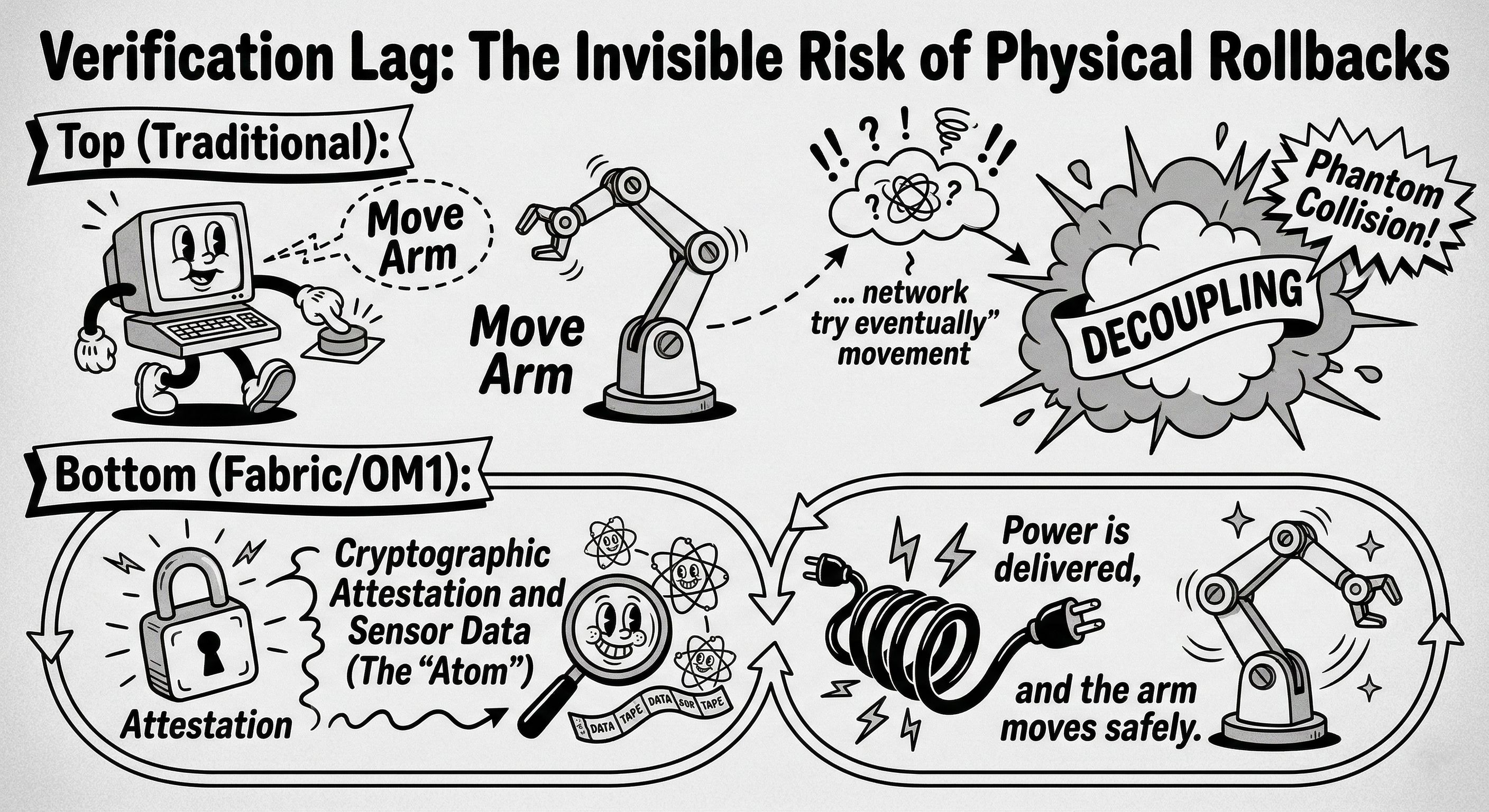
It leads to "phantom collisions," where a machine acts on stale or unverified data. Think of it like a self-driving car receiving a "stop" command that isn't finalized until after the intersection... it’s useless.
The System: Attested Kinetic Execution
The @Fabric Foundation (established as a non-profit to oversee the "Robot Economy" in 2024-2025) is building a social contract between humans and moving machines. They aren't just making software; they are building a universal execution layer called OM1.
It reminds me of how Linux or Android unified fragmented hardware. Instead of every manufacturer like UBTech, AgiBot, or Fourier having their own "walled garden," Fabric creates a universal operating system where a single "skill" can be deployed across any humanoid or robotic arm.
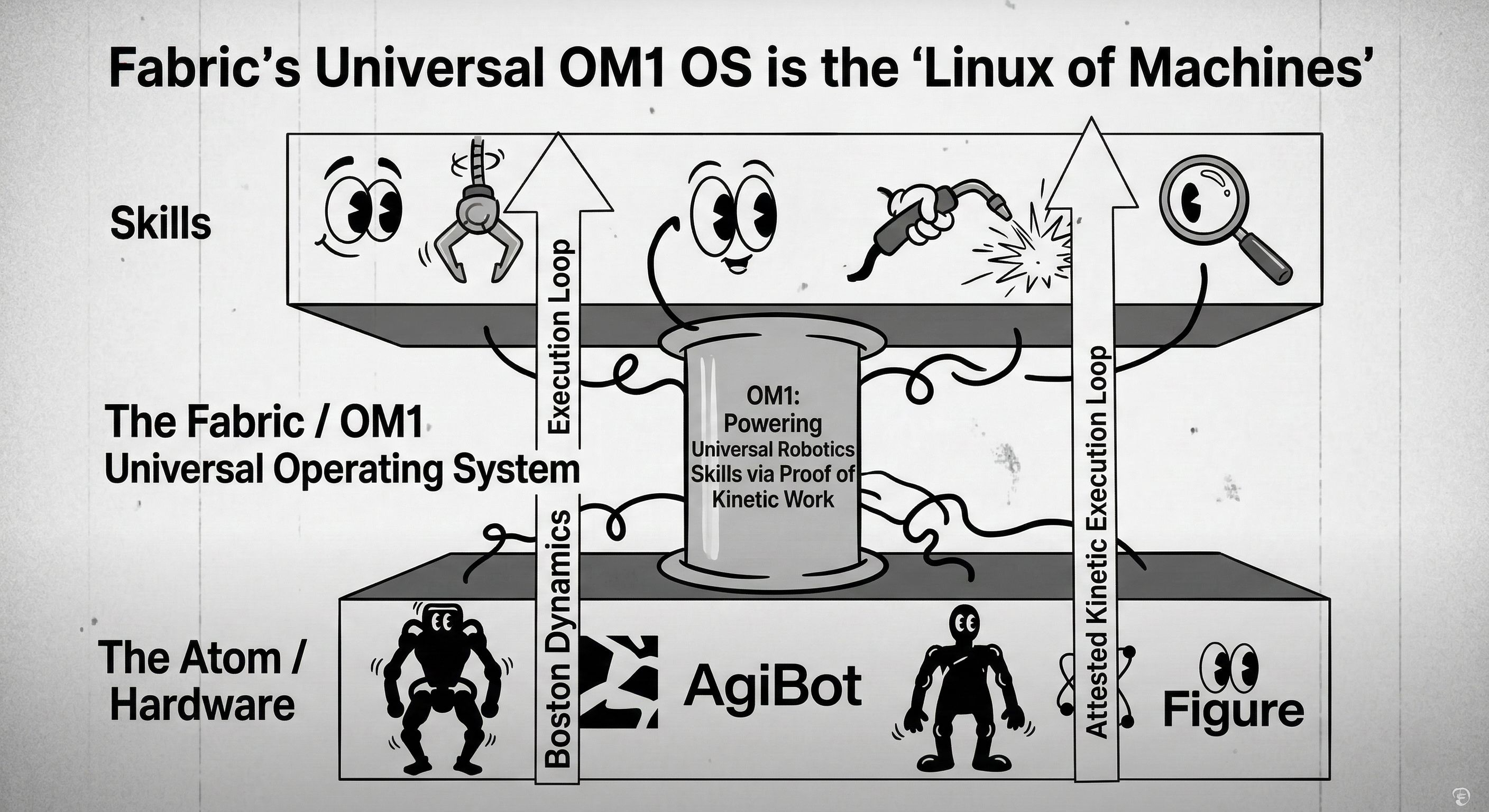
The core mechanism here is Attested Kinetic Execution. This binds a cryptographic proof to a physical movement in real-time. It ensures that a machine cannot execute a command unless the physical world—the "atom"—matches the digital contract.
Real-World Stakes
Imagine a fleet of warehouse robots managed by a logistics operator like TriMark or a retail giant like GNC (who have already leaned into modular commerce stacks). If a robot at a Hyundai plant—where Boston Dynamics' Atlas is already being tested in early 2026—loses sync with the network, the consequences are physical.
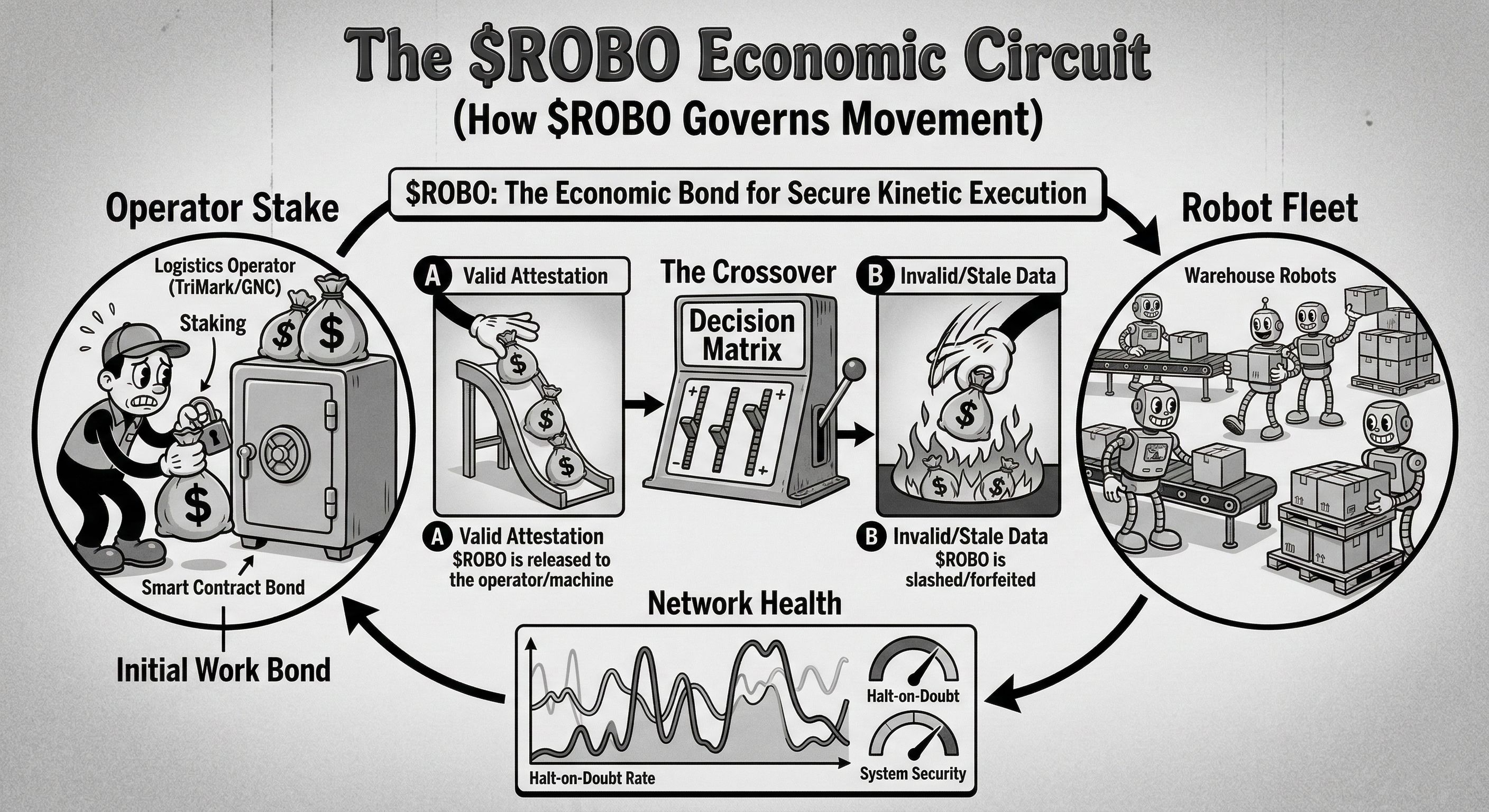
Fabric solves this by requiring a Work Bond. If a machine or its operator provides a false attestation of its state, they lose their stake. The economic cost of a lie finally matches the physical cost of a failure.
The Fuel: $ROBO
Powering this entire machine economy is the $ROBO token. It’s the lifeblood of the network. According to official documents from the Fabric Foundation (2026), ROBO serves three critical functions:
Network Fees: Robots don't have bank accounts. They use ROBO to pay for their own charging, compute, and task verification.
Staking for Security: Operators must stake ROBO to participate in the "Robot Genesis." This is their "skin in the game."
Proof of Robotic Work (PoRW): Participants are rewarded in ROBO for verified machine labor or data contributions.
Just recently, in late February 2026, the project hit a massive milestone with the $ROBO TGE on the Virtuals Protocol "Titan" mechanism. This wasn't just another listing... it was the launch of a financial identity for robots.
Healthy vs. Unhealthy Systems
So, how do we know if this is working?
Healthy: The system prioritizes "Halt-on-Doubt." If the attestation fails, the machine stops immediately. The cryptographic proof is a prerequisite for power.
Unhealthy: The system operates on "Optimistic Actuation," where movements are executed and verified later. This introduces "physical rollback risk"—which is just a fancy word for a crash.
The transition from software trust to physical truth is no longer optional. We are moving away from agreements in databases and toward covenants hard-coded into matter. If the ROBO mechanism can successfully penalize digital-physical decoupling, it becomes the foundational layer of industrial safety.