
When I first noticed $ROBO appearing on exchange listings and trading dashboards, my instinct as a trader was simple: new narrative, fresh liquidity, and a market that loves anything connected to AI. But over the years I have learned that not every AI token deserves attention. Many ride the hype cycle and disappear. So before taking any exposure, I always try to understand one thing clearly. Is this just another narrative trade, or is there actual infrastructure behind it?.The project behind the token, Fabric Foundation, caught my attention because it is trying to solve a problem that is rarely discussed in crypto but will become very real in the next decade. As robots and autonomous machines start performing work in the physical world, they will need identity, coordination systems, and payment rails. Robots cannot open bank accounts or sign legal contracts, yet they will still need a way to receive tasks, get paid, and interact with other machines. Fabric is building a decentralized network to handle exactly that.
In simple terms, Fabric acts like a coordination layer for robotic labor. Machines can have verifiable on chain identities, accept tasks, and settle payments through the network. The system even introduces a concept called Proof of Robotic Work, where value and rewards are tied to real tasks completed by machines rather than just token speculation.
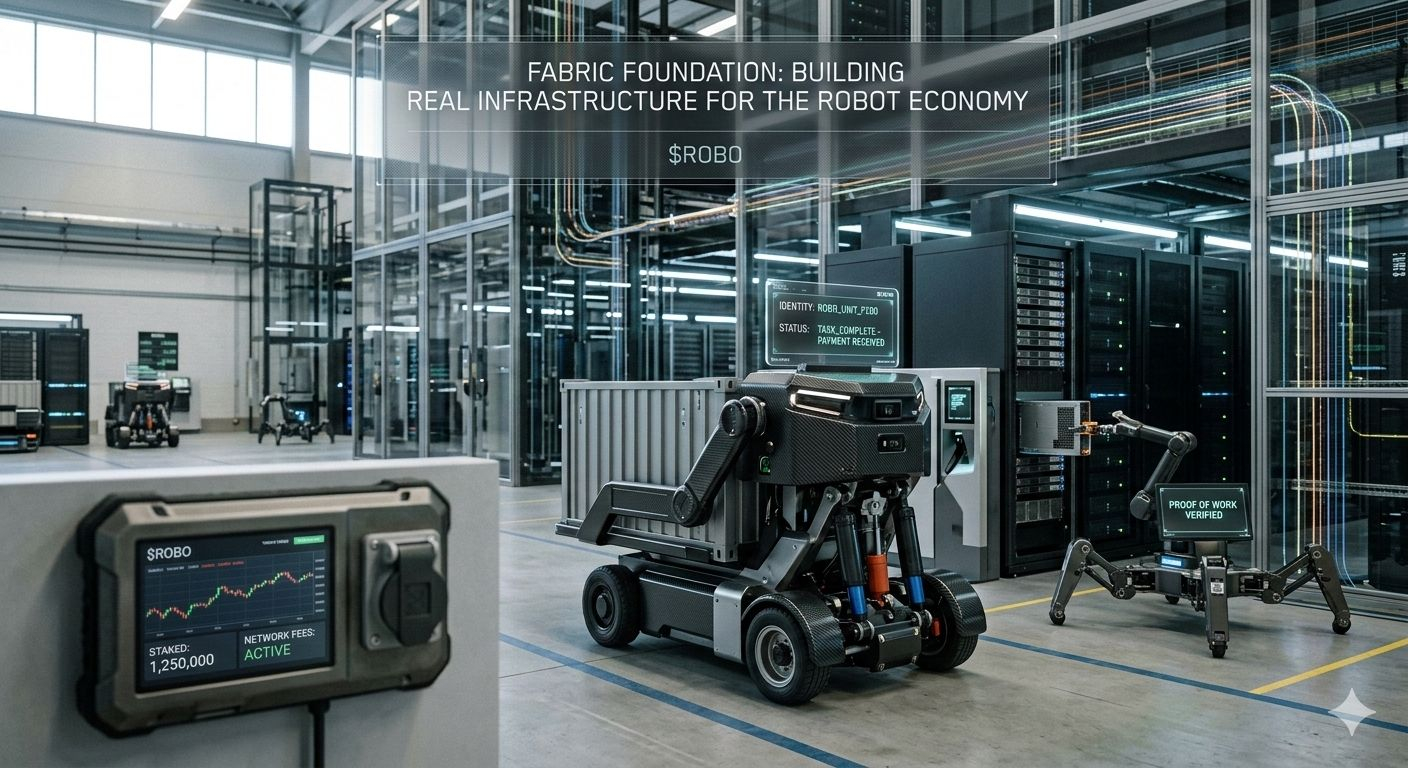
This is where the $ROBO token comes into play. It is not just a speculative asset. It is the fuel that powers the network. Operators stake it to register robots, developers stake it to build applications, and it is used to pay fees for services, identity verification, and task settlements inside the ecosystem.
Of course, as traders we cannot ignore the reality of the market. $ROBO is a newly launched token, and early price action has already shown strong volatility driven by exchange listings, trading campaigns, and speculation. Liquidity is improving, but circulating supply remains relatively low, which means dilution risk and sharp price swings are very possible in the early phase.
From a long term perspective, the real question is adoption. Building infrastructure for a robot economy is ambitious. If Fabric can actually attract robotics developers, hardware operators, and real world deployments, the protocol could become an important coordination layer for machine economies. If adoption stalls, the narrative alone will not be enough to sustain value.
My personal approach with projects like this is simple. I do not chase the first pump. Instead, I treat early exposure as a small strategic position and watch how the ecosystem evolves. Real infrastructure takes time to mature. Patience matters more than speed.