

Yesterday evening I was doing my usual routine scrolling through CreatorPad discussions and reading what people are building around AI narratives. Most projects I see follow the same pattern: a token, some AI branding, maybe a dataset marketplace.
Then I came across something mentioning ROBO1 connected to Fabric Protocol.
ROBO1 is the general-purpose robot being developed within the Fabric Protocol robotics network ecosystem.
I’ll be honest… the first thing I thought was “okay, another robotics concept trying to ride the AI trend.” But after digging into the idea a bit more, I realized Fabric isn’t really trying to build just a robot.
It’s trying to build a network that develops robots.
That difference took me a moment to understand.
Here’s how I personally interpreted it.
Instead of a company training a robot inside a private lab, Fabric proposes an open system where different people contribute pieces of the development process. Someone might contribute training data. Someone else might provide computation. Others help verify outputs or secure the system.
All those contributions get coordinated through the protocol.
And importantly… they’re recorded and rewarded.
So the development process becomes something closer to a shared ecosystem rather than a closed research lab.
All of this activity eventually feeds into ROBO1, which is basically the robot the network is trying to evolve over time. But the robot isn’t static. It’s designed to grow as the network improves it.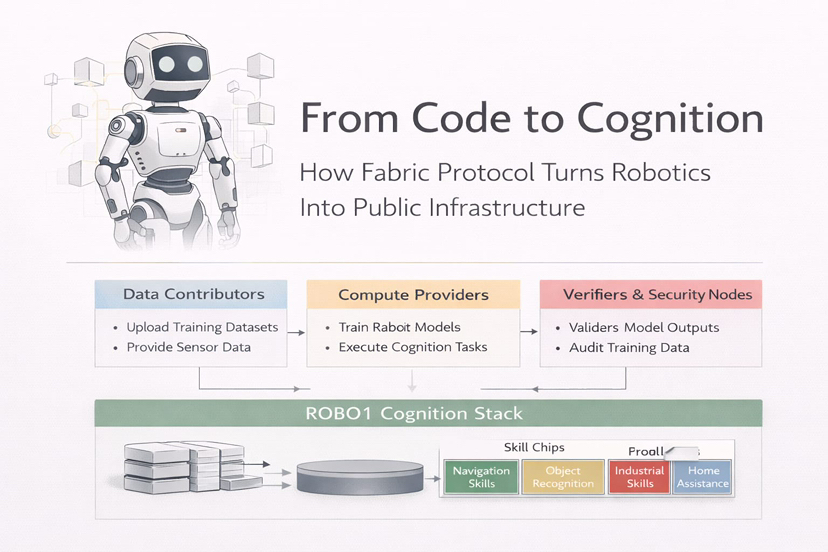
What I found interesting is how its intelligence is structured.
ROBO1 runs on a modular cognition stack made up of smaller functional components. Instead of hardcoding every capability into one system, new abilities can be plugged in using something called skill chips.
Think of it like installing extensions.
One chip might allow navigation in unfamiliar environments.
Another might focus on object recognition.
Another could enable industrial task automation.
As more contributors build these modules, the robot gradually becomes more capable.
That’s the part that made me pause for a second.
In most robotics projects, all of that development happens internally within a company. Fabric is proposing something closer to open-source robotics, except with economic incentives attached.
ROBO1 uses what Fabric calls an AI-first cognition stack.
Which is where the crypto layer starts to make sense.
In Web3 we’ve already seen decentralized compute networks and DePIN systems where infrastructure is shared across participants. Fabric feels like it’s applying a similar coordination model, but instead of GPUs or storage, the network is coordinating robot intelligence and capabilities.
One detail I found particularly notable is how the protocol aligns incentives. Contributors who help train, secure, or improve the system earn ownership through the network. At the same time, users who want to access the robot’s capabilities pay for those services.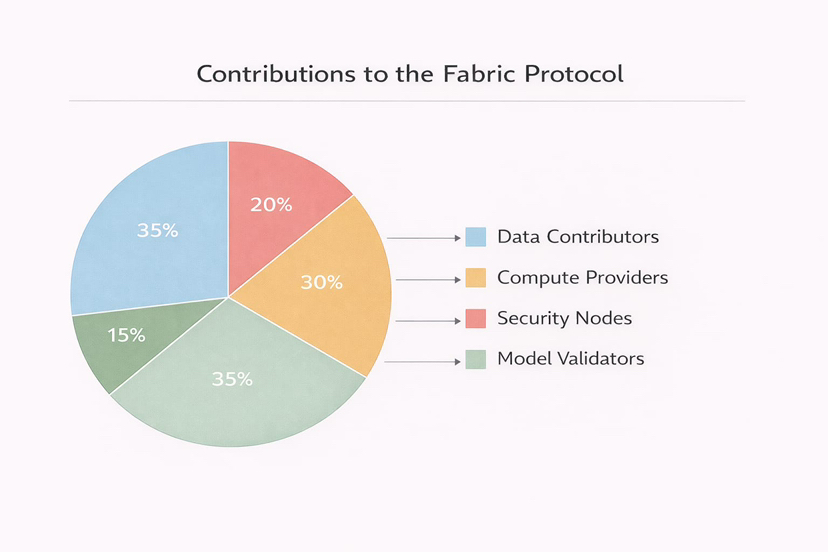
So there’s a loop forming there.
Development feeds capability.
Capability attracts usage.
Usage rewards contributors.
Of course, robotics adds a layer of complexity that software alone doesn’t have. Real-world data can be messy, and physical environments aren’t predictable. I’m still curious how Fabric plans to handle those challenges at scale.
But the underlying idea turning robotics development into something like a public network feels like a direction we haven’t really explored much in Web3 yet.
Maybe it works. Maybe it doesn’t.
Either way, I’m definitely watching how ROBO1 evolves as the Fabric ecosystem grows. It’s one of those concepts that sounds unusual at first… and then slowly starts to make more sense the longer you think about it.
@Fabric Foundation #ROBO $ROBO
