
I didn’t notice this from a chart. I noticed it from my own taps. One conversion took 9 refreshes before I accepted a quote, and the one I accepted expired in under 2 seconds.
At that point you are not executing. You are negotiating with a timer.
Binance conversions look simple on the surface. You ask for a quote, you accept, you move on. But the quote window is a policy boundary. It decides how long “the number” stays real, and what kind of participant the venue rewards when the tape gets noisy. 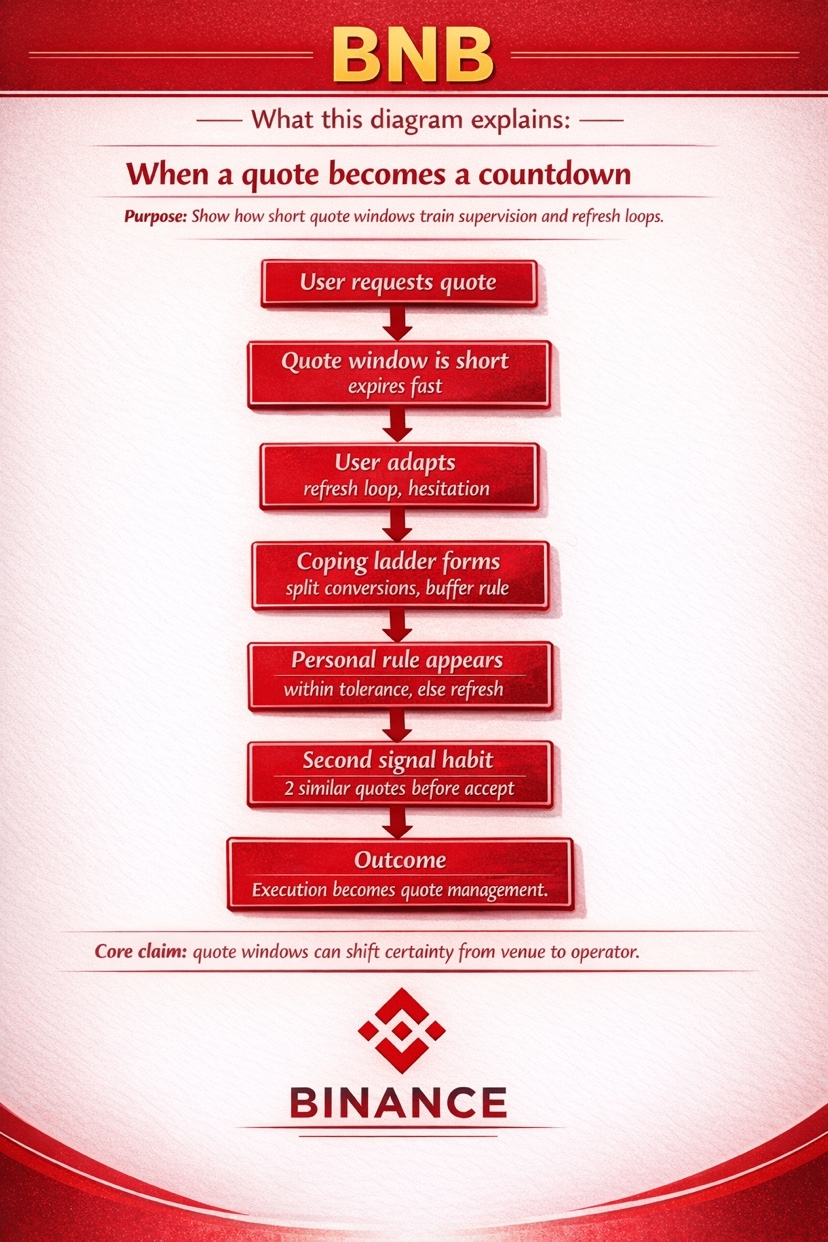
The axis is not price. It is whether a quote behaves like an offer or like a countdown. The moment it becomes a countdown, certainty moves from the venue into the operator.
You can feel the posture shift before any dashboard tells you. Your hand changes. You stop treating the first quote as actionable. You start sampling until the number looks safe. The workflow becomes refresh, hesitate, accept, regret, repeat. Nothing is broken. The behavior is trained.
A quote window exists for good reasons. It protects the venue from being picked off when prices jump and it protects liquidity from stale acceptance. In fast conditions, someone has to carry the risk of being last to update. A short window pushes that risk away from the venue.
But pushing risk away has a cost. The cost shows up as attention tax.
And once attention is the tax, the coping ladder appears in a very predictable order.
First is the refresh loop. You start fishing for a quote that will survive long enough to click. Second is the split. One conversion becomes three smaller conversions, not because you want to scale in, but because you want fewer seconds riding an expiring number. Third is the personal rule. Only accept if the quote is within 10 bps of spot, otherwise refresh. Fourth is the buffer. Wait for a calmer minute, then try again. Fifth is the silent supervision step. You look for 2 similar quotes before you believe either one.
A quote that needs supervision is no longer execution certainty. It is a metronome.
This is why “price present” can still feel unusable. The book can look healthy and the quote can still act like a timer that forces humans into defensive posture. Under that posture, execution stops being a plan and becomes a series of small permissions you grant yourself, one refresh at a time.
There is a real trade here and it is sharp.
Lengthen quote windows and you invite the fastest participants to pick off stale quotes, especially in whipsaws. Tighten quote windows and you protect the venue, but you also shift the bill to everyone else. Humans pay in refreshes, splits, hesitation, and plan drift. The venue looks efficient. The operator becomes the missing layer that makes it usable.
This is cost relocation, but you can measure it.
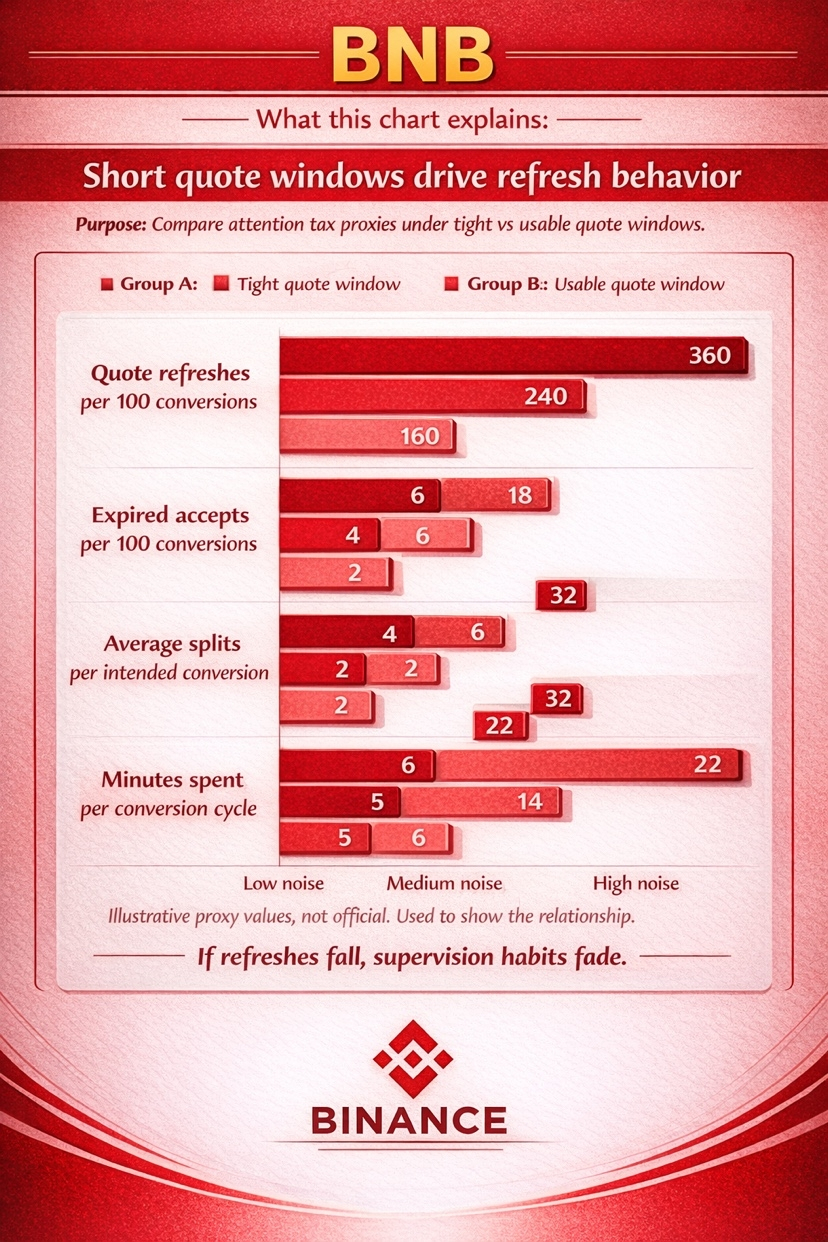
Here is an illustrative model. These numbers are illustrative, not claims about Binance. The point is the mechanism.
In Environment A, the quote window is tight enough that humans often miss it in noisy sessions. In Environment B, the window stays usable more often.
Quote refreshes per 100 conversions, A at 240, B at 90.
Expired accepts per 100 conversions, A at 18, B at 6.
Average splits per intended conversion, A at 4, B at 2.
Minutes spent per conversion cycle, A at 14, B at 6.
Illustrative. The point is that once the quote is a countdown, the user pays in attention and branching decisions.
Only late does $BNB belong here. The token is not the thesis. It changes the marginal cost of acting on Binance, and that changes how big the decision surface feels. If refreshing and reattempting are cheap, it becomes easier to normalize the refresh loop instead of fixing the boundary that caused it. Low friction can help disciplined execution. It can also quietly finance indecision.
So I don’t judge this by whether the quote looks attractive. I judge it by what the quote trains me to do.
When the tape is noisy, do quote refreshes per 100 conversions fall back toward baseline. Do “two similar quotes” rules disappear instead of spreading. Do conversions stop splitting just to outrun expiry. And do operators stop treating acceptance as a timing game.
If a quote keeps acting like a timer, the hidden cost is not fees. It is attention.
@Binance Vietnam $BNB #CreatorpadVN