
How Mira Network Works (Step-by-Step)
1️⃣ User Makes AI Request
Someone asks an AI model a question (for example: legal, medical, coding, etc.).
2️⃣ Output Is Sent to Mira
The AI result is submitted to the Mira network.
3️⃣ Validators Check It
Network participants (validators) review or algorithmically verify the AI output.
They:
Compare with other AI models
Check factual references
Score accuracy
4️⃣ Consensus Is Reached
If enough validators agree, the result is marked as “verified.”
5️⃣ Result Is Recorded On-Chain
The verification proof is stored on blockchain (Base network).
This creates:
Transparency
Traceability
Proof of validation
🪙 What the MIRA Token Does
The token is important inside the ecosystem.
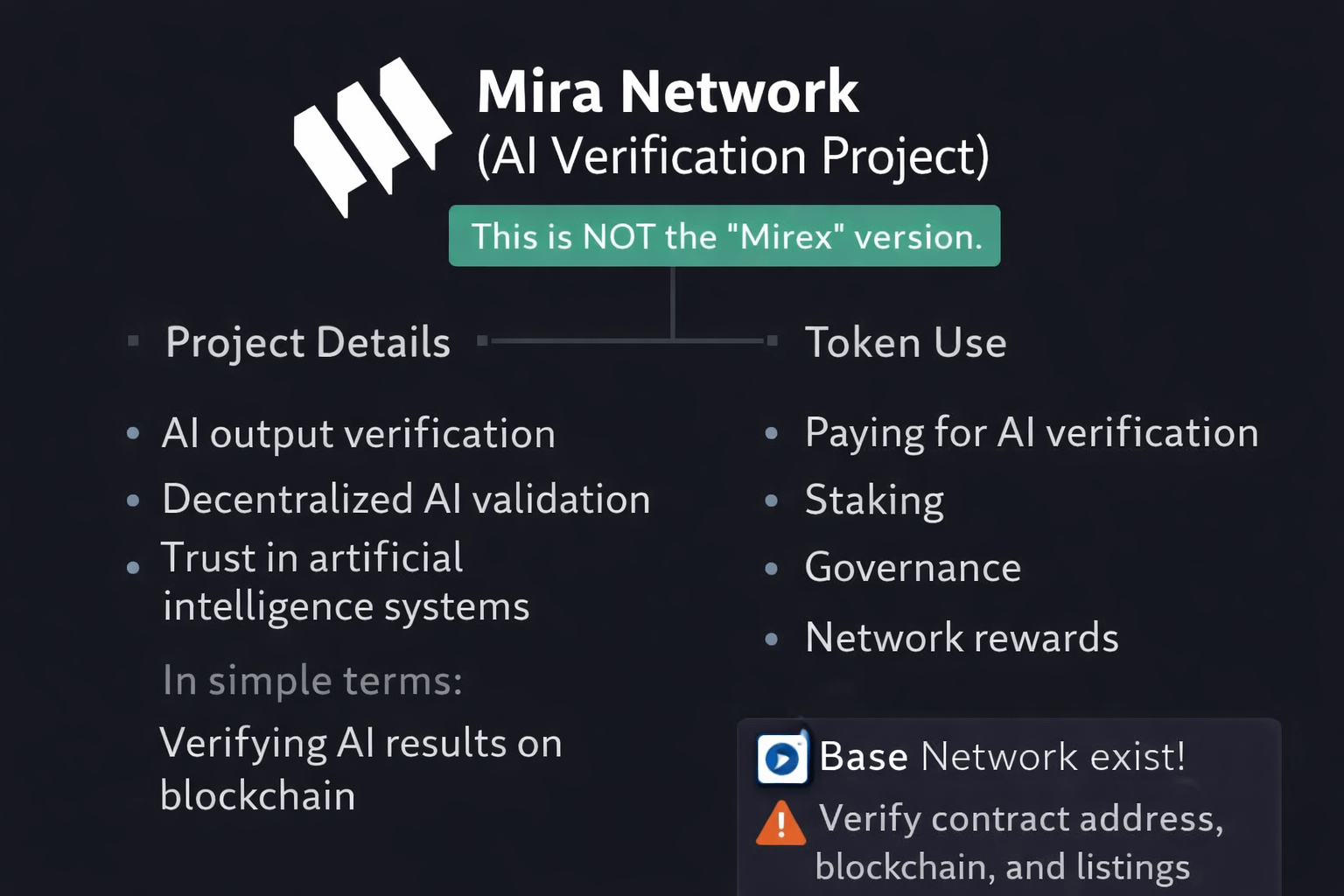
🔹 1. Payment
Developers pay MIRA tokens to:
Submit AI outputs for verification
Access verification APIs
🔹 2. Staking
Validators must:
If they act dishonestly, they can lose tokens
This creates economic security.
🔹 3. Rewards
Validators earn MIRA tokens for:
Participating
Voting honestly
Providing accurate verification
🔹 4. Governance
Token holders may vote on:
Network upgrades
Parameter changes
Fee structure
🏗 Why It Uses Base (Ethereum Layer 2)
Base provides:
Lower transaction fees
Faster confirmations
Ethereum-level security
So Mira is not its own blockchain — it runs on top of Ethereum infrastructure.