
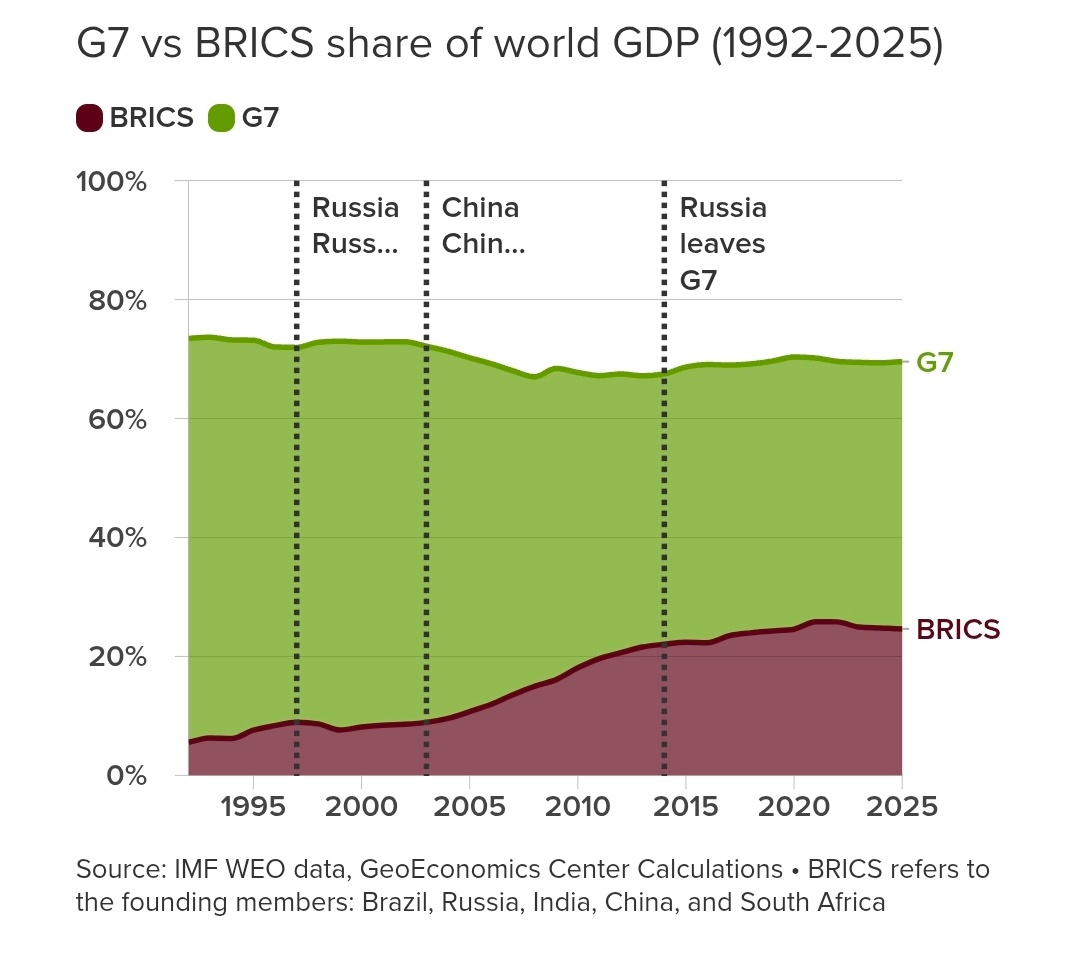
Originally created as an economic coordination body, the G7 began to put foreign policy and national security on its agenda in the 1980s, as the Soviet Union’s political influence was waning. Soon after, Russia attended its first G7 Summit as a guest in 1991, formally joined in 1998, creating the Group of Eight (G8), and then was suspended in 2014 due to its annexation of Crimea.
In the years since, new geopolitical rivals have entered the fray: Since the COVID-19 pandemic, G7 summits and declarations have attempted to address China’s role in the global economy. Last year’s leaders’ communiqué was especially harsh on China—which was mentioned twenty-nine times—on everything from its material support to Russia’s war against Ukraine to Beijing’s malicious cyber activities. But China was once a guest at the forum, first joining in this capacity in 2003.
Other members of the G7+5, an unofficial grouping of large emerging markets—India, Mexico, Brazil, and South Africa—have been invited as guests in recent years. If that sounds familiar, it is because India, Brazil, and South Africa, along with Russia and China, are the founding members of the BRICS group of emerging economies, which some would consider a representation of the geopolitical and economic competition the G7 faces today.
This year, Australia, Ukraine, South Korea, Brazil, Mexico, and India were invited to attend as guests. These invitations are a signal of broad alignment among the G7 and its guests. These invitations demonstrate the importance of the guests’ economic might on the global stage, even though India has shifted away from the G7 quite significantly in the last fifty years, as seen in the graph above. In 1992, when Russia first attended the G7 as a guest, its gross domestic product (GDP) was less than 1 percent of the world’s GDP, and the combined economies of the five founding BRICS countries made up less than 9 percent of global GDP. At the time, the G7 represented 63 percent of the world’s GDP. Today, the G7’s share is now 44 percent of the world’s GDP and the founding BRICS members’ share has more than doubled to almost 25 percent.