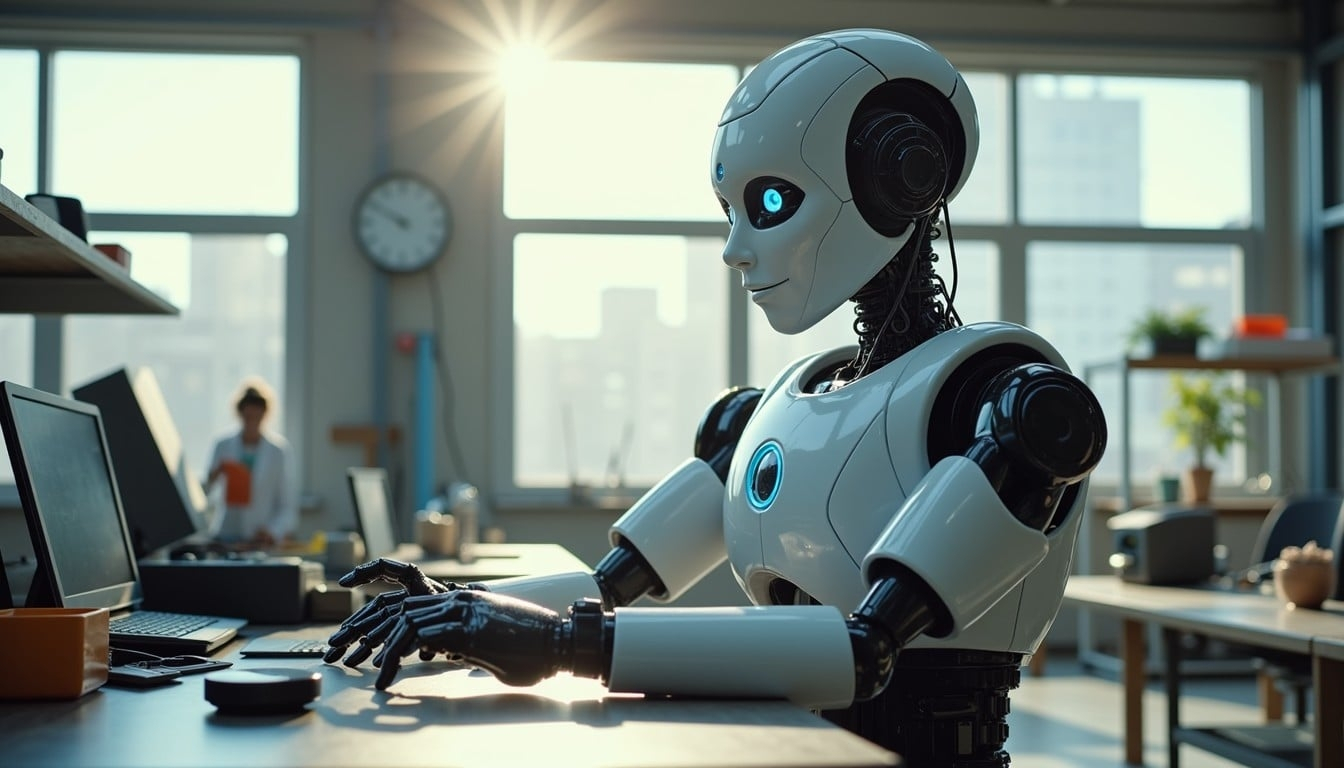
ROBO doesn’t feel like a typical crypto project chasing attention. It feels more like an idea that’s patiently waiting for the world to catch up.
In a market where “AI” is often reduced to chatbots and trading bots, ROBO represents something more physical and more grounded. It imagines a world where machines don’t just compute — they act. They lift, assemble, transport, inspect, and build. And more importantly, they prove that they’ve done it.
At the center of this vision is the work connected to Fabric Foundation, which focuses on creating infrastructure for machine identity and coordination. The goal isn’t simply to deploy robots. It’s to give them a way to exist economically — with accountability.
What makes ROBO human, in a strange way, is that it is built around responsibility. In traditional automation, machines perform tasks and generate logs that most people never see. But in a machine-driven economy, invisible actions create invisible risk. ROBO challenges that by asking a deeper question: what if every machine action could be verified, referenced, and valued?
Imagine a robot completing a complex warehouse task. Under a conventional system, the job is done and forgotten. Under a ROBO-like framework, that action becomes a recorded, provable unit of productivity. Another machine could reference it. A system could audit it. A network could price it. The action itself becomes an economic building block.
That shift changes everything.
Instead of value living only in hardware ownership, it begins to live in verified output. Instead of productivity being measured only by volume, it becomes measured by reliability and reusability. The machine is no longer just a tool — it becomes a participant in a structured economic loop.
There is something quietly ambitious about that. ROBO is not promising a world where robots replace humans overnight. It is proposing a world where machine work becomes structured enough to be trusted at scale. And trust, in any economy, is the real currency.
As automation expands across logistics, manufacturing, and infrastructure, coordination becomes more important than intelligence alone. Machines need shared standards. They need interoperable identities. They need ways to signal that their actions are authentic and verifiable. Without that layer, scale turns into chaos.
ROBO positions itself in that missing layer — the space between action and value.
The long-term implication is subtle but powerful. If actions themselves become composable assets, productivity could be traded almost like digital goods. Verified machine output could move across platforms and industries without friction. Data created by real-world tasks could compound in value rather than disappear into isolated databases.
In that sense, ROBO is less about robots earning money and more about redefining what counts as economic output in the first place.
It’s easy to underestimate infrastructure projects because they don’t always create dramatic headlines. But infrastructure shapes everything that gets built on top of it. If autonomous machines become a dominant force in global industry, they will need economic rails. They will need identity. They will need verification.
ROBO is a quiet bet that the future won’t just be automated — it will be accountable.
And perhaps that’s what makes it feel human after all.