

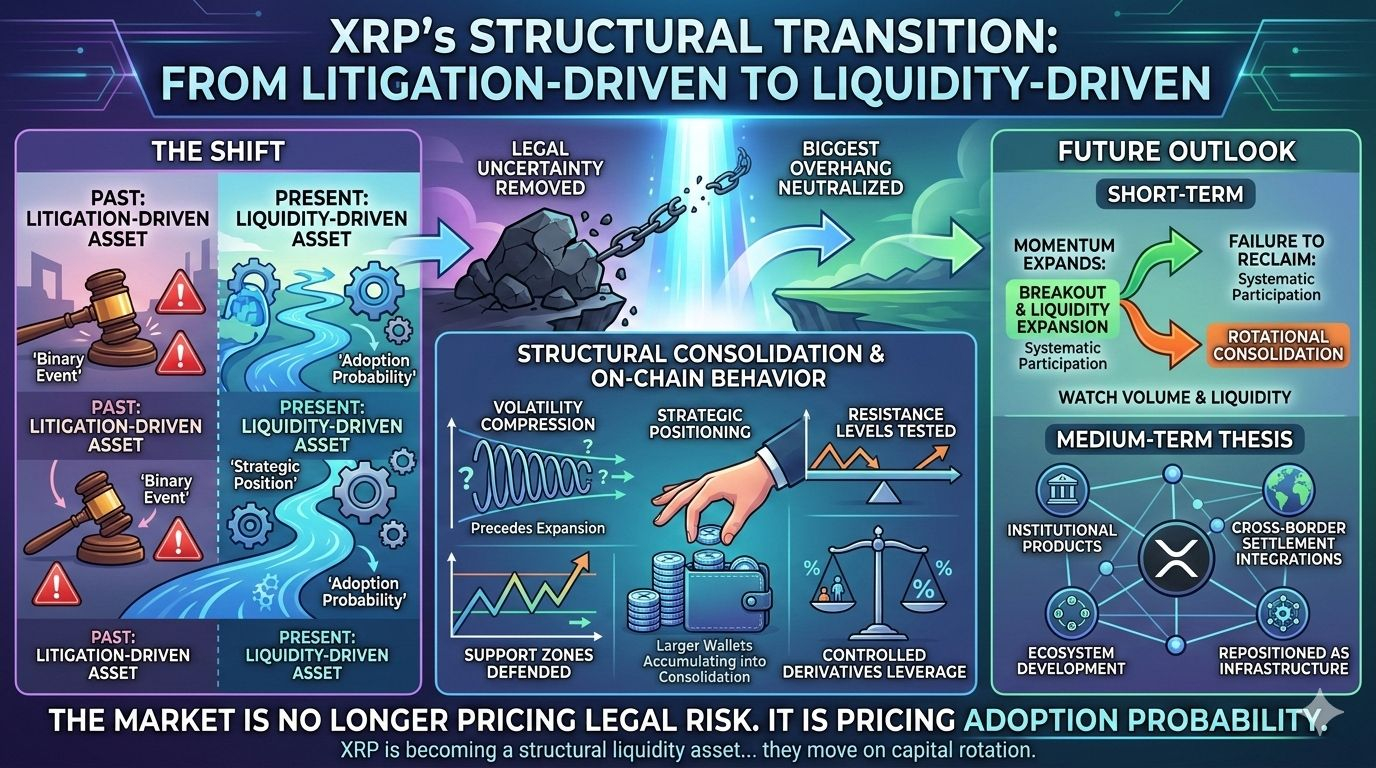
For years, uncertainty defined the narrative around . Today, that variable is largely neutralized. With the legal chapter involving effectively resolved, XRP has transitioned from a litigation-driven asset to a liquidity-driven one. That shift matters more than most traders realize.
What we’re seeing now is structural consolidation — not weakness.
Price action has been range-bound, reflecting equilibrium between post-clarity accumulation and broader market hesitation. Volatility compression typically precedes expansion. The key question is direction, not movement.
On-chain behavior shows strategic positioning rather than speculative frenzy. Larger wallets have been steadily accumulating into consolidation phases. That’s not euphoria — that’s positioning. Meanwhile, derivatives activity suggests controlled leverage, not overheated conditions.
From a structural standpoint:
Support zones are being defended consistently.
Resistance levels are tested but not aggressively rejected.
Volume patterns suggest absorption, not distribution.
This is what transition phases look like.
Short-Term Outlook:
If momentum expands with broader crypto strength, XRP has room to challenge higher resistance bands. A confirmed breakout would likely trigger liquidity expansion and systematic participation. Failure to reclaim upper ranges keeps price rotational within consolidation.
Medium-Term Thesis:
The removal of regulatory uncertainty repositions XRP as infrastructure, not just a trade. Institutional products, cross-border settlement integrations, and ecosystem development now matter more than courtroom headlines.
The market is no longer pricing legal risk. It is pricing adoption probability.
That’s a completely different framework.
XRP is no longer a binary event asset. It’s becoming a structural liquidity asset.
And structural assets don’t move on hype — they move on capital rotation.
Watch volume. Watch liquidity inflows. Watch breakout confirmation.
The compression phase won’t last forever.