
How I Experienced AI Reliability with Mira Network
When I first started exploring Mira Network, I didn’t expect to be so drawn in. I remember sitting at my desk, running some AI-generated content through the platform, and immediately noticing something different.
Unlike other AI tools I’ve used, where outputs often felt half-baked or required constant double-checking, Mira’s system gave me a sense of confidence I hadn’t felt before. I could see that the claims generated were being verified across multiple nodes, and the way the network handled errors penalizing inaccurate validators while rewarding consistent ones actually made me pause and think: this is how decentralized AI should work in practice. Watching the verification cycles unfold in real time felt almost like participating in a living system rather than just observing code on a screen.
Here’s what I found interesting when I dove in. Mira doesn’t just store AI outputs on a blockchain. It breaks every output into smaller claims and sends them to multiple AI nodes for verification. Each node reviews, cross-checks, and submits its assessment, and any inaccurate or careless reporting comes with a real cost the node loses stake. I watched a few of these verification cycles during testing, and it’s impressive how the system self-corrects. Validators who made mistakes quickly adjusted their approach, while consistent, accurate nodes earned rewards. It’s a small detail, but to me it signals real accountability built into the mechanics.
Then there’s the token side of things. $MIRA isn’t just another speculative coin. It’s woven into the network’s functioning. Node operators have to stake $MIRA to participate in verification. During my observations, I noticed that nodes with more at stake produced outputs that passed verification more consistently. That alignment between risk and accuracy is subtle but important: it means the network incentivizes honesty and quality, not just participation. For traders or creators looking for projects with real utility, that kind of design matters it’s measurable, it’s practical, and it’s observable.
I also started thinking about where Mira fits in the bigger picture. AI adoption is spreading fast, but reliability hasn’t kept up. Enterprises, content creators, and even DeFi platforms need outputs they can trust. Mira doesn’t try to replace AI; it makes AI verifiable and accountable. I personally ran a few test outputs through the system, and the difference was clear: outputs that went through Mira’s verification process were more consistent, easier to rely on, and less prone to subtle errors. It’s like having a built-in quality control system for AI, which is something you can’t easily replicate with any other project right now.
From my own experience participating in early verification rounds, the network behavior itself tells a story. Nodes respond naturally to incentives: mistakes are penalized, accuracy is rewarded, and over time, the system shapes itself toward reliability. Watching this in real time gave me confidence that Mira isn’t just theoretical—it works as intended, and you can see it happen. That’s rare in the crypto space, where “decentralization” often exists more on paper than in practice.
For creators and traders, this setup has real implications. $MIRA isn’t a passive asset—it’s directly tied to network performance and reliability. That adds a layer of utility beyond speculation. As someone tracking token flows and verification outcomes, I can see how engagement itself reinforces network health. Participating isn’t just about earning rewards; it directly improves the trustworthiness of AI outputs across the network. That’s a kind of value that feels tangible, practical, and sustainable.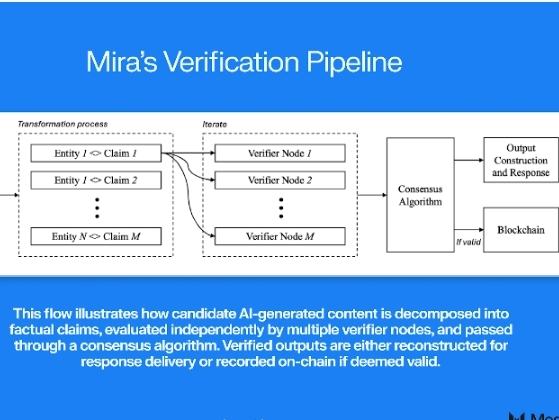
The biggest takeaway for me? Mira Network turns AI from something you admire from afar into something you can actually trust and rely on, without central oversight. It’s not promising perfection. It’s promising verifiable, accountable, and economically enforced reliability and that’s a distinction that makes all the difference. In an ecosystem full of flashy projects, Mira stands out because it focuses on substance over hype, and I can see it in action.