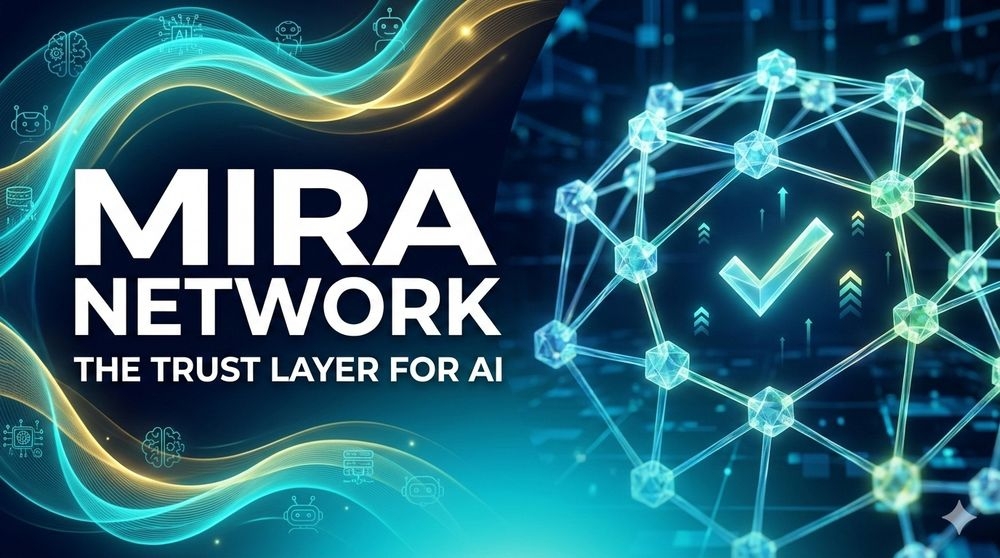
Artificial intelligence is advancing at an extraordinary pace. It writes reports, powers trading systems, supports medical research, and drives automation across industries. Yet behind its impressive capabilities lies a serious challenge reliability. AI models can hallucinate facts, reflect hidden biases, and produce confident but inaccurate responses. In critical sectors, even a small error can create massive consequences. Mira Network was built to confront this problem directly and reshape how the world trusts AI.
Mira Network is a decentralized verification protocol designed to transform AI outputs into cryptographically validated intelligence. Instead of relying on a single centralized model to generate answers, Mira introduces a multi layer validation system that ensures outputs are checked, confirmed, and secured before being trusted.
The process begins by breaking complex AI generated responses into smaller, verifiable claims. Each claim is distributed across a network of independent AI validators. These validators operate separately, analyzing logic, consistency, and factual alignment. By decentralizing the review process, Mira reduces the risk of unchecked hallucinations or biased reasoning influencing final results.
Once validation occurs, blockchain based consensus mechanisms determine whether the claims meet predefined accuracy standards. Only when consensus is reached does the system finalize the output. This consensus is recorded cryptographically, creating transparency and auditability. The result is not simply an AI generated answer. It becomes verified intelligence supported by decentralized agreement.
A key strength of Mira Network is its trustless architecture. Traditional AI systems rely heavily on centralized control and reputation based trust. $MIRA replaces that structure with mathematically enforced consensus. Trust is not assumed. It is earned through verification and secured through blockchain technology. This shift removes dependency on any single authority and distributes reliability across the network.
Economic incentives play an essential role in maintaining integrity. Validators are rewarded for accurate and honest participation. Malicious behavior or low quality validation is discouraged through penalties. This incentive structure aligns participants toward maintaining reliability and strengthening the overall ecosystem.
The real world applications of Mira Network are significant. In financial markets, AI driven analysis can be verified before execution, reducing risk exposure. In healthcare, diagnostic assistance can undergo decentralized validation before influencing patient decisions. Enterprises can integrate AI into operational workflows with greater confidence, knowing outputs have passed consensus verification. Autonomous agents operating in complex systems can rely on validated intelligence rather than uncertain predictions.
@Mira - Trust Layer of AI also supports interoperability. Because the verification layer is model agnostic, different AI systems can contribute to validation without being restricted to a single provider. This open framework reduces systemic risk and encourages innovation across the broader AI landscape.
As artificial intelligence becomes more deeply integrated into global systems, reliability becomes the foundation of adoption. Power alone is not enough. Accuracy, transparency, and accountability are essential for long term trust. $MIRA lNetwork positions itself as the infrastructure layer that bridges advanced AI capabilities with verifiable security.
$MIRA @Mira - Trust Layer of AI #mira
By converting uncertain outputs into consensus backed results, Mira Network creates a future where artificial intelligence can operate with confidence and accountability. In a world increasingly shaped by automation and machine reasoning, decentralized verification may become the standard that defines trustworthy intelligence.