
When I look at the emerging robot economy, I don’t just see automation, I see governance. And that’s exactly where ROBO becomes more than a token. From what I’ve studied, ROBO and the Fabric Foundation are not simply building coordination software; they are designing the rulebook for machine-to-machine civilization.
In the opening layers of the Fabric Protocol, you can already see how ROBO, the Fabric Foundation, and the broader governance model are tightly interwoven. ROBO isn’t floating above the system, it is embedded inside the authority structure that determines how robots act, earn, and resolve conflict.
Most robotics discussions revolve around efficiency. Faster robots. Smarter AI. Better sensors. But very few ask the harder question: who sets the rules when machines transact value autonomously? That’s the political layer of decentralized robotics. And in my view, ROBO is attempting to formalize that layer through protocol governance rather than corporate oversight.
The Fabric Foundation frames robots as economic actors with on-chain identity, machine-level wallets, and programmable task execution. But once robots become economic agents, governance becomes unavoidable. Who approves protocol upgrades? Who defines task standards? Who adjusts payment rails? These are not technical questions alone, they are structural power questions. That’s where ROBO plays a central role.
Through the Fabric Protocol, ROBO anchors governance decisions to token-based coordination. The Robot Identity Registry, coordination networks, and payment rails all operate within parameters that can evolve. And evolution requires structured consent. Instead of relying on a single corporate operator, the Fabric Foundation distributes influence through the ROBO token.
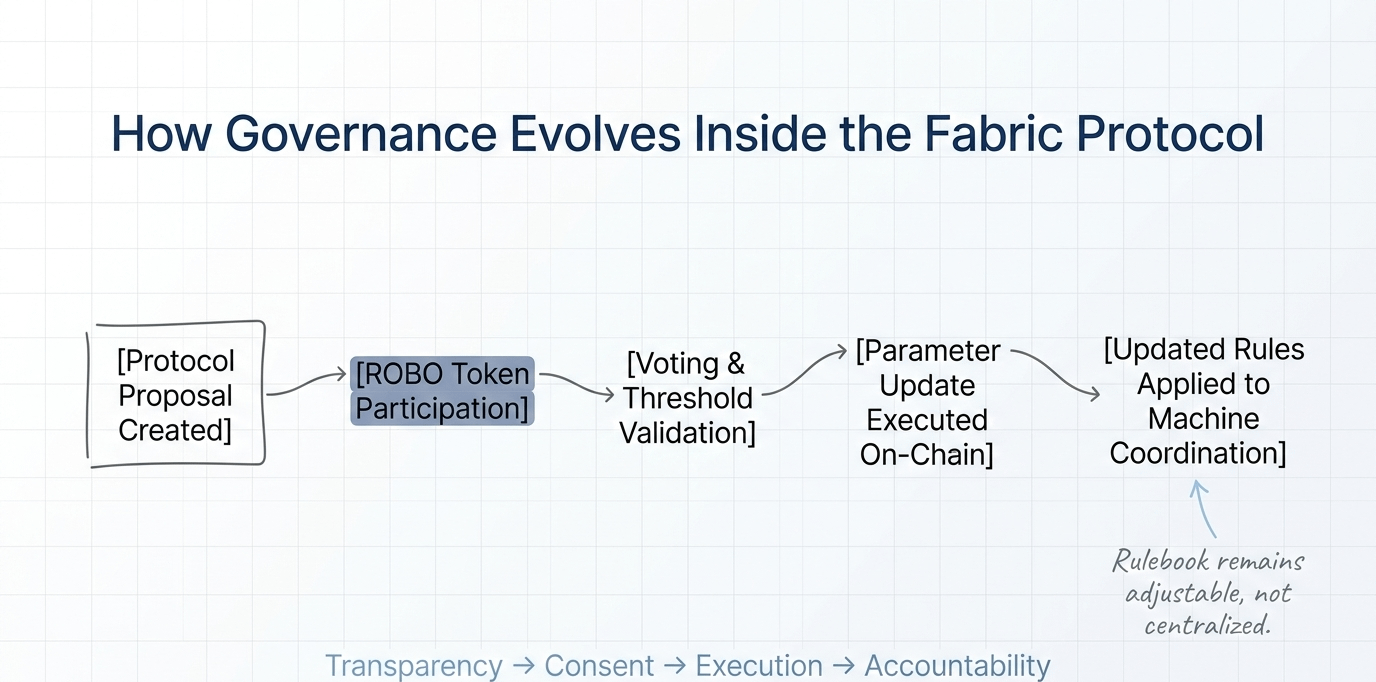
What makes this interesting to me is how governance connects to accountability. If robots execute tasks autonomously, but the rules governing those tasks can change, the governance layer must remain transparent. ROBO is not just fuel for transactions; it is also a mechanism to shape protocol direction. That gives stakeholders a voice in how machine economies function.
Let’s consider coordination standards. Suppose the Fabric Protocol tightens verification requirements for autonomous task execution. That decision impacts cost structures, execution latency, and liability exposure. Under a centralized system, that change would come from executives. Within the ROBO ecosystem, governance anchored in the token allows distributed input into those structural shifts.
The Fabric Foundation also introduces programmable compliance within the protocol. Instead of external regulators imposing oversight after deployment, the Fabric layer encodes operational standards directly. In this sense, ROBO doesn’t resist governance, it internalizes it. The robot economy becomes self-regulating through transparent rule updates.
I’ve noticed that many blockchain ecosystems treat governance as a marketing feature. With ROBO, governance appears functional. Machine-level wallets settle payments automatically. Coordination networks validate task completion. On-chain identity links action to entity. When these primitives evolve, the governance model behind ROBO determines how trust scales.
Another dimension is economic policy inside the robot economy. Since ROBO flows only where verified work occurs, incentives align with operational contribution. That policy choice is political in nature. The Fabric Foundation deliberately rejected passive yield mechanics. By ensuring ROBO accrues value through productive robot activity, it defines an economic philosophy: output over speculation.
The governance architecture also intersects with interoperability. As more robotic platforms integrate into the Fabric Protocol, rule harmonization becomes critical. ROBO holders effectively shape the standards that external robotics networks must meet to participate. That transforms ROBO from a utility token into a coordination instrument.
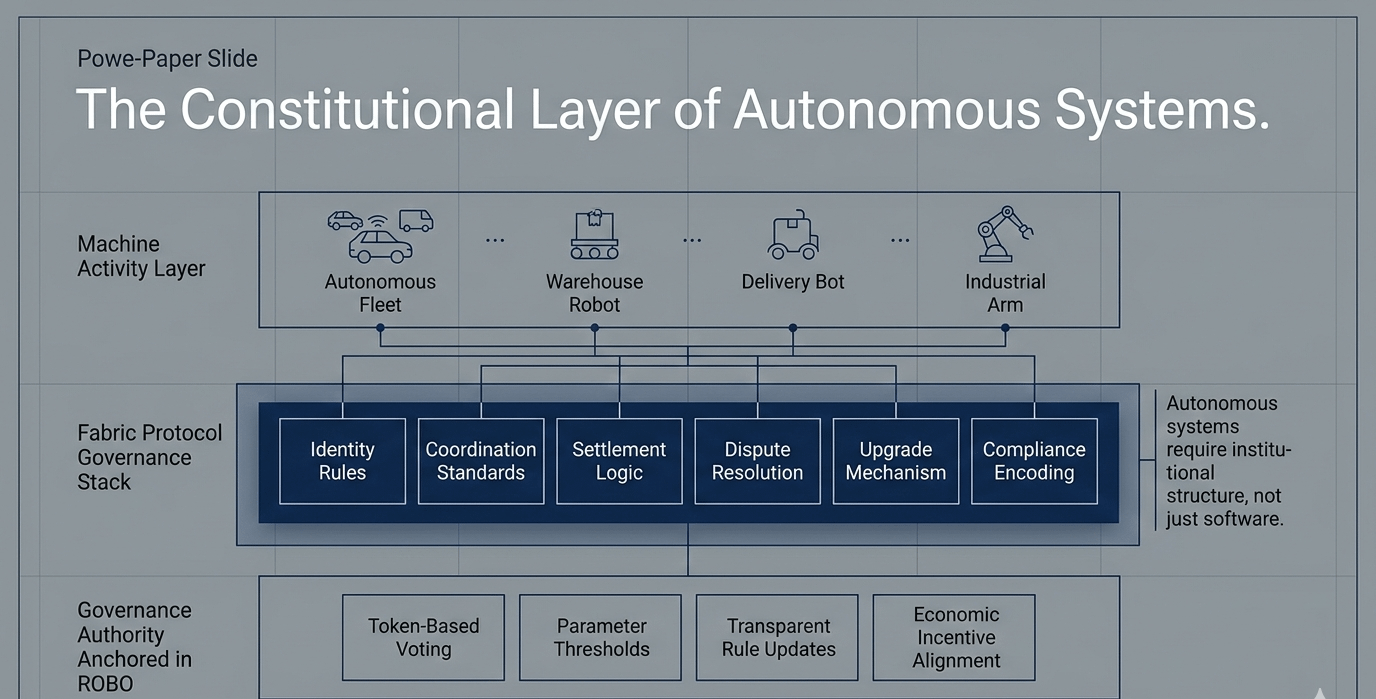
From a macro perspective, I see the Fabric Foundation building a constitutional layer for autonomous systems. Identity rules, dispute resolution pathways, settlement logic, and coordination thresholds are not static. They require oversight that scales with adoption. ROBO provides the mechanism through which that oversight evolves without reverting to centralized command.
We also have to consider long-term sovereignty. If autonomous fleets operate across jurisdictions, traditional regulatory frameworks may struggle to keep pace. Embedding governance inside ROBO allows the ecosystem to adapt dynamically. The protocol can refine compliance requirements, modify coordination thresholds, and update identity verification standards through structured token participation.
The deeper I examine the Fabric Protocol, the clearer it becomes that this isn’t just robotics infrastructure. It’s institutional design. ROBO acts as connective tissue between economic activity and governance authority. The Fabric Foundation does not merely deploy software, it architects a governance stack for machine civilization.
And this is where the politics of the robot economy truly reside. Not in speeches or corporate press releases, but in protocol parameters, voting thresholds, and encoded standards. ROBO ensures that those parameters are not frozen or monopolized. They remain adjustable, transparent, and economically aligned.
If decentralized robotics is going to scale responsibly, governance cannot remain informal. It must be structured, auditable, and incentive-compatible. In my assessment, ROBO and the Fabric Foundation are attempting to solve that governance equation before fragmentation sets in.
The robot economy will not be shaped solely by hardware capability. It will be shaped by who controls the rulebook. With ROBO, that rulebook is not hidden in boardrooms, it is written into the protocol itself.
@Fabric Foundation #ROBO $ROBO #robo
