
Pick two. You can't have all three.
That's how trilemmas work in crypto—Ethereum's scalability/security/decentralization problem gets discussed endlessly. But there's another trilemma nobody's mapped yet, and it's blocking robotics deployment at scale.
The Robot Coordination Trilemma:
Interoperability (robots from different makers work together)
Verifiability (prove robots actually did what they claim)
Neutrality (no single company controls the system)
Traditional robotics picks two, sacrifices one. Always.
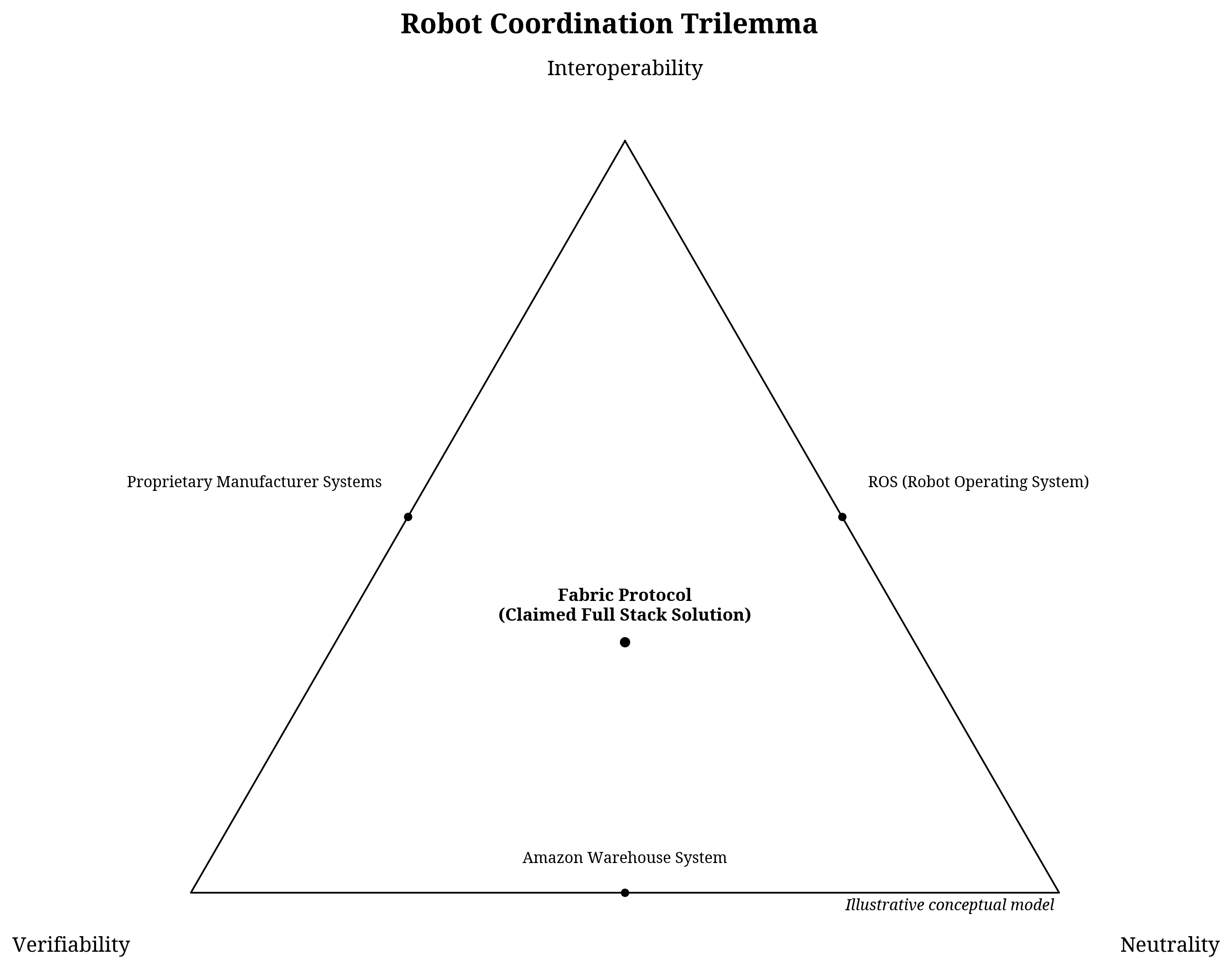
Amazon's warehouse robots? Verifiable (Amazon controls the data) + Neutral within Amazon's system (one database) = No interoperability. Those robots don't work with anyone else's systems.
ROS (Robot Operating System)? Interoperable (works across manufacturers) + Neutral (open-source, nobody owns it) = No verifiability. How do you prove a robot completed a task when there's no authoritative record?
Manufacturer proprietary systems? Verifiable (company database) + Interoperable (within their ecosystem) = No neutrality. Tesla controls Tesla robots. Boston Dynamics controls Atlas.
Fabric Foundation looked at this trilemma and said: Blockchain solves it.
Let me show you why they're right—and where they might be wrong.
How Fabric Foundation Attacks Each Corner
INTEROPERABILITY: The OM1 Play
OpenMind's OM1 operating system runs on hardware from UBTech, AgiBot, Fourier Intelligence, and Unitree. That's four major manufacturers (all Chinese, notably) agreeing to run the same OS.
Why'd they agree? Because OM1 doesn't lock them in. It's open-source. Released on GitHub in September 2025. Any manufacturer can fork it, modify it, integrate it. But if they stay on the main branch, they get automatic compatibility with Fabric Foundation's coordination network.
The January 2026 Robot App Store launch proves this works. Developers write once, deploy everywhere. Compare that to traditional robotics where you'd need separate codebases for each manufacturer's API.
Data point: OM1 integrates with OpenAI, Gemini, DeepSeek, and other AI models. It's hardware-agnostic—runs on AMD64 and ARM64 via Docker. That's genuine technical interoperability, not just marketing.
But here's the catch: All four hardware partners are Chinese companies. Where's the Western adoption? Boston Dynamics? Figure AI? Tesla? Crickets.
That's not technical failure. It's geopolitical reality. US robotics companies won't run Chinese-backed infrastructure. Fabric Foundation has interoperability within China's robotics ecosystem. Globally? Unproven.
VERIFIABILITY: The Blockchain Bet
February 18, 2026 changed things. The x402 protocol launch with Circle means robots can now autonomously pay for services—and every transaction creates an auditable record.
Here's how verification actually works in Fabric Foundation's system:
Step 1: Robot completes task, sensors collect performance data
Step 2: Data gets cryptographically signed using robot's private key
Step 3: Signed data submitted to Fabric Protocol validators
Step 4: Validators check: data format correct? Signature matches registered identity? Task within authorized permissions?
Step 5: If verified, task completion written to public ledger
Step 6: Robot's permanent identity record updates
Step 7: $ROBO distributed to operator as payment
This is Proof of Robotic Work. It's not Proof of Stake (validators don't just lock capital). It's not Proof of Work (no mining). It's proof that a specific physical robot completed a specific physical task.
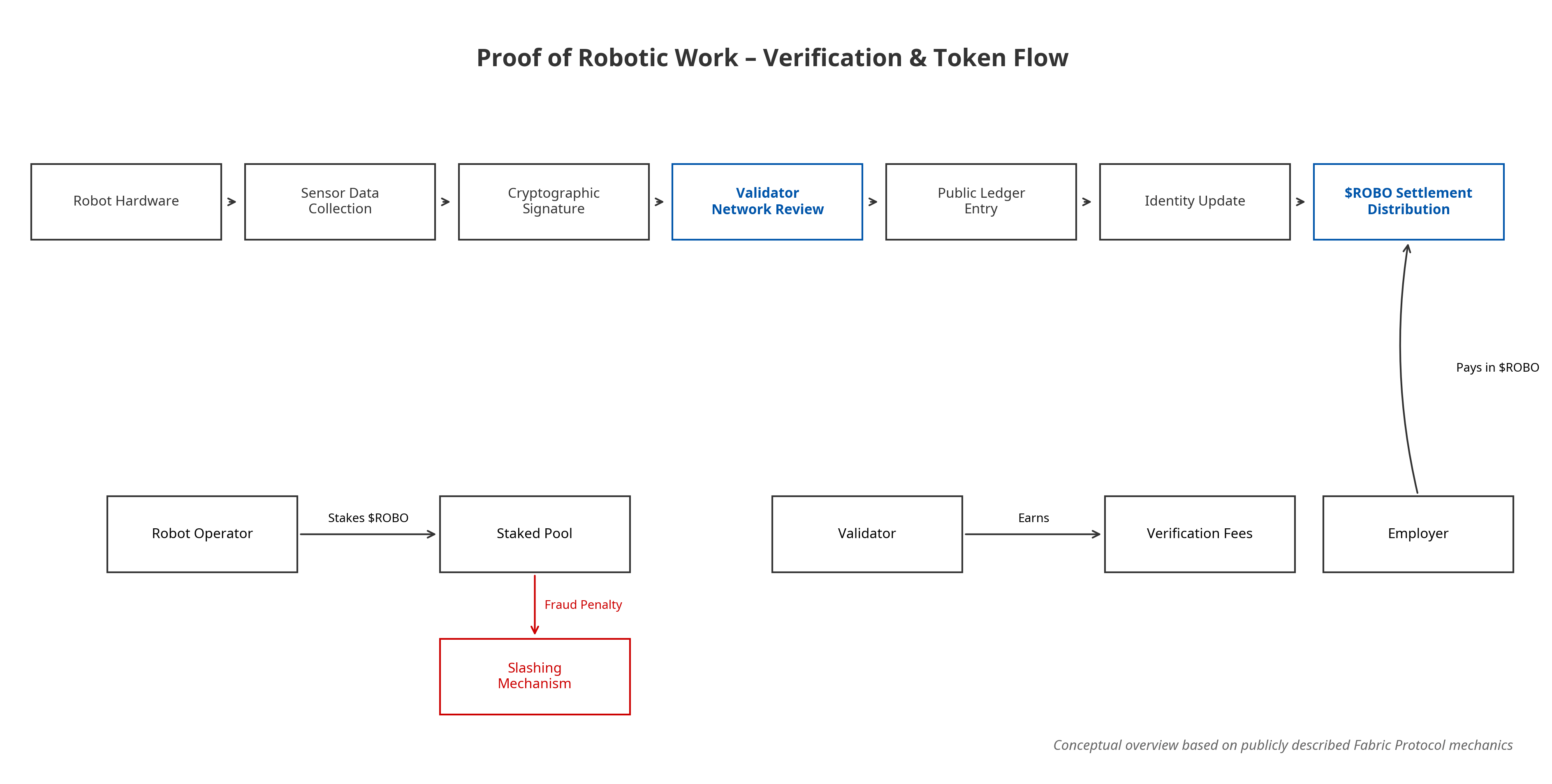
The genius part? Economic incentives align with honesty. Robot operators stake ROBO when registering hardware. That stake gets slashed if they submit fraudulent task claims. Employers pay in ROBO. Validators earn ROBO for checking submissions.
Nobody trusts anyone. Everyone verifies cryptographically.
But: This only works if there's enough ROBO demand to make the staking/slashing mechanism meaningful. Current market cap is ~$111M. If a major operator deploys 1,000 robots, how much ROBO do they need to stake? What's the slash amount for fraud? These numbers matter, and Fabric Foundation hasn't published detailed tokenomics specifications yet.
NEUTRALITY: The Foundation Structure
This is where it gets interesting politically.
Fabric Foundation is structured as an independent non-profit. OpenMind (which builds OM1) is a separate entity and core contributor—not the token issuer. Fabric Protocol Ltd. (BVI-incorporated) issues the token.
Why this structure? Because neutrality requires it.
If UBTech controlled Fabric Protocol, AgiBot wouldn't use it. If a VC-backed company owned it, manufacturers would worry about future pricing changes or data exploitation. By separating the foundation (governance), the technology (OpenMind), and the token entity (Fabric Protocol Ltd), they created structural neutrality.
Compare this to how Tesla builds Optimus. Everything's proprietary. Tesla owns the hardware, software, data, and monetization. That's fine for Tesla's business model, but it means Optimus will never coordinate with Figure AI's robots. They're competitors.
Fabric Foundation positioned itself as neutral infrastructure both companies could theoretically use. Like TCP/IP for robots. Nobody owns TCP/IP. Everybody uses it.
The risk? Foundation structures sound great until economic pressure hits. Ethereum Foundation claims neutrality too, but Vitalik Buterin's influence is undeniable. Who really controls Fabric Foundation's direction? The $20M from Pantera and Coinbase Ventures came with terms. VCs don't give money without influence.
True neutrality is rare. Claimed neutrality is common.
Why The Trilemma Matters For ROBO Value
Here's my actual analysis of token value capture:
If Fabric Foundation achieves all three (interoperability + verifiability + neutrality):
Every robot needs a ROBO-staked identity to register
Every cross-manufacturer task needs ROBO settlement
Every verification needs ROBO validator fees
Demand scales with robot deployment numbers
If they only get two out of three:
Limited interoperability = small addressable market (Chinese manufacturers only)
Weak verifiability = employers don't trust the system, go with proprietary solutions
Compromised neutrality = manufacturers build competing standards
Current state (March 2026):
Interoperability: ✓ within China, ✗ globally
Verifiability: ✓ technically sound, ? economically untested at scale
Neutrality: ✓ structurally, ? practically
The March 2 data showing $111.4M volume against $111.6M market cap (1:1 ratio) suggests people are using ROBO, not just holding it. That's bullish for utility. But what percentage of that volume is actual robot coordination vs. speculative trading? We don't know because Fabric Foundation hasn't published on-chain metrics about registered robots or task settlements.
That's the data I actually want to see:
How many robots currently registered on Fabric Protocol?
How many tasks verified through Proof of Robotic Work?
What's the daily ROBO burn rate from transaction fees?
How much ROBO is staked for robot registration vs. liquid supply?
Without these numbers, we're analyzing architecture, not usage.
The Uncomfortable Question
Does solving the robot coordination trilemma even matter if deployment happens slowly?
Fabric Foundation built infrastructure for a world with millions of deployed robots coordinating across manufacturers. But what if that world is 2030, not 2026? What if Tesla, Boston Dynamics, and Figure AI all succeed with closed systems before interoperability becomes necessary?
The $150B robotics market projection everyone cites assumes fast adoption. But humanoid robots cost $50K-$150K currently. UBTech's Walker S costs $90K. Unitree's cheaper R1 at $5,900 is still expensive for consumer adoption. Enterprise deployment requires ROI justification, regulatory approval, insurance frameworks that don't exist yet.
Maybe Fabric Foundation is early. Maybe they're building infrastructure the market needs in 2028 but doesn't need today.
That's the bear case. They solved the trilemma technically. But if adoption timelines stretch longer than their $20M runway and token vesting schedules, being technically correct doesn't matter.
The bull case? If just one major Western manufacturer adopts OM1, the network effects accelerate dramatically. If NVIDIA officially endorses OM1 as the preferred OS for Jetson-powered robots, Fabric Foundation instantly accesses thousands of existing deployments. If Circle's USDC integration makes enterprise adoption frictionless, the coordination network could achieve critical mass faster than competing standards emerge.
I'm watching deployment numbers more than token price. Fabric Foundation needs to publish transparent metrics: registered robots, verified tasks, staked ROBO, transaction volume. Those numbers tell you if they're solving a real problem at scale or building impressive technology too early.
The coordination trilemma is real. Fabric Foundation's solution is technically sound. Whether the market adopts it before alternatives emerge—that's the actual question.