
Here's a number that stopped me: 150.
1️⃣5️⃣0️⃣🥕🥕🥕🥕
That's roughly how many robotic hardware manufacturers exist globally right now .
Boston Dynamics makes robots. Tesla makes robots. Unitree makes robots. Add another 147 companies you've probably never heard of.
Each of them builds their own systems. Their own software stacks. Their own communication protocols. Their own closed ecosystems.
The result?
A delivery robot from Company A can't tell a warehouse robot from Company B that it's arrived. A security robot from Company C can't ask a cleaning robot from Company D for help navigating around a spill. Humans end up running around with tablets, manually moving data between machines .
This is where Fabric Protocol starts to make sense.
@Fabric Foundation isn't building another robot. The market doesn't need another robot. It needs a way for the 150+ types of robots already out there to actually talk to each other.
The team behind it comes from places you'd expect if you were serious about this problem.
Jan Liphardt, co-founder, is a Stanford professor who's done work for NIH, NSF, and the Department of Energy . CTO Boyuan Chen came from MIT CSAIL and Google DeepMind .
Advisors include the former CEO of Willow Garage, the folks who basically created the Robot Operating System (ROS) that much of robotics runs on today .
In August 2025, they raised $20 million.
Lead investor? Pantera Capital.
Also participating: Coinbase Ventures, Digital Currency Group, Ribbit Capital, Sequoia China, Amber Group . That's not a random crypto fund throwaway. That's deep-tech infrastructure investors betting on a specific thesis.
The thesis outlined is: Robots need an operating system AND an economic layer.
They've built two things so far.
First, OM1. It's an open-source operating system for robots. Think Android, but for machines . It handles perception, memory, reasoning, action—the whole loop.
It's hardware-agnostic, so developers don't have to rewrite code for every single robot type. It already runs on Unitree's humanoid robots, quadrupedal bots, and more . The beta dropped in September 2025. It's on GitHub (MIT license), and developers worldwide are contributing .
Second, the FABRIC protocol. This is the coordination layer. It gives robots on-chain identities. It lets them verify each other. It records actions on a public ledger. And crucially, it enables them to pay each other .
That last part is where $ROBO enters the picture.
$ROBO is the native token. Total supply: 10 billion, fixed . Distribution breakdown:
· Ecosystem & Community: 29.7% (30% unlocked at TGE, rest over 40 months)
· Investors: 24.3% (12-month cliff, then 36 months linear)
· Team & Advisors: 20% (same lockup as investors)
· Foundation Reserve: 18% (30% at TGE, rest over 40 months)
· Community Airdrop: 5% (100% at TGE)
· Liquidity & Launch: 2.5% (100% at TGE)
· Public Sale: 0.5% (100% at TGE, $400M FDV)
The public sale was tiny—just half a percent. It launched on Kaito in January and was oversubscribed . By late February, $ROBO hit Binance Alpha. First two days of trading? Over $140 million in volume . Then listings on Coinbase, Kraken, OKX, Bybit, Gate.io . That's not typical for a project this early.
But here's what actually matters: real-world deployment.
OpenMind (the core development team behind Fabric) partnered with Circle. You know, the folks behind USDC .
Together, they're building payment infrastructure for autonomous machines. The first concrete use case? Robot charging stations .
Picture this example: A delivery robot's battery is low. It navigates to a charging station. The station recognizes its on-chain identity. The robot pays using USDC (or ROBO) automatically. No human swipes a card. No paperwork. No monthly invoice review. Just machine-to-machine commerce, settled instantly .
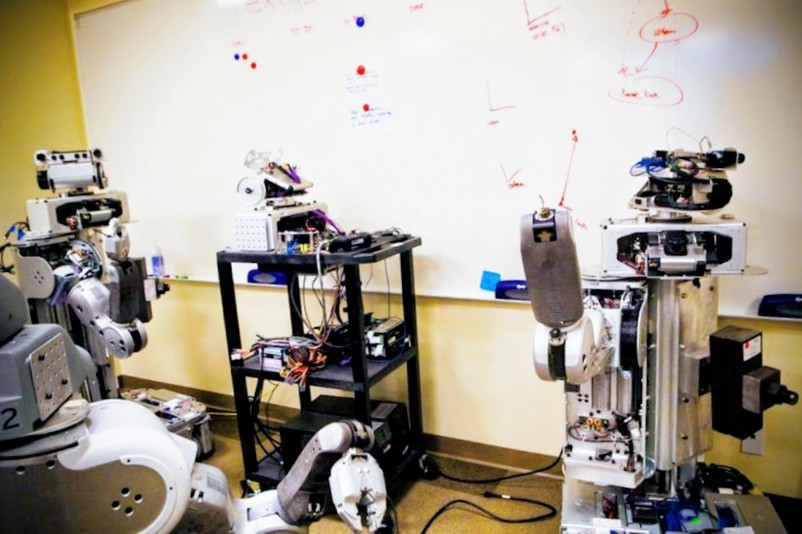
That's not a theory. That's deployment scheduled for the coming months .
Why this matters more than "AI agent" hype.
Most AI x Crypto projects are about software agents trading tokens or posting on social media. Those are fine. But they don't touch the physical world.
Fabric is building infrastructure for machines that actually do things. Move boxes. Clean floors. Deliver packages. Patrol perimeters. Care for elderly patients.
Those machines exist today. They're just isolated. They can't coordinate. They can't pay for services. They can't prove who they are to other machines .
Jan Liphardt put it simply: "If AI is the brain and robotics is the body, coordination is the nervous system. Without it, there's no intelligence—just motion" .
The risk side.
Let's be realistic. Fabric is early. Really early. The token launched less than a month ago . The OM1 beta just dropped. The charging station deployment hasn't happened yet. Hardware adoption is slow. Developer ecosystems take years to build .
The fixed supply means no inflation, but it also means demand has to come from actual usage—robot fleets paying for coordination, developers staking to access the network, enterprises using it for deployments . That usage isn't guaranteed.
And the team unlock schedule matters: investors and team are locked for 12 months, then release linearly over 36 . That means selling pressure starts in early 2027. Worth watching.
What I'm watching.
Not price. At least not yet.
I'm watching whether robots with OM1 actually ship in volume. Whether the charging stations go live. Whether developers start building skills on the network. Whether real robot fleets start using ROBO or real payments.
The numbers so far suggest people are paying attention. $140M in two days isn't nothing. Listings on every major exchange aren't nothing. A $20M raise from top-tier investors isn't nothing.
But attention isn't adoption. The next 12 months will tell us whether Fabric becomes the Android of robots—or just another interesting experiment.
For now, it's one of the few crypto projects that actually builds for the physical world.
That alone makes it worth watching.
Early acknowledge of a project of this potential should just be illegal.
🥕 🥕 🥕