
I realized the time window problem the day a task came back verified, looked clean, and still triggered a 30 second validity window in our runbook before we let the next step fire. Not because the verdict was wrong, but because the world it was verified in had already moved. The verdict wasn’t wrong, it was just late enough to be dangerous.
We started tracking a blunt proxy after that, rechecks per 100 tasks, and the number spiked during busy hours.
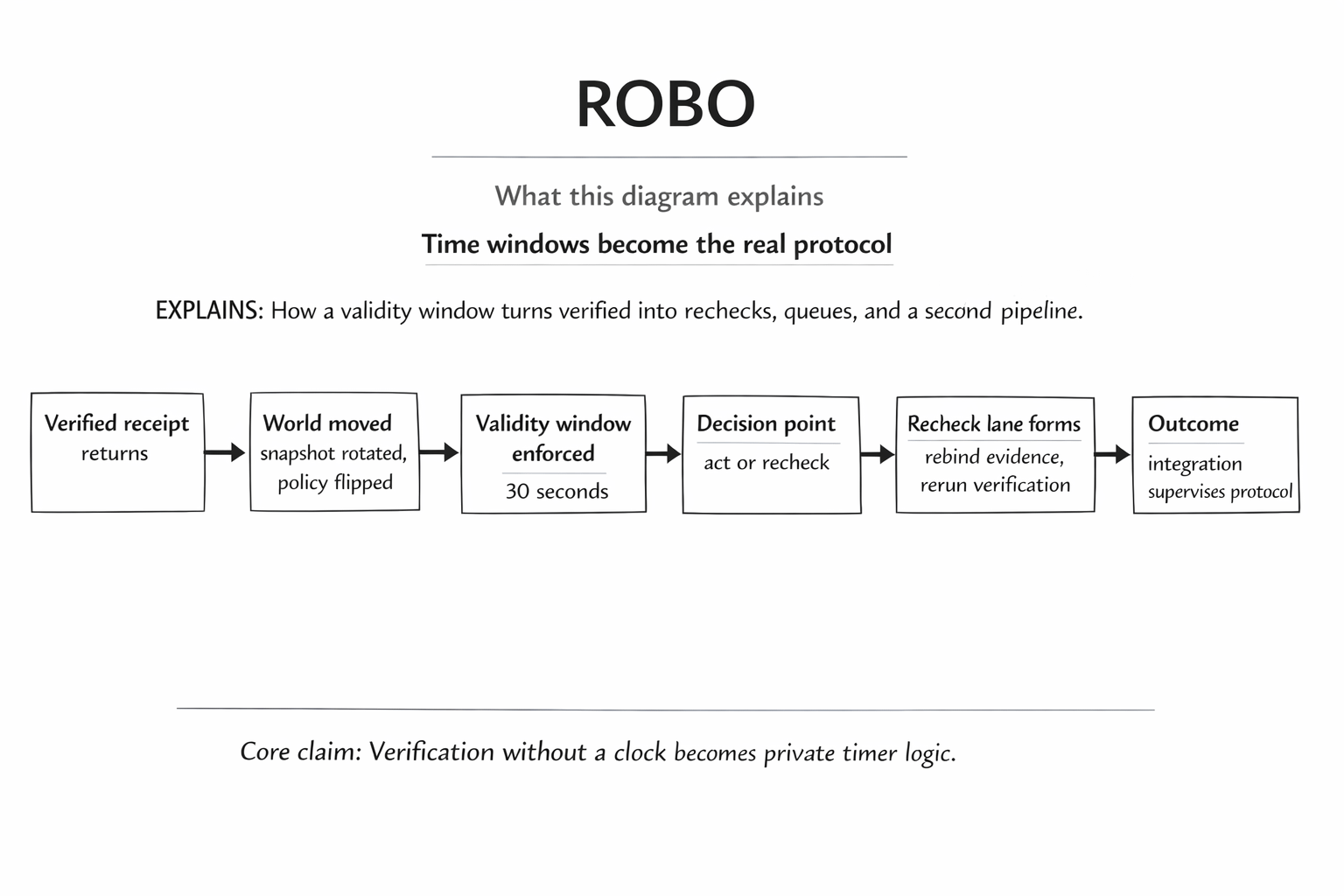 Verification without a clock is just a label.
The source snapshot had rotated. A policy bit had flipped. The environment the verifier checked no longer matched the environment my workflow was about to act in. The outcome was valid in a past world, and my next step lived in the current one.
That is how I end up reading ROBO, in practice.
One question, and it is operational.
When ROBO coordinates real work, freshness windows become the protocol.
Most systems talk about verification as if it is only a yes or no. In production, verification is also a timestamp. A claim is not just true or false. It is true under a specific snapshot, a specific policy state, a specific tool environment, and a specific moment.
On ROBO, a receipt is often a trigger, not a report. When the protocol does not make that moment explicit, the ecosystem adds expiry rules for it.
Staleness is not an edge case. It is the default failure mode of any automation stack that tries to act on the real world, because the world changes faster than the pipeline.
A work surface like ROBO has a loop. A task is posted. An operator produces an outcome. Evidence is gathered. Claims get checked. An acceptance signal is emitted. Downstream execution happens.
Now the only question that matters once the loop runs at scale.
How long is an accepted outcome safe to act on.
When that answer is unclear, the system trains a habit.
Wait, and recheck.
Once that habit shows up, it spreads fast. Wallets and apps add guard delays. Integrations add refresh lanes. Ops teams add watcher jobs that revalidate after success. None of these teams think they are rewriting anything. They think they are shipping reliability.
But they’re defining the time contract the network didn’t.
The artifacts appear in a predictable order.
Start with a small hold, wait 2 seconds, then proceed.
Add a validity window, discard anything that arrives outside 30 seconds, and recheck.
Wire a recheck loop, rebind evidence, rebuild the claim set, rerun verification, and try again.
Route anything outside the window into a reconciliation queue, where humans decide whether it is safe.
At that point, the network is still verifying, but the integration is supervising.
Freshness is not just a performance concern. It is a governance surface.
Without a protocol level staleness rule, integrators create their own, and they do not converge.
One team sets a 10 second window. Another sets 2 minutes. Another treats any policy change as invalidation. Another ignores policy changes and only refreshes on snapshot drift. Another routes anything risky to a human gate.
The result is fragmentation.
Not because the protocol forked, but because time did.
Different apps end up living in different realities for small windows of time. Not long enough to trigger an outage, long enough to create advantage. Bots live in those windows. Operators learn which windows are safe to exploit. Risk teams widen buffers because they were burned once.
This is where the boring work starts to matter.
A serious work surface needs a shared notion of freshness. A receipt needs an explicit validity bound, enforced the same way across the stack.
The alternative is not flexibility. The alternative is private expiry logic everywhere.
The bill shows up as traffic, complexity, and advantage. More reads, more rechecks, more state machines, and the same quiet outcome, whoever can refresh fastest acts first.
So the freshness decision is not just about safety. It is about what kind of behavior you train under load.
With no freshness discipline, you get fewer explicit failures, and more silent ambiguity. Integrators pad time, and autonomy quietly decays.
With strict freshness discipline, you get more visible rejections, and teams complain the system is harsh. Some of them will be right. Strict expiry narrows what can succeed, it forces cleaner bindings and phase boundaries, and it makes loose integrations pay upfront instead of leaking cost later.
But that strictness buys something the market misprices.
It keeps time policy from turning into a private market.
A stable and explicit no is better than a vague yes that expires unpredictably.
A vague yes is just a delayed no with extra blast radius.
This is also where you find out whether a network is truly coordinated, or merely coexisting.
When the protocol defines freshness, everyone plays the same time game. Apps stay single pass longer. Operators can reason about what a receipt means. Downstream automation can fire without consulting a second source.
When freshness is left to local rules, the system becomes a patchwork, and that patchwork is what turns autonomy into supervised automation.
$ROBO comes into focus only after you price that discipline.
You have to pay for fast rechecks, receipt completeness, and enforcement, otherwise the cost relocates into private providers.
If $ROBO is not tied to that operational reality, the cost leaks anyway. It leaks into private infrastructure deals, privileged data providers, and integrations that can afford aggressive recheck loops. The public network still exists, but the usable network belongs to whoever can pay to keep time under control.
The only way I know to evaluate this later is simple.
When ROBO is busy, integrators either rely on a shared freshness contract, or they start writing expiry rules locally.
Recheck loops either stay rare, or they become the second pipeline.
Watcher jobs either shrink, or they multiply.
Apps either converge on one definition of final enough, or they ship competing timer ladders.
By the time “refresh lane recommended” shows up in an integration doc, the time window is already the real protocol.
The day teams stop writing private expiry logic is the day time windows stopped being a hidden protocol.
Until then, the chain is not just coordinating work.
It is coordinating clocks.
And if the clocks do not agree, humans will.