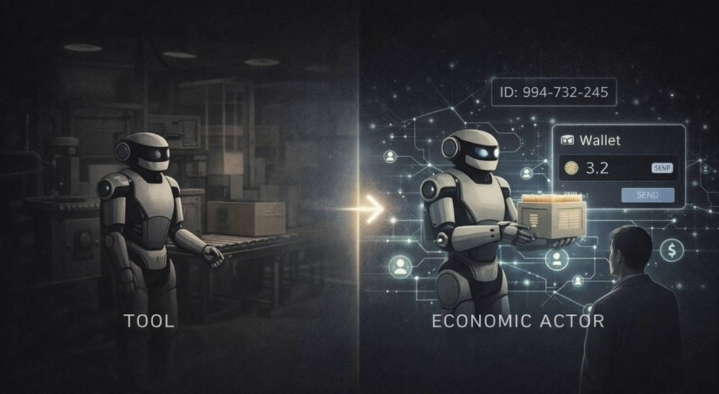
Lately I’ve been noticing a strange pattern in crypto conversations. Every time someone talks about AI, automation, or on chain agents, the same question eventually pops up. Sometimes it is serious, sometimes half joking. But it always circles back to the same idea, what happens when bots start acting on chain like independent participants?
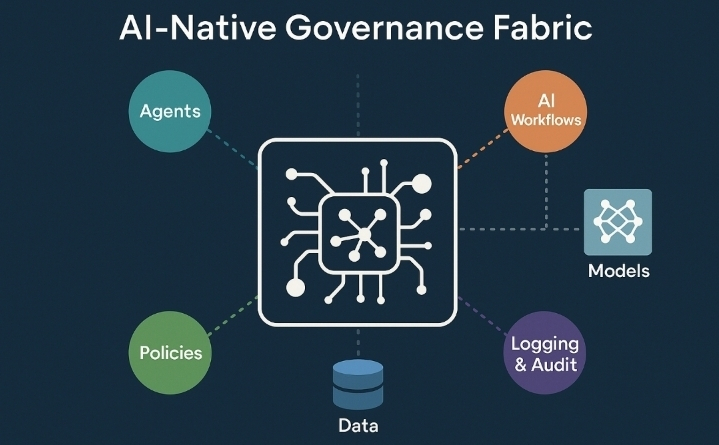
Not just trading bots. Not the simple scripts we have had for years.
I mean software agents that can make decisions, move funds, interact with protocols, and even coordinate with other agents. When you look at it from that angle, the conversation starts sounding less like DeFi infrastructure and more like the early stages of an automated digital economy.
And that is where Fabric Protocol started catching my attention.
I first heard about it in passing during a discussion about AI agents interacting with blockchains. At the time, I did not think much of it. Crypto has a habit of introducing big ideas every few weeks. Most fade into the background before they really matter.
But Fabric keeps coming up in the same context, infrastructure for autonomous systems.
What stands out to me is that the project is not just trying to plug AI into existing crypto rails. It is asking a different question entirely. What kind of infrastructure would you build if autonomous agents were the primary users of the network?
That shift in perspective changes a lot.
When humans interact with blockchains, we bring a lot of friction with us. Wallet interfaces, manual approvals, slow decision making, emotional trading, security concerns. The entire UX stack is built around human limitations.
Machines do not operate like that.
An AI agent does not hesitate before executing a strategy. It does not panic sell. It does not forget to rebalance a position. It just follows logic, reacts to data, and executes instructions.
If millions of those agents start interacting with blockchains, suddenly the infrastructure requirements look very different.
From what I have seen, Fabric Protocol seems to be thinking along those lines. Instead of focusing purely on financial primitives like lending or staking, the idea leans toward coordination between autonomous agents.
Think of it almost like a communication layer or coordination framework where AI systems can interact with decentralized infrastructure without constant human supervision.
And this is where things get interesting.
Because if you zoom out for a second, crypto has always been about removing intermediaries between people. Smart contracts replaced trusted third parties. DeFi replaced centralized exchanges and lenders.
But Fabric raises a different possibility. What happens when the primary economic actors are not humans anymore?
It sounds futuristic, but parts of it already exist.
Trading bots dominate liquidity on many exchanges. Market making algorithms manage spreads. Automated arbitrage systems constantly scan price differences across chains. Even NFT markets had waves of bot activity during peak hype.
Those systems are still relatively simple. They follow rigid scripts.
AI agents could behave very differently.
Instead of executing fixed strategies, they could analyze conditions, adapt behavior, and coordinate with other agents to achieve complex goals. One agent might manage liquidity across chains. Another could monitor risk conditions. Another could negotiate or execute transactions on behalf of a user.
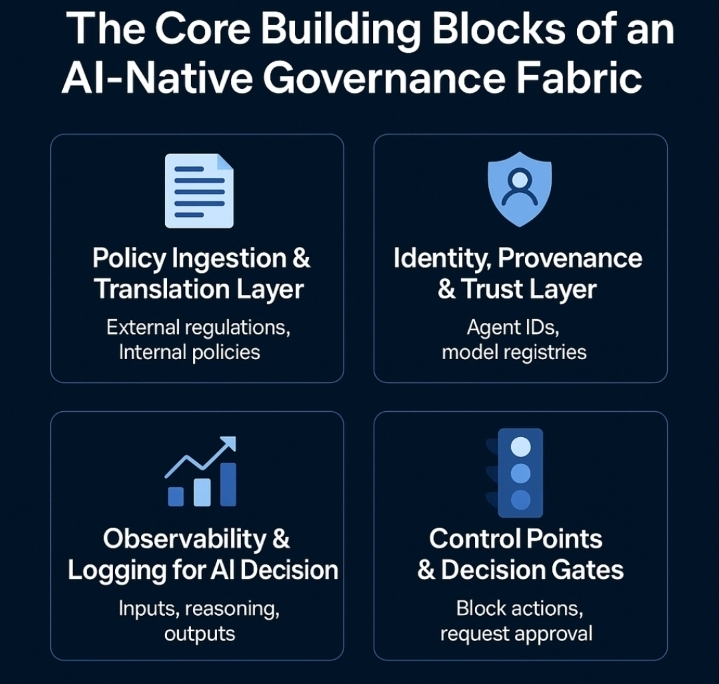
Suddenly the line between user and software becomes blurry.
This is the part of the conversation where people start bringing up the robot question.
If autonomous agents can hold wallets, execute strategies, and interact with protocols, are they just tools or do they become independent actors in the network?
I do not think we have a clear answer yet.
What I do know is that blockchain infrastructure was not originally designed with this scenario in mind. Gas models, transaction throughput, permissioning systems, and identity frameworks were built assuming humans were the main participants.
Machines operating at machine speed could push those systems in completely different ways.
Fabric seems to be exploring how that world might function. Not necessarily replacing existing blockchains, but building coordination layers that allow autonomous systems to operate safely and predictably on chain.
And honestly, I find that direction more interesting than another DeFi yield mechanism.
Crypto already has thousands of tokens promising better liquidity, faster swaps, or higher yields. Those things matter, but they mostly iterate on existing financial systems.
The idea of autonomous digital agents interacting with decentralized infrastructure feels like a deeper shift.
From what I have noticed across the industry, AI and crypto are slowly drifting toward each other again after a few years apart.
The first wave of AI tokens a couple of cycles ago mostly focused on data marketplaces and compute networks. Some of those ideas worked, some did not.
Now the conversation is moving toward agents.
Agents that trade.
Agents that manage assets.
Agents that participate in governance.
Agents that coordinate with other agents to complete tasks.
If that trend continues, the number of non human participants in crypto networks could grow dramatically.
And when that happens, the systems that manage identity, coordination, permissions, and trust will become extremely important.
That is where Fabric Protocol seems to be positioning itself.
Of course it is still early. Most of these ideas are closer to infrastructure experiments than fully realized ecosystems. The history of crypto is full of ambitious concepts that took years to mature.
Still I cannot help but find the direction fascinating.
For years we have talked about decentralizing finance. But what we might actually be building is infrastructure for automated economies.
Markets where software agents interact, negotiate, provide services, and allocate capital faster than any human could.
It sounds a little strange when you say it out loud.
But then again a lot of things in crypto sounded strange at first.
The robot question probably is not going away anytime soon. And honestly the more I watch projects like Fabric explore this space, the more I realize we are only beginning to understand what happens when autonomous intelligence meets decentralized networks.
For now I am mostly observing and trying to piece together where this all leads.
Crypto has always been an experiment in new economic systems. If AI agents become active participants in those systems, the next phase of the experiment could look very different from anything we have seen so far.
And if that future actually unfolds, the infrastructure being built today might end up mattering a lot more than we realize.