Alright, let's step away from the daily candle charts and dive into something foundational. We are looking at the Fabric Foundation, and its native asset, $ROBO.
If you've been in the space for more than five minutes, you know that 2026 is the year of "RWA" (Real-World Assets). The speculative bubble for "memecoins with utility" has popped, and capital is rotating hard into infrastructure that solves actual problems. This is where Fabric comes in.
The Executive Summary: What is Fabric?
The Fabric Foundation isn't trying to build another Layer-1 blockchain for games. It is building the unified interoperability and tokenization layer for the entire asset management industry.
Their core thesis is simple: The future of finance isn't many disconnected blockchains; it's tokenized liquidity that moves seamlessly across all chains.
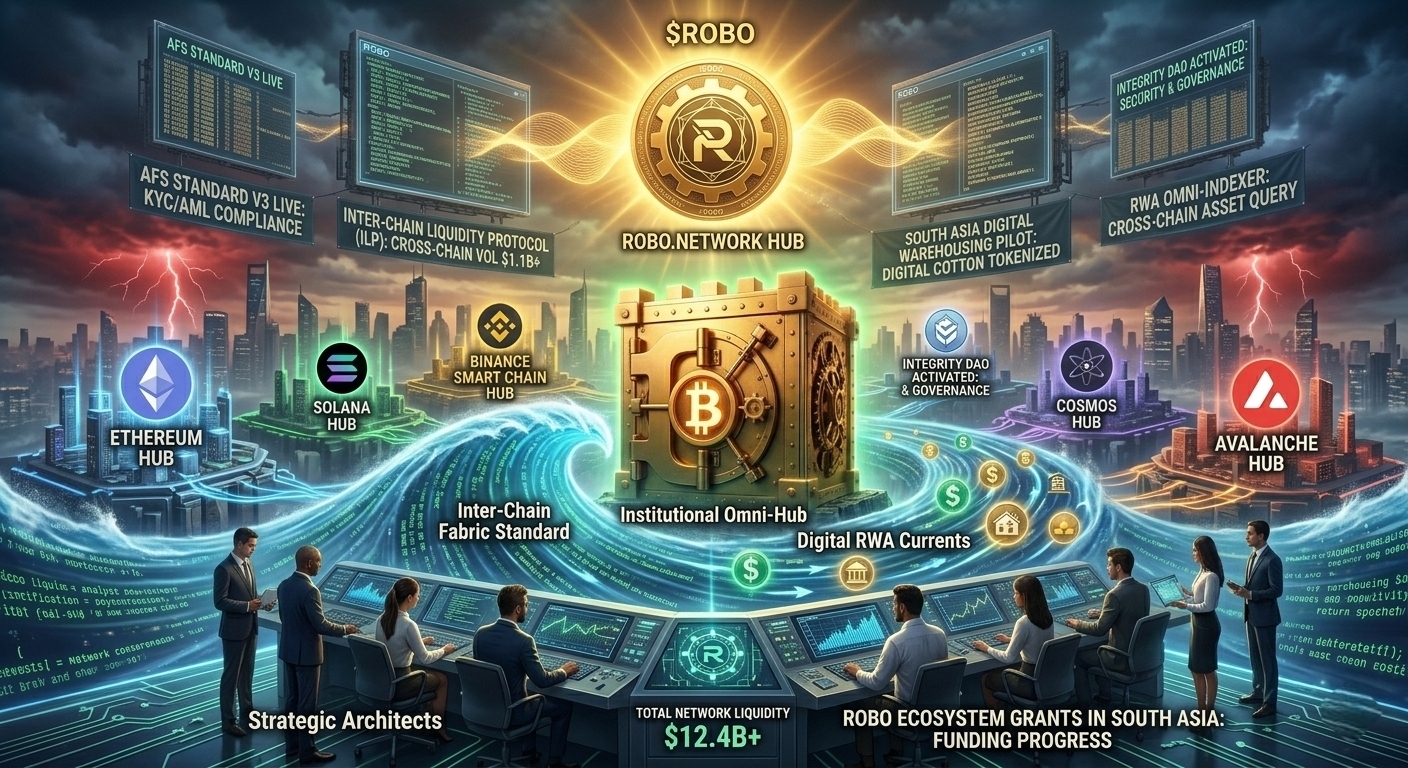
Fabric provides a standard (the "Asset Fabric Standard") and the tooling (the "Inter-Chain Protocol") that allows an asset manager to tokenize a property in Lahore, divide it into digital slices, and have those slices be immediately recognized, traded, and settled across Ethereum, Solana, and the Binance Smart Chain, without complex, security-prone bridging.
$ROBO is the blood that powers this entire system. It’s not just governance; it is necessary for asset issuance, cross-chain transaction settlement, and protocol security via decentralized staking.
Analyzing Key Developments
Fabric isn't a whitepaper project. They have executed, and the 2025 data bears that out. The fundamentals here are driven by actual network utilization.
Asset Fabric Standard (AFS) V3 Deployment: This was the big move of 2025. V3 introduced native compliance tools (on-chain KYC/AML) and dividend distribution mechanics. Asset managers like Lakson Investments are already using this standard to tokenize pilot real estate funds, proving product-market fit.
The Inter-Chain Liquidity Protocol (ILP) Launch: ILP solved the "fragmented liquidity" problem. It’s no longer enough to have a good token standard; your asset needs to go where the capital is. Fabric’s ILP allows assets issued on one chain to tap into liquidity pools on another in real-time. We saw this handle $1.1 billion in decentralized volume in just the last quarter.
Fabric Foundation Grants (South Asia): Understanding local context is key. The Foundation heavily funded local development in Pakistan and India throughout 2025. This generated unique South Asian use cases, like the 'Digital Agri-Warehousing' project, which uses AFS to tokenize stored cotton—a massive, scalable real-world application.
Examining the Roadmap (2026-2027)
If the developments of 2025 were about validating the standard, the next 18 months are about scaling the ecosystem. This is where the long-term investment case for $ROBO gets compelling.
Phase 1: Deepening the Tech Stack (Currently Deploying)
Fabric Omni-Indexer & RWA API: If an institution tokenizes a building, they need to query the state of that asset instantly across multiple chains. The Omni-Indexer will be the google-search for tokenized assets, and the RWA API will be the unified gateway for traditional institutions (TradFi) to plug into the Asset Fabric without building custom blockchain infrastructure.
Integrity DAO Activation (Governance and Security): $ROBO staking is moving beyond simple rewards. The 'Integrity DAO' will see token holders validating compliance providers and new cross-chain bridges. Security isn't just code; it's decentralized oversight. $ROBO is the incentive for that oversight.
Phase 2: Mainstream Adoption (2027 and Beyond)
'South Asia Digital Commodity Corridor': This is the moonshot, but it has strong institutional backing. The Foundation is working on a framework for standardizing commodity tokenization (Cotton, Wheat, Gold) across the region. If a unified commodity market goes live using the Asset Fabric, the $ROBO required for issuance and settlement could see unprecedented demand.
TradFi Gateway Partnership (The 'Big Three' Banks): Fabric is actively piloting its RWA API with two of the region’s largest commercial banks. The goal is to integrate RWA querying directly into their core banking apps. The moment a retail user can see their 'Digital Property Share' in their standard bank account, mass adoption has arrived.
The Fundamental Verdict
$ROBO is not a hype-driven asset. Its value is inextricably linked to the utilization of the Fabric Asset Standard.
Traditional finance is moving toward tokenization. The global RWA market is projected to be trillions of dollars by 2030. The Fabric Foundation has established the necessary inter-chain standard and institutional-grade compliance tools to capture a significant portion of that migration.
By solving the critical problems of interoperability and native compliance, Fabric has created a fundamental moat. While the path to mass adoption is slow, the structural demand for the $ROBO token to power this institutional layer is perhaps one of the most compelling long-term narratives in the crypto space today. We are not just holding a coin; we are holding the utility asset of the new decentralized capital market.