
I didn’t start paying attention to Robo because I was looking for another token.
What actually pulled me in was a much simpler question that kept sitting in my head for a while.
If robots are going to become autonomous and start operating in real environments… who decides how they behave?
Most of the robotics discussion right now focuses on intelligence. Better AI models. Better sensors. More capable machines. But the deeper issue isn’t just how smart robots are. It’s how they are governed once they become part of real infrastructure.
That’s where Fabric Protocol started to make sense to me.

Fabric is not trying to manufacture robots. It is trying to build the coordination layer underneath them. A global open network where the construction, governance, and collaborative evolution of general-purpose robots can happen in a transparent way. The project is supported by the Fabric Foundation which already signals that the goal is not a closed corporate ecosystem.
At first I thought of it as just another Web3 infrastructure idea attached to robotics. But the more I looked into it, the more the architecture started to make sense.
Fabric introduces verifiable computing into the robotics stack. That part is important.
Right now when a robotic system runs certain processes, you usually trust that the software is doing what it claims. In sensitive environments that trust becomes fragile. If machines are operating in logistics hubs, hospitals, or public infrastructure, you need something stronger than trust.
Verifiable computing allows the network to prove that certain computations were executed correctly. Instead of relying on a manufacturer’s promise, the computation itself becomes auditable.
Fabric coordinates this through a public ledger that handles data, computation, and regulatory logic. Developers can contribute modules, operators can interact with the network, and governance can evolve through transparent participation.
That’s where $ROBO fits in.
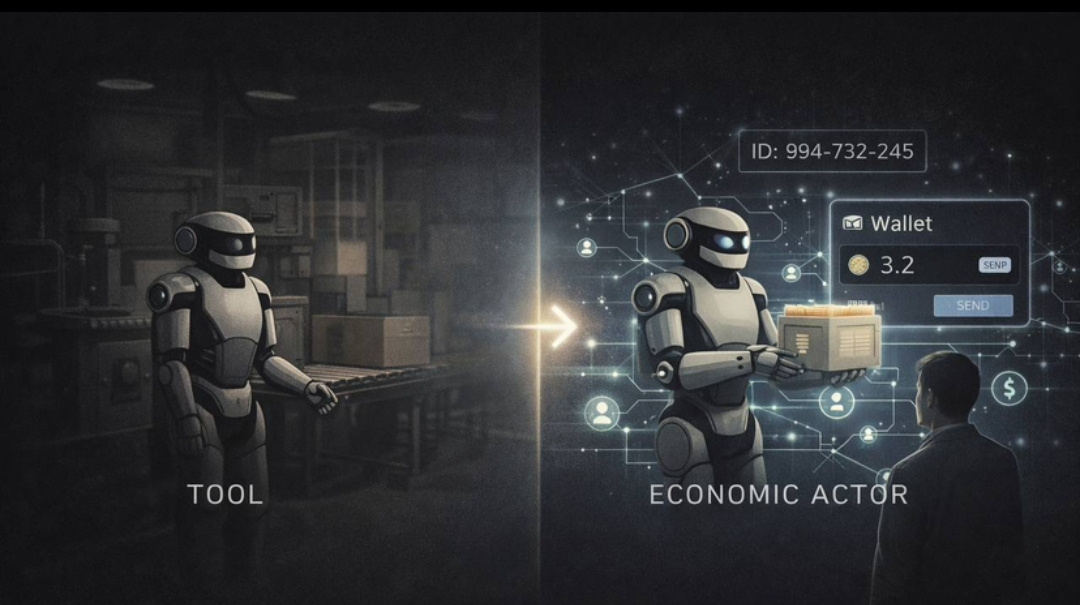
The token acts as the economic layer inside this system. Validators, developers, and governance participants are aligned through incentives rather than central control. Instead of one entity deciding how robotics infrastructure evolves, the protocol allows distributed coordination.
What interests me most about Robo is the timing.
Robotics is accelerating fast. AI agents are improving. But governance frameworks for autonomous machines are still very immature. Most systems still depend on centralized oversight.
Fabric is essentially asking a different question early:
What if we build the coordination infrastructure before robots become ubiquitous?
It’s not the most flashy narrative. It’s slower infrastructure work. But historically those layers tend to matter the most once ecosystems grow.
The ROBO Claim Window: Important Reminder
Right now there is another practical detail around the Robo ecosystem that people should know.
There are only 9 days left for eligible users to claim their ROBO tokens, and the claiming window closes on March 13, 2026.
Some users visiting the Fabric Foundation claim page are seeing a message saying “Not Eligible.” That simply means the wallet address did not participate in earlier activities tied to the ROBO distribution. The system automatically blocks those addresses from claiming.
But this does not mean the opportunity is gone.
What The ROBO Chart Is Showing
Looking at the current ROBO price action on Binance Alpha gives a quick snapshot of market sentiment.
Current price roughly $0.053
Recent movement about +6%
Price recently moved from $0.046 → $0.055
RSI around 58, meaning the token is not overbought
Volume candles show strong green spikes
This kind of structure often suggests buyers are still active. When price holds above the middle Bollinger Band during small pullbacks, traders usually watch for possible continuation.
Of course this is not financial advice. Markets always carry risk.
How To Buy ROBO On Binance Alpha
For users who are not eligible for the claim, Binance Alpha provides a simple alternative.
Inside the Binance app:
1. Open Alpha
2. Select ROBO (Fabric Protocol)
3. Choose Instant trade
4. Set From: USDT
5. Set To: ROBO
6. Enter the amount
Example shown in the interface:
11 USDT ≈ 202 ROBO tokens
After clicking Place Order, the tokens appear immediately in your Alpha holdings.
No eligibility checks. No external wallets required.
Two Different Doors
At this point the situation is simple.
If you are eligible, claim your ROBO tokens before March 13, 2026. Waiting until the last moment is usually how people miss deadlines.
If you are not eligible, the market itself becomes the second door. Binance Alpha allows anyone to accumulate ROBO directly.
Airdrops reward early participants. Markets allow everyone else to participate later.
Either way the bigger story around Robo is not just the token. It’s the idea that robotics will eventually need an open coordination layer.
Fabric is trying to build that layer early.