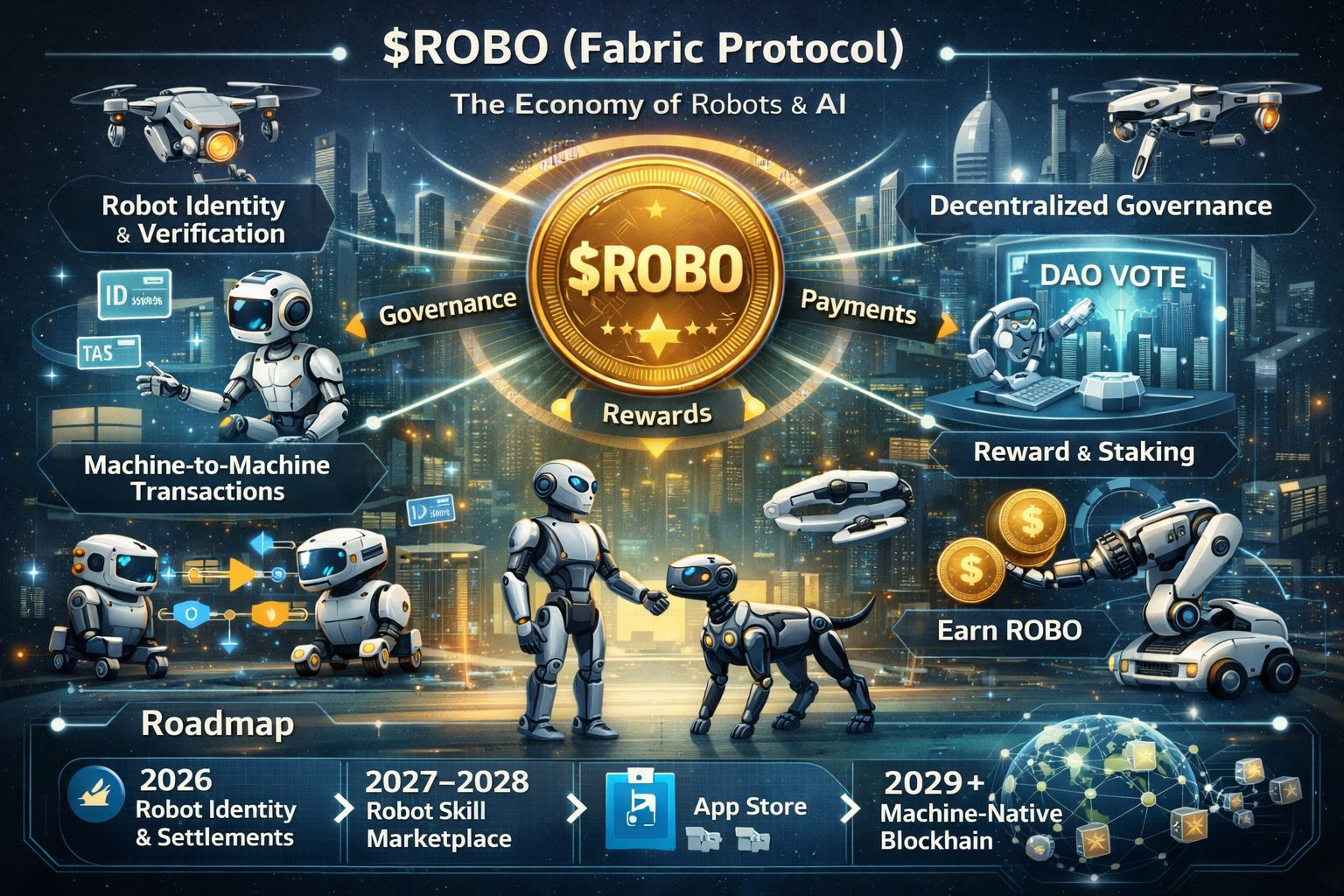
📊 Fundamental Analysis: $ROBO (Fabric Protocol)
🧠 Project Overview
@Fabric Foundation $ROBO is the native utility and governance token of the Fabric Protocol, a blockchain-driven infrastructure designed to power a decentralized Robot Economy where autonomous machines, AI agents, and humans can interact, transact, and coordinate value creation without centralized intermediaries.
Fabric’s vision extends beyond conventional decentralized finance — it aims to provide on-chain identities, machine-to-machine payments, verification systems, and incentive mechanisms that are crucial for robots and AI to participate economically in a secure and open ecosystem.
---
📌 Core Fundamentals
⭐ Utility of $ROBO
1. Governance & Network Fees – $ROBO is used to vote on protocol upgrades, emission parameters, fee structures, and strategic direction. Governance power is enhanced via veROBO, a time-locked voting model that rewards long-term stakeholders.
2. Settlement Token – It functions as the medium for robot payments, service fees, identity verifications, and economic coordination between autonomous agents and human participants.
3. Reward Mechanism – Verified contributions — including verified robotic task completions, data contributions, staking compute, or developing ecosystem modules — are rewarded in $ROBO. This aligns token issuance more with labor participation than purely speculative accumulation.
These features position $ROBO not just as a speculative asset, but as a functional layer token in a novel economic system coupling blockchain with robotics and AI.
---
📊 Tokenomics & Market Position
Fixed Supply: 10 billion tokens with structured vesting (12-month cliff, 36-month unlock) to help curb short-term sell pressure and align stakeholder incentives.
Exchange Listings: Debuted for spot trading on major exchanges like Binance Alpha, Coinbase, Bybit, KuCoin, Bitget, MEXC, and gate platforms starting in February 2026, adding liquidity and visibility.
Initial Price Action: Early trading saw strong speculative demand and significant volume growth, with ROBO reaching notable price levels shortly after listing.
These developments suggest that, beyond narrative potential, the project has attracted real trading interest — a necessary (but not sufficient) condition for long-term token liquidity and ecosystem growth.
---
🛠️ Roadmap & Development
The Fabric Protocol’s development can be understood across short-, mid-, and long-term milestones:
🟢 Short Term (2026)
Robot Identity & Settlement: Rolling out core modules for on-chain robot identities, task settlement, and verifiable contribution layers.
Incentive Layers: Launch of contribution-based reward mechanisms that link token rewards to real robotic tasks.
Multi-Robot Coordination: Support for workflows that involve multiple robots acting in concert on shared tasks.
🟡 Medium Term (2027–2028)
Human-in-the-Loop Tools: Enhanced tooling for developers and human operators to manage autonomous systems collaboratively.
Robot Skill App Store: A decentralized marketplace where developers can publish robot capabilities, potentially earning through ecosystem engagement.
🔵 Long Term (2029+)
Dedicated Layer-1 Chain: Migration away from Base Layer-2 into a fully machine-native blockchain optimized for robotic economic activity.
Global Robot Economy: Scaling to support a broad set of autonomous participants, with DAO-driven governance and true machine economic participants treated as first-class citizens.
---
📈 Investment Considerations & Risks
🔹 Strengths
Strong Narrative: Combines blockchain, robotics, and AI — three high-growth technological domains.
Real Utility: Clear on-chain functions, governance, and economic coordination use cases.
Institutional Interest: Inclusion in major exchange roadmaps (like Coinbase) boosts legitimacy.
🔸 Risks
Adoption Dependency: Success hinges on real robotic manufacturer and operator participation — not just speculative trading.
Execution Complexity: Building a machine-native economy is technologically ambitious and requires coordination with real-world robotics ecosystems.