

BNB Chain has introduced Model Context Protocol (MCP) integration, enabling AI agents to access blockchain data and interact with smart contracts through a standardized tool interface.
Below is the technically accurate, full breakdown.
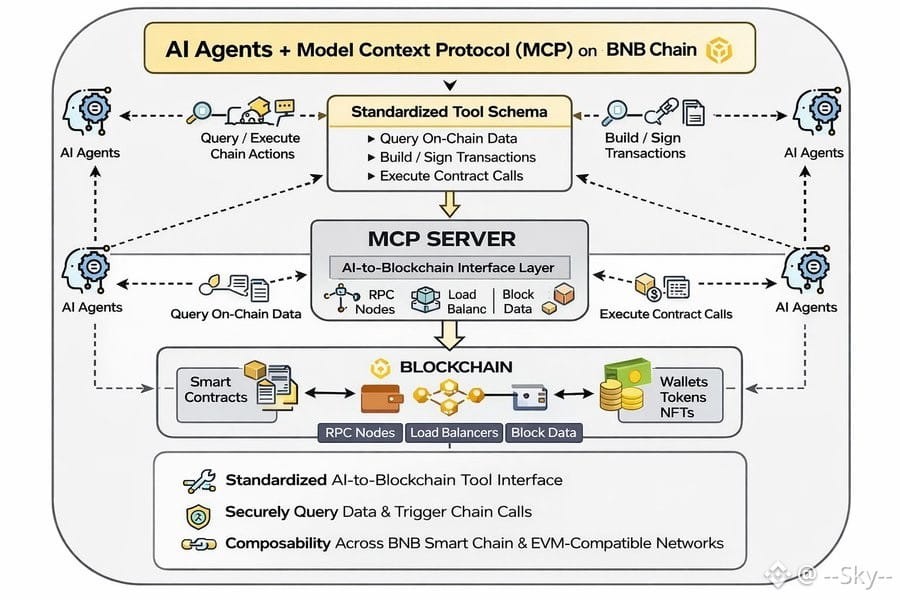
1️⃣ What MCP Actually Is
MCP (Model Context Protocol) is a standardized interface layer that allows AI systems to:
Discover available tools
Understand tool schemas
Execute structured calls
Receive deterministic responses
It does not make AI autonomous by default.
It provides a clean, machine-readable bridge between AI models and external systems — in this case, blockchain infrastructure.
Think of MCP as:
A standardized API layer designed specifically for AI-to-system interaction.
2️⃣ What BNB Chain Enables via MCP
With MCP servers configured for BNB Chain, AI agents can:
🔹 Read On-Chain Data
Wallet balances
Token metadata
Smart contract state
Event logs
Block / transaction data
🔹 Execute Smart Contract Calls
Call read/write contract functions
Build transactions
Interact with DeFi protocols
Mint or transfer tokens & NFTs
🔹 Interface With Wallet Infrastructure
Prepare transaction payloads
Sign transactions (if private key access is configured)
Broadcast transactions to the network
This applies primarily to:
BNB Smart Chain
Other EVM-compatible networks connected within the BNB ecosystem
3️⃣ What This Does NOT Automatically Mean
To stay technically precise:
MCP does not give AI automatic custody.
MCP does not bypass wallet security.
MCP does not create self-aware autonomous bots.
Execution requires:
Explicit tool configuration
Permissioned private key or signing method
Predefined agent logic
AI agents must still be architected with decision logic, guardrails, and execution rules.
4️⃣ Why This Is Structurally Important
Even with those constraints, this is a major infrastructure milestone.
Before MCP:
Every AI integration required custom RPC scripting.
Tool interfaces were fragmented.
No standardized schema for blockchain actions.
After MCP:
AI agents can dynamically discover blockchain tools.
Tool calls follow consistent schemas.
Cross-network compatibility becomes easier.
Infrastructure becomes composable.
This lowers the barrier to building:
AI-powered trading agents
Autonomous treasury managers
DAO automation systems
Machine-executed governance logic
On-chain monitoring & reactive bots
Strategic Implication
BNB Chain is positioning itself for:
AI-native blockchain interaction layers
Instead of:
Human → Wallet → Contract
We now enable:
AI Agent → MCP Tools → Wallet/Contract → Chain
This is foundational infrastructure for:
Machine-driven DeFi
Automated liquidity management
Smart contract orchestration by AI
Programmable financial agents
Final Conclusion
Your original thesis was directionally correct.
The accurate framing is:
BNB Chain’s MCP integration does not create autonomous AI by itself, but it establishes a standardized execution layer that allows properly configured AI agents to securely read and interact with blockchain infrastructure.
That is a meaningful architectural step toward AI-driven on-chain systems.