


Why the next phase of crypto infrastructure will look less like a monolith—and more like a well-orchestrated system
Introduction: Why Modular Is No Longer Optional
Every crypto cycle pretends it’s different—until the same bottlenecks appear again. Congestion. Fragmented liquidity. Bloated nodes. Security trade-offs disguised as innovation.
After spending years watching Layer 1s promise “infinite scalability” and Layer 2s patch symptoms rather than causes, I’ve reached a clear conclusion: monolithic blockchains are approaching their design ceiling. The future isn’t about squeezing more performance out of a single chain. It’s about re-architecting how blockchains are built in the first place.
This is where Mira Network enters the conversation—not as hype, but as an architectural response to a structural problem.
Mira isn’t trying to be “Ethereum but faster.” It’s attempting something more ambitious: a clean-slate modular design optimized for the realities of modern crypto usage.
The Problem with Monolithic Chains (Explained Simply)
Traditional Layer 1s try to do everything at once:
Execute transactions
Reach consensus
Store data
Secure the network
This is like asking one computer to run the database, web server, security system, and user interface—all at the same time, forever.
It worked when blockchains were small and usage was light. It doesn’t work in a world of:
High-frequency DeFi
AI-driven on-chain automation
Gaming and social apps
Cross-chain liquidity
The result? Trade-offs everywhere. Speed hurts decentralization. Scalability hurts security. Fees explode under demand.
Modular design breaks this “one-chain-does-all” mindset.
Modular Blockchains: The Architecture Shift Most People Still Underestimate
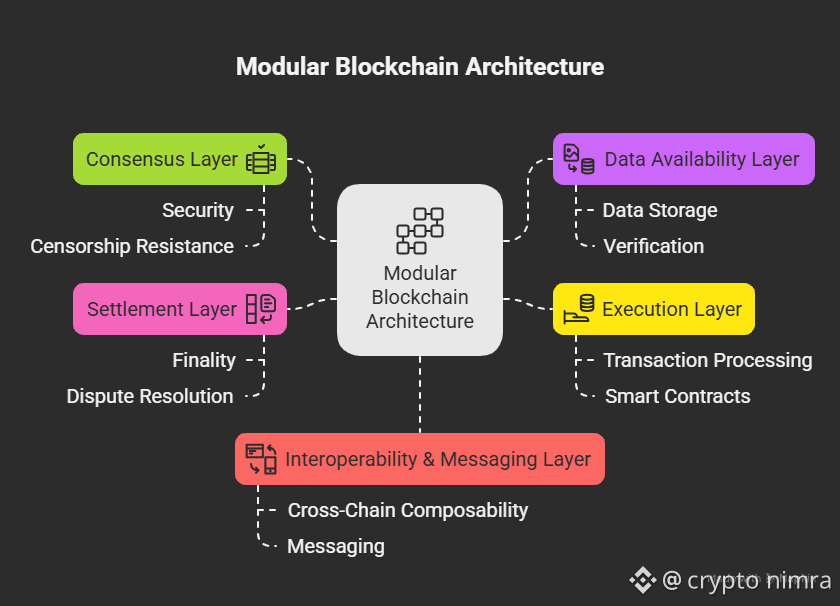
A modular blockchain separates core functions into specialized layers:
Execution layers focus purely on processing transactions
Data availability layers ensure transaction data is accessible
Consensus layers handle security and ordering
Think of it like cloud infrastructure. You don’t host Netflix on one server. You distribute workloads across optimized systems.
This design philosophy has already gained traction with projects like Celestia, but Mira takes the idea further by focusing on developer-native execution and interoperability from day one.
What Makes Mira Network Architecturally Interesting
1. Execution-First Mentality
Most modular stacks start with data availability. Mira flips the perspective.
Mira treats execution as the primary product, optimizing for:
Low-latency transaction processing
Parallel execution environments
Predictable fee markets
From my perspective, this matters more than most people realize. Users don’t feel data availability. They feel slow swaps, failed transactions, and unpredictable fees.
Execution is the UX layer of blockchains—and Mira designs around that reality.
2. Developer-Centric Modularity
Mira isn’t just modular under the hood; it’s modular by choice for developers.
Builders can:
Customize execution environments
Launch app-specific chains without security bootstrapping
Scale independently without global congestion
This aligns with a broader trend: application sovereignty. Developers no longer want to compete for block space with meme coins during peak volatility.
3. Cleaner Interoperability Assumptions
Instead of bolting on bridges later, Mira assumes a multi-chain world from the start.
That’s a subtle but critical distinction.
Most exploits historically come from:
Afterthought bridges
Liquidity silos
Inconsistent execution guarantees
Mira’s architecture reduces cross-domain friction by design, not patchwork.
Market Context: Why Timing Matters
We’re entering a phase where infrastructure narratives are rotating back into focus.
Key signals I’m watching:
Declining marginal returns from meme-driven speculation
Rising on-chain volumes in DeFi primitives
Growing demand for app-specific rollups and execution environments
When markets mature, capital flows downstream—from narratives to infrastructure that supports real usage.
Modular stacks benefit disproportionately in this phase.
Trading Activity & Liquidity Dynamics (What the Market Is Quietly Signaling)
While Mira is still early, broader modular ecosystems show a clear pattern:
Higher developer activity precedes volume
Volume precedes liquidity depth
Liquidity depth precedes institutional interest
Execution-layer networks historically experience delayed price discovery because their value is embedded in usage growth, not speculation.
From a trader’s perspective, this creates asymmetry:
Short-term volatility remains narrative-driven
Long-term valuation tracks ecosystem throughput
This is the same pattern early Layer 2s followed before fee revenue became visible on-chain.
Where Visuals and Data Add Impact
For maximum CreatorPad performance, this article pairs well with:
A modular vs monolithic architecture diagram
Execution throughput comparison charts
Developer ecosystem growth timelines
Transaction fee stability visuals
These visuals help non-technical readers see why architecture matters.
Risks: What Could Go Wrong
No serious analysis is complete without friction.
1. Adoption Risk
Great architecture doesn’t guarantee developers will show up. Ecosystem bootstrapping remains the hardest part.
2. Modular Complexity
Modular systems introduce coordination challenges. If tooling isn’t seamless, developers default to simpler stacks.
3. Narrative Competition
The modular thesis is becoming crowded. Differentiation must be proven, not promised.
Opportunities: Where Mira Has Leverage
1. App-Specific Chain Demand
Gaming, AI agents, and high-frequency DeFi require predictable execution.
2. Fee Market Stability
Execution-focused design creates smoother fee dynamics—something users actually care about.
3. Infrastructure Capital Rotation
As speculation cools, capital historically migrates to picks-and-shovels infrastructure.
Future Outlook: The Next 24 Months
My base-case view:
Modular becomes default, not experimental
Execution layers differentiate based on UX, not TPS marketing
Ecosystems consolidate around developer experience
If Mira executes well, it doesn’t need to dominate everything. It just needs to become the execution layer developers trust when performance actually matters.
That’s a defensible niche with long-term relevance.
Investor Takeaways (Clear, Practical, Grounded)
Modular architecture is not a trend—it’s a necessity
Execution layers capture usage-based value, not hype-based value
Mira’s design aligns with real developer pain points
Early-stage infrastructure requires patience, not momentum chasing
From my personal standpoint, Mira represents the kind of project I watch quietly—not because it promises the loudest gains, but because it’s solving the right problem at the right layer.
Final Thought
Crypto doesn’t fail because of lack of ideas. It fails because of bad architecture scaling into real demand.
Mira Network is part of a new generation that understands this lesson early.
And in this market, design discipline is alpha.
If you’re building, analyzing, or investing for the next cycle—not the last one—modular execution is a conversation you can’t afford to ignore.
#Mira @Mira - Trust Layer of AI $MIRA
